

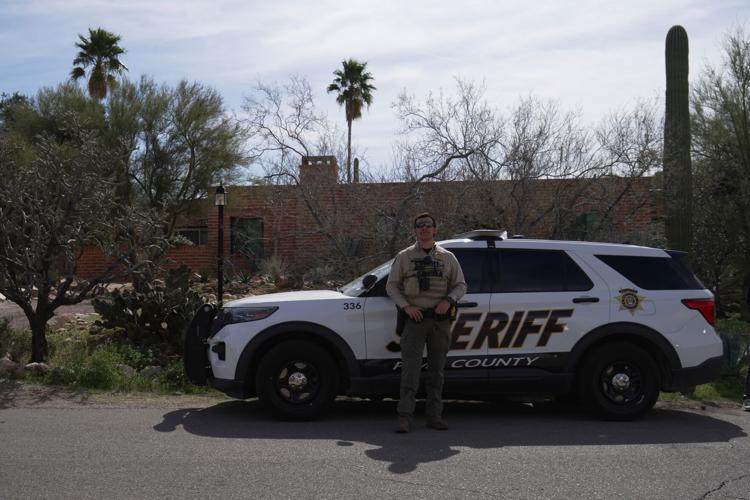

Crime scene investigators from the Pima County Sheriff's Department spent at least 20 hours combing through Nancy Guthrie's Tucson home in the hours after she went missing.
The next day, the property went back to Guthrie's family in a move that some legal observers said was not only unusual, but could possibly complicate a future prosecution.
"I don't see a reason why you would release the scene," said Brian Kohlhepp, a 25-year policing veteran who teaches advanced crime investigation at the John Jay College of Criminal Justice in New York. "That's certainly a crime scene that I would recommend you hold because you're not inconveniencing anyone. There's not a whole family, there's not a business here that's trying to reopen."
"It's self-inflicted wounds," said Mike Jette, a former state and federal prosecutor who served 18 years in Arizona and most recently ran to be the county's top prosecutor. "Every investigation should be handled textbook. It sure doesn't sound like this was handled textbook."
Pima County Sheriff Chris Nanos defends the move by his investigators to release Guthrie's property back to her family Feb. 2, a day after the 84-year-old mother of NBC "Today" show co-anchor Savannah Guthrie was reported missing.

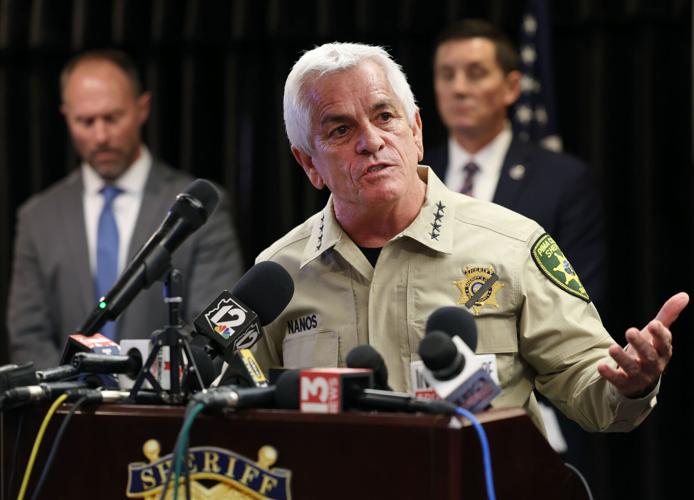
Pima County Sheriff Chris Nanos defends the release of Guthrie's property back to her family one day after the 84-year-old mother of NBC "Today" show co-anchor Savannah Guthrie was reported missing.
"Our forensics teams work at their direction, and they process a crime scene. Sometimes those crime scenes may last an hour, two hours, six hours, whatever it is, but they call that shot," Nanos told the Star in an interview Thursday. "They were out there a good 20-plus hours, is my guess. Maybe even longer. But when they got done, they get to determine what done is."
Nanos said a Sheriff's Department forensics team arrived at Guthrie's home in the afternoon of Feb. 1 after deputies responding to the initial missing person's report contacted him about 2 p.m. with a text that read: "There's something about the scene that's kind of concerning to us."
"So homicide probably got into this pretty early on, and they started looking at it from a criminal investigation standpoint," Nanos said.

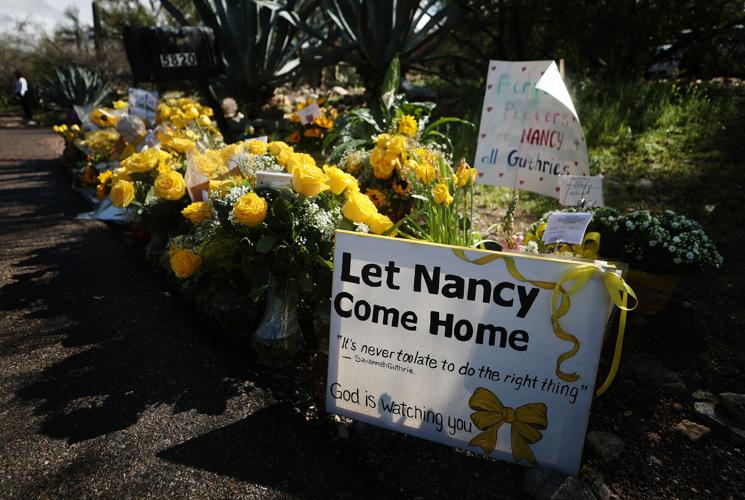
Well-wishers have left a growing assortment of yellow flowers near Nancy Guthrie's house in the days after she was reported missing Feb. 1.
The sheriff said evidence, including DNA collected from the residence that day, was submitted Feb. 2 to a lab for testing. The physical evidence "of say, a cell phone, a camera, those kinds of things that get technology from digital analysis or forensic analysis of computers and software, those we said, let's get them over to our detective who works over at the FBI."
Nanos said the FBI was "plugged in the minute we got started on this."
A reporter at a news briefing the following morning asked Nanos about deputies leaving the foothills residence about 6 p.m. Feb. 2. The reporter noted that there was no crime scene tape and told the sheriff he saw an Amazon driver walk up to the door.
"Is that pretty standard?" the reporter asked.

Sheriff Chris Nanos speaks during a news conference Thursday regarding the disappearance of Nancy Guthrie, the 84-year-old mother of NBC "Today" show host Savannah Guthrie.
Nanos responded that "the scene is done. We're done with the residence."
"If we need to go back . . . we contact the family and let them know, but we have turned that over to the family," he said that day.

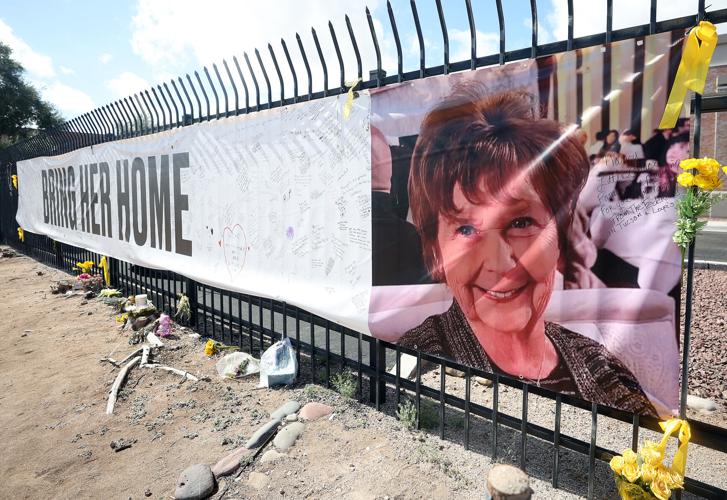
A banner covered with messages from well-wishers supporting the family of Nancy Guthrie hangs outside of the offices of KVOA-TV.
That same afternoon, TV reporters were setting up live shots from Guthrie's front yard and News Nation correspondent Brian Entin and a cameraman strolled from the street to the front door, where the cameraman zoomed in on a trail of blood drops.
During a live broadcast, Entin, an Emmy award-winning reporter whose resume includes intensive coverage of the 2021 Gabby Petito investigation and the Idaho student murders, commented about how easy it was to access the property.

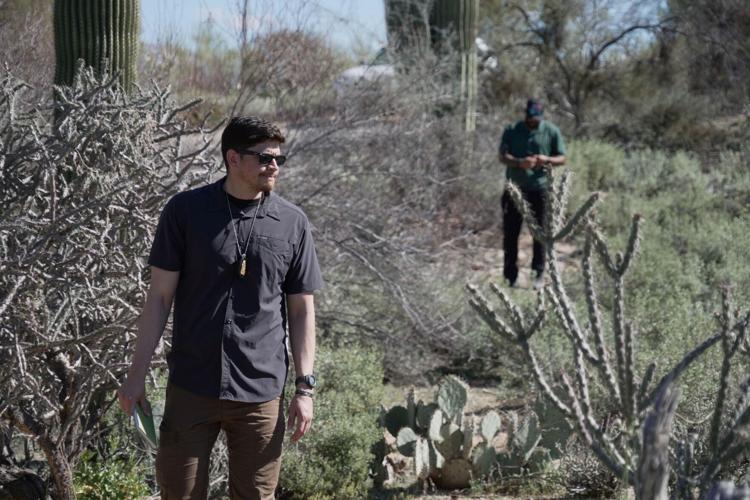
Law enforcement agents check vegetation areas around Nancy Guthrie’s home in the days after her disappearance.
"It surprised me. In other crimes I've worked, they'll keep the whole house closed off with crime scene tape for a week while they're still investigating," Entin said during the Feb. 3 broadcast.
"Anytime you release a crime scene, you know you are then basically giving up control of it," said Kohlhepp, of John Jay College. "For that window of time that it was open, you had no control over it. And unless there's surveillance cameras or something like that that you can fall back on, you really cannot say with any kind of reasonable degree of certainty what happened there, who went there, what evidence might have been brought, changed, tampered."
Reports of people accessing the property, including a pizza delivery to Nancy Guthrie's door, could raise questions about the integrity of evidence, said Jett, the former prosecutor.
"Now as a prosecutor, I've got to ... consider things from a defense point of view, like what they can argue," Jette said. "Anything that tampers with evidence is seen as fodder for a defense attorney to say reasonable doubt."
"Theoretically, you investigate all cases the same, but we know that in the real world, the added pressure of a celebrity or a known personality is going to play into that," Kohlhepp said, including from critics and people watching every move of the investigation. "So I think it's even more important in those types of situations to be extra careful. And again, I don't see a reason why you would release the scene."
Sheriff's Sgt. Aaron Cross, president of the Pima County Deputies Organization, said he was personally uncomfortable with releasing the scene so early in the investigation.
"I think the smartest angle would have been, okay, you want to do the initial search warrant and forensic gathering, fine, but then let's put up some crime scene tape around the property and post security because it's highly likely we're going to have to come back here as the investigation unfolds," he said.
That would have reduced the potential for evidence to be challenged, he said.
"If you're gonna go back out there and you're taking swabs, or if you're taking you know, anything, any gathering, any evidence, gathering of forensic things on scene, you're going to have to explain that in court," Cross said. "The chain of custody issues are going to be huge. And there's no point to it."
When asked about the potential that the open scene could invite legal scrutiny in an eventual prosecution, Nanos told reporters at a Feb. 5 news briefing, "I'll let the courts worry about that."
In photos: The disappearance of Nancy Guthrie
Guthrie candlelight service
Updated
A couple walks up to St. Philip's in the Hills Episcopal Church to attend the candlelight service for Nancy Guthrie, the 84-year-old mother of NBC "Today" show host Savannah Guthrie in Tucson, Ariz. on February 4, 2026. Nancy Guthrie went missing from her home Saturday night or Sunday morning in what investigators believe was an abduction.
Guthrie candlelight service
Updated
St. Philip's in the Hills Episcopal Church hosted a candlelight service for Nancy Guthrie, the 84-year-old mother of NBC "Today" show host Savannah Guthrie in Tucson, Ariz. on February 4, 2026. Nancy Guthrie went missing from her home Saturday night or Sunday morning in what investigators believe was an abduction.
Guthrie candlelight service
Updated
A group of people walk up to St. Philip's in the Hills Episcopal Church to attend the candlelight service for Nancy Guthrie, the 84-year-old mother of NBC "Today" show host Savannah Guthrie in Tucson, Ariz. on February 4, 2026. Nancy Guthrie went missing from her home Saturday night or Sunday morning in what investigators believe was an abduction.
Guthrie candlelight service
Updated
A group of people walk up to St. Philip's in the Hills Episcopal Church to attend the candlelight service for Nancy Guthrie, the 84-year-old mother of NBC "Today" show host Savannah Guthrie in Tucson, Ariz. on February 4, 2026. Nancy Guthrie went missing from her home Saturday night or Sunday morning in what investigators believe was an abduction.
Sheriff Chris Nanos
Updated
Sheriff Chris Nanos speaks during a press conference regarding the disappearance of Nancy Guthrie, the 84-year-old mother of NBC "Today" show host Savannah Guthrie, at the Pima County Sheriff’s Department headquarters on February 4, 2026.
Nancy Guthrie press conference
Updated
An updated timeline is released from the Pima County Sheriff’s Department regarding the disappearance of Nancy Guthrie, the 84-year-old mother of NBC "Today" show host Savannah Guthrie, at the Pima County Sheriff’s Department headquarters on February 4, 2026.
Sheriff Chris Nanos
Updated
Surrounded by local and national media, Sheriff Chris Nanos speaks during a press conference regarding the disappearance of Nancy Guthrie, the 84-year-old mother of NBC "Today" show host Savannah Guthrie, at the Pima County Sheriff’s Department headquarters on February 4, 2026.
Nancy Guthrie
Updated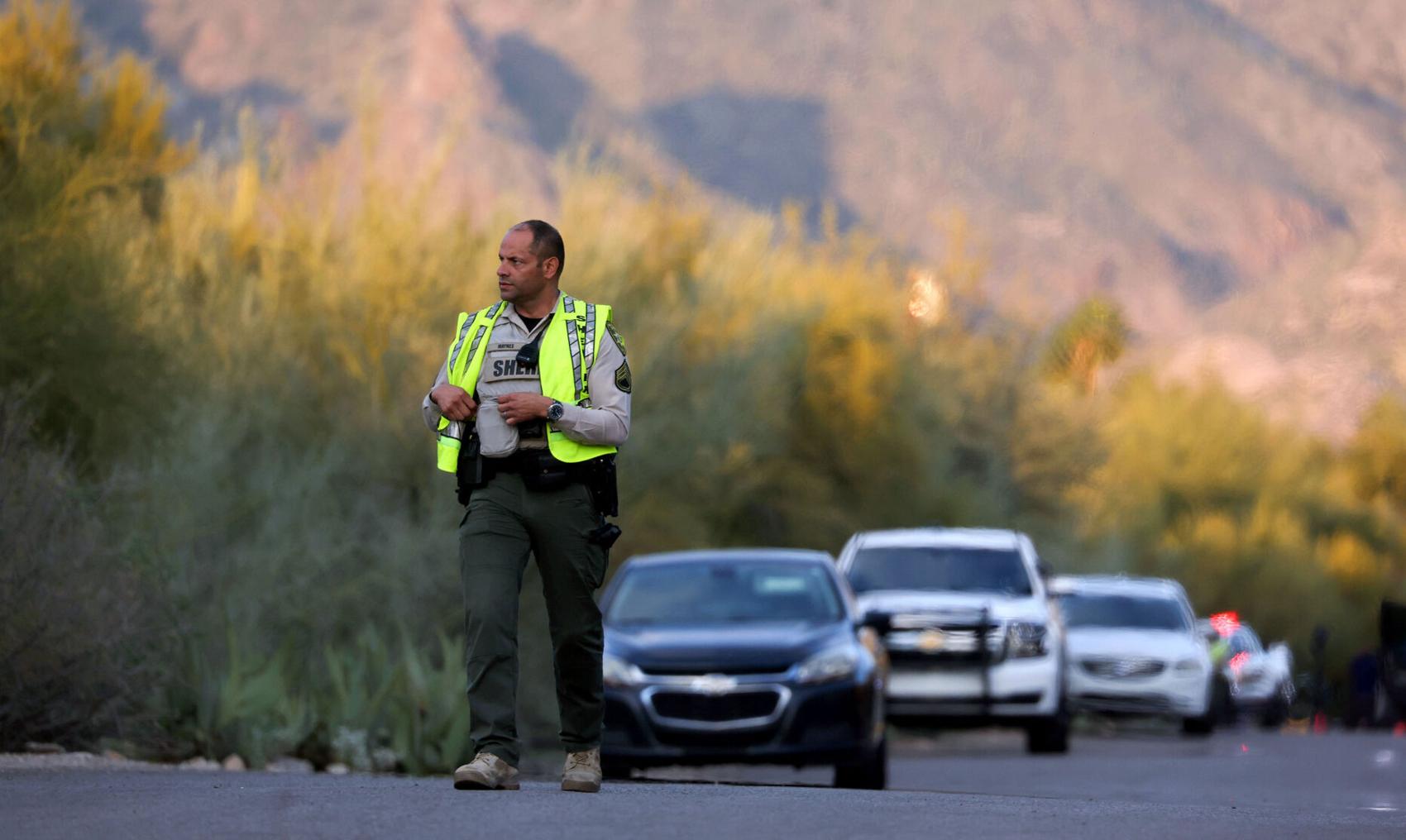
Members of the Pima County Sheriffs department on the scene in Nancy Guthrie's neighborhood late Friday afternoon, North Camino Escalante, Tucson, Ariz., Feb. 6, 2026.
Annie Guthrie’s home
Updated
An agent grabs mail from Annie Guthrie’s Tucson home using plastic gloves in Tucson on Feb.11, 2026.
Nancy Guthrie
Updated
Law enforcement agents walk the neighborhood around Nancy Guthrie’s home in Tucson, Ariz., on February 11, 2026. Guthrie, the 84-year-old mother of NBC "Today" show host Savannah Guthrie disappeared on February 1.
Nancy Guthrie
Updated
Law enforcement gather after walking the neighborhood around Nancy Guthrie’s home in Tucson, Ariz., on February 11, 2026. Guthrie, the 84-year-old mother of NBC "Today" show host Savannah Guthrie disappeared on February 1.
Nancy Guthrie
Updated
A helicopter flies around the home of Nancy Guthrie in Tucson, Ariz. on February 11, 2026. Guthrie, the 84-year-old mother of NBC "Today" show host Savannah Guthrie disappeared on February 1.
Nancy Guthrie
Updated
Members of the local. national and international media line the road outside of Nancy Guthrie’s home in Tucson, Ariz. on February 11, 2026. Guthrie, the 84-year-old mother of NBC "Today" show host Savannah Guthrie disappeared on February 1.
Nancy Guthrie
Updated
A cyclist rides his recumbent bike outside of Nancy Guthrie's home as a Pima County Sheriff's Department deputy is parked in the driveway on February 11, 2026. Guthrie, the 84-year-old mother of NBC "Today" show host Savannah Guthrie disappeared on February 1.
Nancy Guthrie
Updated
Kim Kolodge, in front, walks towards a display carrying a sunflower to place in front of Nancy Guthrie’s home on February 11, 2026. She is joined by her sisters, Kathy Stotz, middle, and Karen Luukkonen. The Catalina Foothills Neighborhood Association sent an email to members and encouraged them to send or place yellow roses creating a visible show of solidarity on the street and a traditional sign of hope for her safe return, stated the email. Guthrie, the 84-year-old mother of NBC "Today" show host Savannah Guthrie disappeared on February 1.
Nancy Guthrie
Updated
Susie Trabant places a flower to a growing display of yellow roses in front of Nancy Guthrie’s home, as her husband, Galen, stands in the background on February 11, 2026. The Catalina Foothills Neighborhood Association sent an email to members and encouraged them to send or place yellow roses creating a visible show of solidarity on the street and a traditional sign of hope for her safe return, stated the email. Guthrie, the 84-year-old mother of NBC "Today" show host Savannah Guthrie disappeared on February 1.
Nancy Guthrie
Updated
A yellow ribbon is tied to a light post outside of Nancy Guthrie's home on February 19, 2026. Guthrie, the mother of Savannah Guthrie, host of the ?Today? show, has been missing since February 1.
Nancy Guthrie
Updated
A small vigil grows near Nancy Guthrie's home with more yellow flowers and signs in Tucson, Ariz. on February 19, 2026. Guthrie, the mother of Savannah Guthrie, host of the NBC “Today” show, has been missing since February 1.
Nancy Guthrie
Updated
Makayla Miller, right, lays down a note and flowers as her sister, Maddie, watches outside of Nancy Guthrie's home in Tucson, Ariz. on February 19, 2026. Guthrie, the mother of Savannah Guthrie host of the NBC “Today” show, has been missing since February 1.
Nancy Guthrie
Updated
A banner in support of Nancy Guthrie hangs outside of KVOA offices on 209 W. Elm Street in Tucson, Ariz. on February 19, 2026. Guthrie, the mother of Savannah Guthrie host of the NBC “Today” show, has been missing since February 1.
Nancy Guthrie
Updated
A banner in support of Nancy Guthrie hangs outside of KVOA offices on 209 W. Elm Street with messages of hope in Tucson, Ariz. on February 19, 2026. Guthrie, the mother of Savannah Guthrie host of the NBC “Today” show, has been missing since February 1.

