

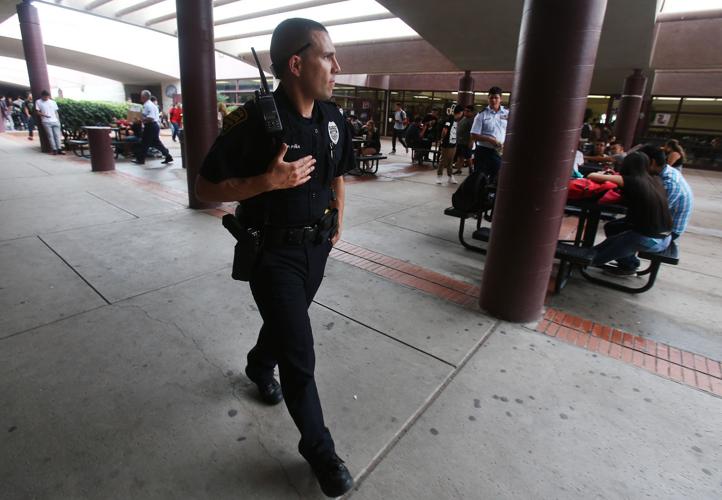

It drizzles as Officer Patrick Piña navigates through waves of Desert View High School students.
He sticks out in his dark blue uniform, duty belt with a gun holster and a large radio attached to his shoulder — in sharp contrast to the casually dressed high schoolers, with their multicolor backpacks.
There’s occasional eye contact and hellos exchanged between Piña and the students, but for the most part, the kids don’t give a second glance to this nine-year veteran of the Tucson Police Department. He’s a natural presence here.
“I know this school inside and out,” he says. This is true. He graduated from Desert View in 2000.
Piña is off of his patrol duties with the Police Department and on duty at the school on a contract basis with the Sunnyside Unified School District. One officer is stationed at each of the district’s three high schools Monday through Friday.
Sunnyside pays about $150,000 annually to hire off-duty police officers to be at the high schools and special events, including football games. It also has school resource officers from the Pima County Sheriff’s Department, which the county pays for.
The district received the 2015 National School Safety Award from the School Safety Advocacy Council for having an effective communication system between the district and law enforcement and reducing response time to crises.
District officials say the partnership with law enforcement has improved not only crime prevention and response, but also student behavior. Both suspensions and referrals for intervention, which include visits to the principal’s office, have drastically decreased in the district’s middle and high schools.
“We’ve taken school safety to the next level,” said Frank Morales, director of security at Sunnyside.
The district’s award-winning approach to security incorporates student and staff training, rapport-building, a streamlined communication channel and collaboration across jurisdictions.
The partnership with Tucson police started in 1993 after a student was fatally shot in a gang-related incident while walking out of a school campus, Morales said. Back then, gang activity was observed more frequently, especially on high school campuses.
The relationship has continued for more than two decades.
PART OF THE COMMUNITY
Piña, the Tucson police officer, knows the area. He’s from here.
“The area that I grew up in is my beat,” he said. On duty, he is a part of TPD’s Operations Division South.
He’s at the schools primarily for law enforcement and crime prevention, but he says he has a hand in influencing the kids’ future, too. He knows the challenges of growing up on the south side, where kids often “think they can’t succeed because of where they grew up.”
“I can tell them, ‘Hey, I came to school here,’” he says.
That is one of the reasons why he blends in so well —despite his uniform.
When asked how they feel about the officer’s presence at the school, Roman Aldana, a junior, says, “Normal.” Senior Maddie Baca says, “Nothing.”
But do they feel safer? They both nod. “I feel a lot safer because they are cops,” Aldana says. Cops are supposed to protect and serve you, he adds. There is no particular sense of intimidation.
In selecting officers for school duty, the district likes to pick ones that are familiar with the area or have grown up there, said José Gastelum, principal of Desert View. The majority are alums of the district.
“They are part of our school, part of our community and part of our culture,” he says.
That kind of familiarity is one of the goals of the partnership, Morales says. When something does happen, it allows for the investigation process to go more smoothly.
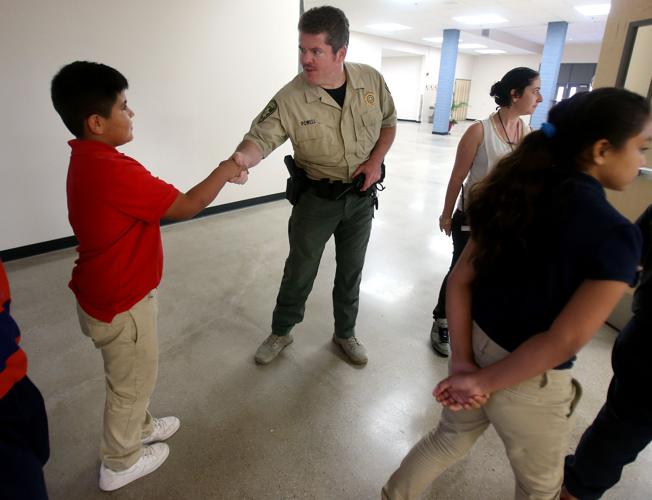
Familiarity is obvious at Gallego Intermediate School, a new fine arts school in the district, where Deputy Ryan Powell of the Sheriff’s Department is a school resource officer.
The school is a “positive environment,” he says. “I’m not always managing crisis.”
As fourth-graders line up to enter the cafeteria, the kids are thrilled to see Powell, each wanting to high-five or wave at him. Every which way he goes, he’s enthusiastically greeted by youngsters.
At Gallego, Powell is a law enforcement officer, a mentor, an instructor and also a guy in a cool uniform with cool things strapped to his waist that kids want to swarm to.
“It’s become a normal thing and not a sense of alarm for the community,” said Anna Warmbrand, Gallego’s principal.
At first, parents were asking if something bad had happened, she said. But within a week or so, after conversations with parents and lectures in classrooms, parents and students got used to seeing the sheriff’s truck out in the parking lot.
Smooth COMMUNICATION
Piña’s day usually starts with checking in at the front office, patrolling the school and making reports. One essential part of his job is to stop conflicts before they get out of hand.
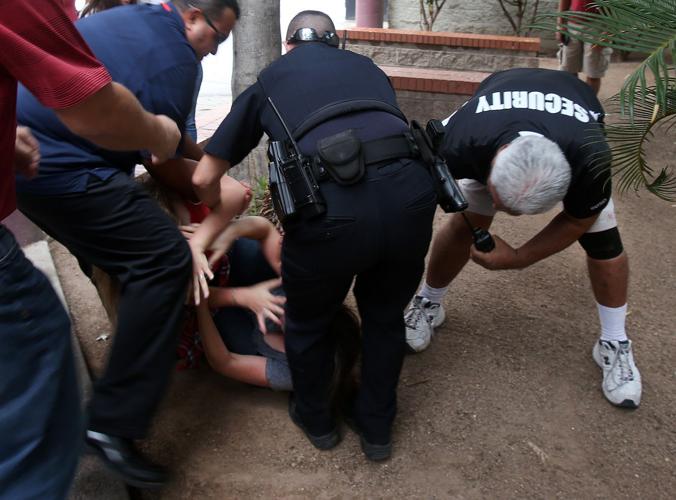
While he’s walking around near the cafeteria at lunchtime, he hears reports of a fight between two students. He bolts without hesitation.
The rest of the cafeteria is oblivious, each group engrossed in its own chatter, but security, Piña and school officials have already been notified. Within minutes, the two girls in the tussle are separated.
Immediately, there is a debriefing.
The quick response reflects one of the major goals for the district and law enforcement. To make that happen, the district and its partner agencies communicate via radio. District officials have access to the police radio, through which they can monitor police activities in the area. Officers have access to the schools’ radio and security footage. That way, everyone can be clued in quickly.
The partnership also crosses jurisdictions. Deputy Powell of the Sheriff’s Department was given access to the Tucson police radio. That helps, especially with his assignment at Gallego Intermediate, a school in the county jurisdiction that is across a soccer field from Gallego Elementary, which is in the city.
“When there’s a crisis and something happens, there is no boundary,” Morales says.
Sunnyside’s partnership with law enforcement is “quite progressive,” says Sgt. Gerard Moretz, who supervises the school resource officer program at the Sheriff’s Department. A collaboration to this extent is unique.
“They are building on a basic notion that information sharing and familiarity with one another only helps in managing emergencies efficiently,” he says.
The partnership also benefits the law enforcement agencies, says TPD Assistant Chief Ramon Batista. For TPD, resources are stretched thin, so off-duty officers’ presence at the schools alleviates on-duty officers’ workload.
The collaboration also has a positive effect on community policing, he says. With national media focusing on the distance and conflict between police agencies and the community, a partnership like this helps officers bond with community members.
And schools are a good place to start, Batista says.
“It goes a long way building relationships with students early on.”

