

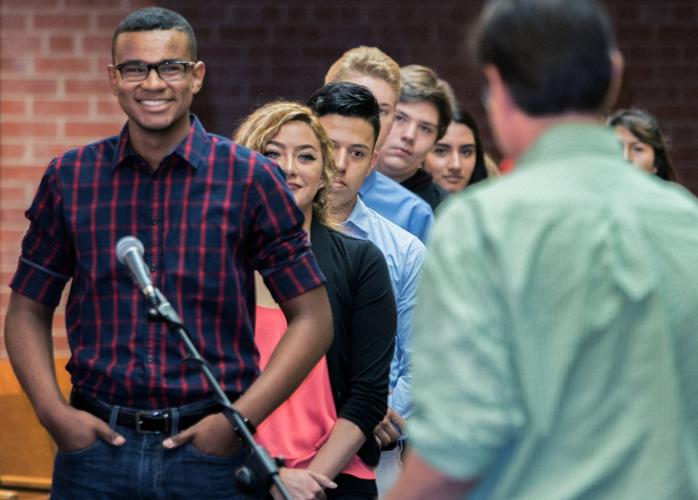
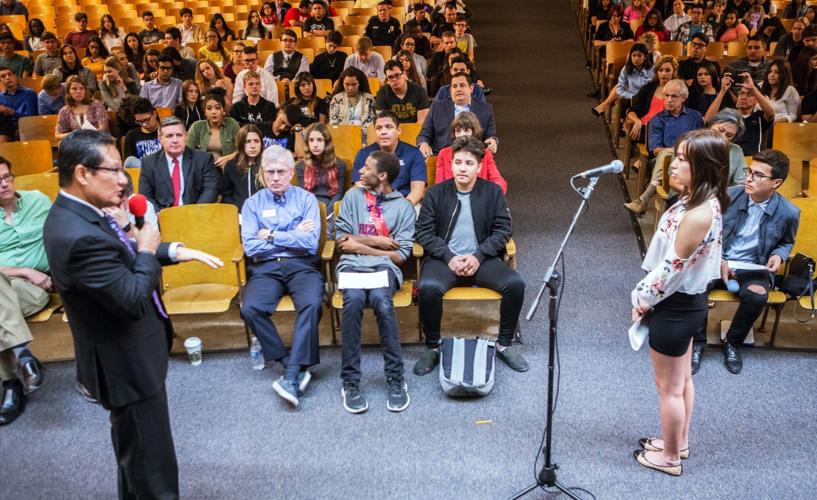

If the politicians and community leaders showed up expecting softball questions, they were wrong.
At the 22nd annual Teen Town Hall put on by the Metropolitan Education Commission, teens from more than a dozen schools in the Tucson area grilled them about student debt, education funding, cuts to joint technical education funding, sex education and other topics.
“The objective is to hear from the students,” said June Webb-Vignery, executive director of the commission, noting students always have a different perspective on policy than adults do.
Panelists that students addressed included Pima County Supervisor Richard Elias, Pima College Chancellor Lee Lambert, State Sens. Steve Farley and David Bradley, and State Rep. Rosanna Gabaldon.
Business leaders, representative of city council members and the University of Arizona were also available to answer questions.
“You words are powerful,” Elias told the crowd, gathered at Catalina High Magnet School. “Your words are important. So lay them on us, please.”
And they did. Students demanded to know what the county or the state were going to do to boost graduation rates in Arizona and to address the worsening teacher shortage.
Did the panelists support sex education? “It has to age-appropriate,” Gabaldon said.
Participants pointed out that more money is spent per prison inmate than per student and that Arizona consistently ranks at the bottom of education rankings.
Tammy Tran, 17, of Amphitheater High School wanted to know how students were expected to pursue further education, which is key in escaping poverty, when the cost of higher education leads to mountains of debt.
Robert Medler, vice president of government affairs at the Tucson Metro Chamber of Commerce, advised that students should make sure they understand the terms of the loans they are getting.
An adviser from the Regional College Access Center, a program of the MEC, told her that students must be competitive if they don’t want to borrow money.
But their answers weren’t quite good enough for Tran, who followed up with a question about those students who try their hardest but still don’t find themselves eligible for scholarships.
“Our grades don’t reflect our actual intelligence,” she said.

