



The single mother would say goodbye to her son before she left for work each morning and then — or so she thought — he would catch his bus to middle school.
“He was up when I left and he would go back to sleep,” she says.
That school year, the boy missed three or four days of school a week, either because he was sleeping or because his worried mother was hauling him to doctor’s appointments for his sleep and anxiety issues. The Star is not identifying them because the boy ended up in the juvenile criminal-justice system because of his chronic truancy.
Thanks to law enforcement intervention and medical help, he started attending classes regularly again and eventually graduated from high school.
He was one of the lucky ones. Education and justice officials say truancy is pervasive in Tucson-area schools — and there are fewer measures to push kids to show up for class or to lure them back if they become chronically truant.
About one in five Pima County students missed 15 or more days of the 2013-2014 school year, new data from the U.S. Department of Education’s Office of Civil Rights show. That’s higher than the national average of about 13 percent.
Most of the schools with the worst truancy rates are alternative district or charter schools, where half of all enrolled students missed 15 or more of the school year’s roughly 180 days. Among those with the highest chronic truancy were Pantano High, Ombudsman — Charter Valencia, Project More Alternative, Marana Career-Technical and Sentinel Peak High schools.
But truancy is a problem at all types of Pima County schools. Even when the Star excluded alternative schools from the calculation, the county average was about 18 percent.
Most schools have mechanisms to alert parents when kids are missing school. TUSD and Amphitheater districts have mobile apps parents can download to keep an eye on their kids’ attendance. But educators across the county say schools lack the resources to chase after every child who is chronically absent. And when parents don’t actively participate in getting their children to school, the problem gets worse.
Abundant research connects chronic truancy to academic failure, dropping out and crime, but community intervention for chronically truant youths has declined in the past decade.
Truancy sweeps, which were facilitated by the Pima County Attorney’s Office and law enforcement partners that cooperated with schools to identify and find truant students, became infrequent as budgets were slashed. Since sweeps require patrol officers, detectives, school resource officers and school officials, the county attorney’s office is able to conduct just two a year now.
Making matters worst, the Center for Juvenile Alternatives — a public-private case management agency that diverted youth offenders from detention to restorative programs — closed in 2012. Schools could refer chronically truant students to the center when it existed without having to report them to the County Attorney’s Office. Now they can’t.
“We are barely making a dent in the number of chronic truants across Pima County,” says Pima County Attorney Barbara LaWall. “We’ve been dealing with this as an issue for so many decades.”
Community leaders have taken notice. Tucson Mayor Jonathan Rothschild launched an attendance awareness campaign in 2013 and formed a partnership with local school superintendents to combat chronic absenteeism.
“This is a communitywide issue,” he says.
A SNAPSHOT
It’s about 8:30 a.m. when Connie Moore, a registrar and attendance tech at Utterback Middle School, gets a phone call from a parent whose child is refusing to go to school. This happens often, she says.
Some kids skip school without their parents knowing; in other cases, the parents are well aware.
The first bell at Utterback rings at 8:45 and the tardy bell follows 10 minutes later. By 9:10 a.m., each teacher should have entered class attendance into a computer system. If a student is marked as absent, an automated call goes out to the parent.
It’s only been four weeks since school started, but Carlos Silva, Utterback’s attendance liaison, is already seeing some red flags. He’s keeping an eye on kids who have missed more than four or five days, or have been tardy several times. Sometimes counselors let him know who to watch out for.
“If you don’t show up, you’re already starting off on the wrong foot,” he says.
Utterback is part of the cluster of middle schools with the highest rates of chronic absenteeism outside of alternative schools. About 42 percent of its students missed 15 or more days in 2013, data showed. Other schools in the cluster include Valencia, Secrist and Safford middle schools, all four of which are federally designated as schools with high poverty rates.
Silva wants to cut Utterback’s rate in half.
When a kid misses school four or five times, Silva calls the parents. So far, he hasn’t had to do that too many times.
A couple of parents have promised to talk to their children. If that doesn’t work, Silva says he’ll start “bugging them a lot.” If that doesn’t work, he’ll pay parents and students a visit at home.
When parents don’t care, that’s the hardest, he says. So he tries to be a good role model to the students, smiling a lot and reminding kids that it’s never too late to straighten up.
“There has to be somebody that cares,” he says.
LINKS TO DELINQUENCY
There are many reasons students are chronically absent: illness, lack of transportation, even a need to work and contribute to the family income.
With each absence, it’s harder and harder for a student to get back on track.
Academic foundations cannot be laid properly if a child is constantly missing school, says Debbie Ferryman, a dropout prevention coordinator for Tucson Unified School District. “They can’t build on that to read, build on that to have the math skills.”
When that happens, students lose their connections to schools and education as learning gaps grow, and they are far more likely to fail. By high school, they could be so short of needed class credits that they see no choice but to drop out.
The risks extend beyond the school walls. School and criminal-justice officials say chronic truancy can predict students’ eventual involvement in crime.
Jane Butler, a Pima County Juvenile Court Judge, always asks youths who come through her courtroom, “Where do you go to school?”
“It concerns me when they say they’re not in school or forgot the name of the school they were enrolled in,” she says.
Thirty-four percent of youths who committed low-level crimes were not in school, Butler says, citing a 2007 report of Pima County Juvenile Court statistics. Of that group, 40 percent who reoffended within 90 days of being released were found not to be in school.
“If they don’t go to school,” she says, “they’re on the streets and getting in trouble.”
ENFORCEMENT, PREVENTION
State law requires parents and guardians to ensure that children between ages 6 and 16 go to school, whether at a district, charter, private or home school. If they don’t, parents could be charged with a Class 3 misdemeanor, a status offense.
But being punitive isn’t the goal, says LaWall, the county attorney. “My goal is to get those kids back in school.”
Between 1996 and 2011, when the Center for Juvenile Alternatives was open, the County Attorney’s Office investigated nearly 1,700 truancy cases.
Just under 1,300 parents were prosecuted. But if parents agreed to participate in diversion programs, including parenting classes, charges were dropped. If they refused, they went to trial. That happened about 200 times over the 15-year period.
None of the children involved were charged, though state law says a child could be prosecuted as “incorrigible youth” for being habitually truant.
During its 15 years, Pima County schools referred an additional 6,500 cases to the Center for Juvenile Alternatives — and even that was “barely scratching the surface,” LaWall says.
Since 2012, when the center shut down due to funding loss, a total of 267 cases have been referred to the Pima County Juvenile Court. LaWall says her office has dealt with only about 80 referrals.
But TUSD’s dropout prevention team is not convinced that referrals to law enforcement or the courts are the answer to reducing chronic truancy. Ferryman, the dropout prevention coordinator, and John Kramkowski, a dropout specialist, both say punitive and threatening approaches have rarely worked at TUSD.
“They create more dysfunction than anything else,” Ferryman says.
Instead, they say, TUSD’s approach is to build a positive relationship between schools and families and to educate students and their parents on the importance of good attendance.
“We want to make sure that we’re educating families that all absences add up to gaps in education,” Kramkowski says.
A community issue
The mother whose son was chronically truant in middle school tried taking the boy for medical treatment to improve his mood and sleep. She tried working with the school to catch him up on his class work and modify his curriculum.
But when he kept skipping school to sleep, she knew she needed more help.
School officials had told her about a paper arrest for chronic truancy. He would be “arrested,” but not handcuffed or taken to jail. Instead, he would be sent to the Pima County Community Justice Board, where volunteers help youths divert from crime.
She decided to give it a try. Over the course of 90 days, her son met with members of his neighborhood’s justice board and completed several exercises intended to teach him about responsibility and accountability. Under board members’ guidance, he wrote essays about his future and dreams, along with an apology letter to his mother.
“It was just making him more aware of his decisions and how they can impact others, how it wasn’t necessarily a punitive measure and that there are programs and people in the community that want to see youths succeed,” she says. “I think he was thinking more that this was going to be awful and meaningless.”
Chris Segrin, chairman of a midtown community justice board, says chronic truancy is often a family and community issue, rather than just about the youth who is skipping or missing school. The board focuses on “restorative justice” to help young people understand that actions have consequences.
“If they admit to their crime, we develop consequences and they are geared toward improving their lives and helping them to achieve their goals,” Segrin says. Activities can include art projects, fixing bicycles, writing essays about college or career goals, going to the library and writing book reports and family-building exercises.
SCHOOL STRATEGIES
Her sophomore year, Perla Samaniego preferred practically anything to school.
She and her friends routinely ditched classes to hang out. Her grades suffered. Her mother was upset.
Then she had an epiphany: “This is not going to take me anywhere,” she realized.
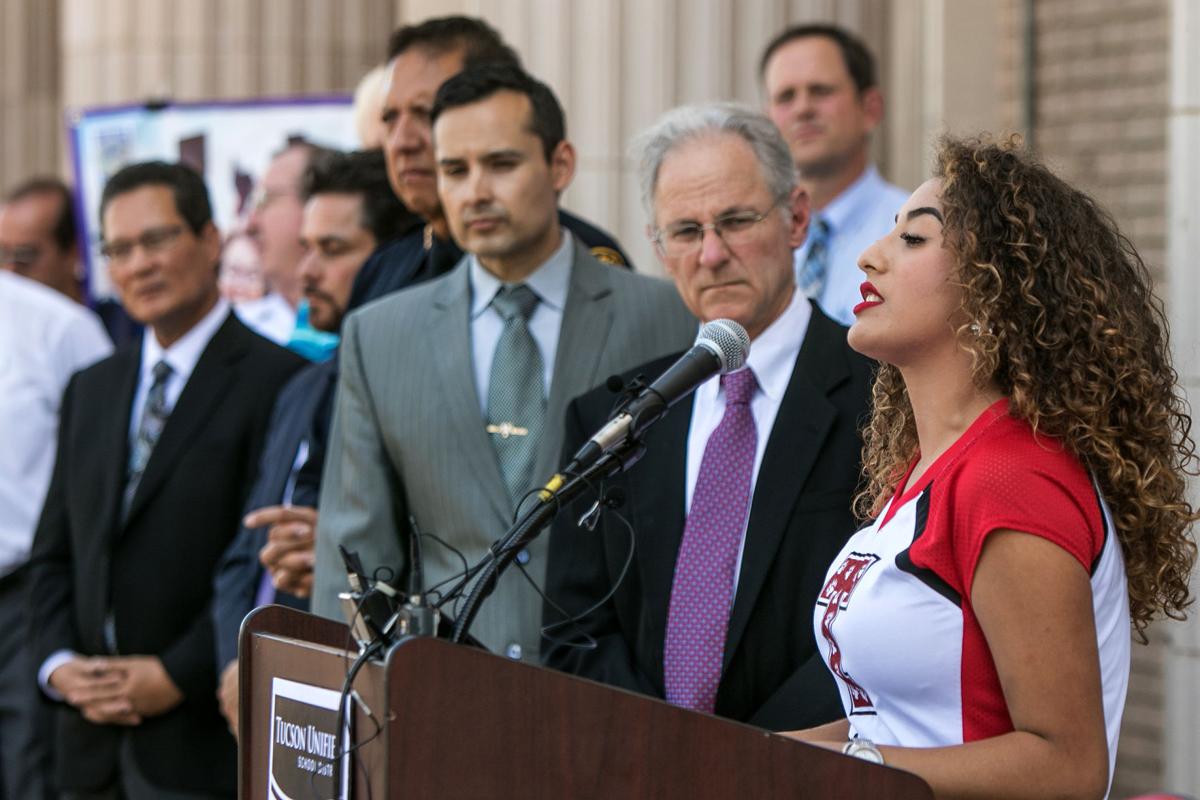
Samaniego, now a senior who dreams of becoming a pediatrician, joined the cheer squad in her junior year, which she says helped her stay engaged in school — she had to have good attendance and grades to be on the squad.
Fun and engaging electives and clubs can help boost attendance, says David Baker, superintendent of the Flowing Wells district, who attended an attendance awareness event Friday with colleagues from other districts. Such activities sometimes get shortchanged in favor of academic achievement, adds Steve Holmes, Sunnyside’s superintendent. But schools are supposed to offer learning beyond academics and have a responsibility to identify why kids are missing school, Holmes says.
To that end, students at Amphitheater schools are connected to adult advisers who ask them about classes, attendance and life outside of school.
“We want kids to know that we want them there,” says Monica Nelson, an assistant superintendent at Amphitheater.
That spirit should extend throughout the community, says Ferryman, of TUSD. For example, convenience store employees could call the nearby school if they see teens wandering during class time.
“Everybody has to be on the same page,” she says, “and on the same team.”

