



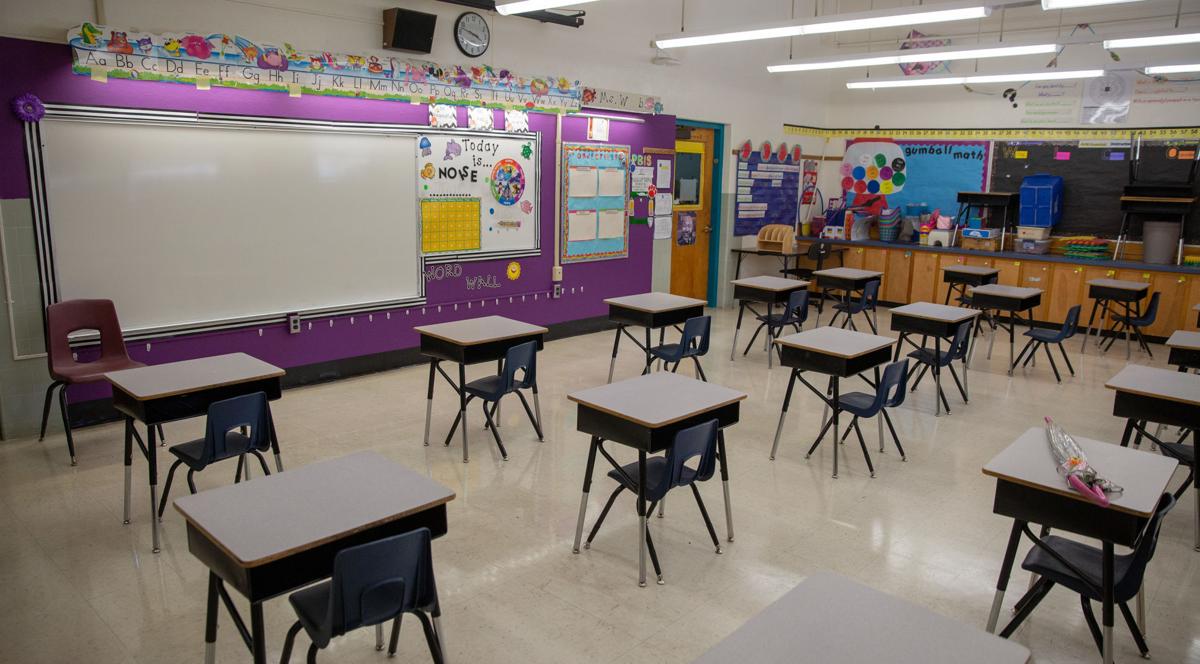
Schools will be unable to open safely — even on a limited basis — for at least six weeks, Pima County health officials told local education leaders Monday.
Health officials briefed area school district superintendents on metrics, that so far are unmet, to decide when kids can safely return to schools, during a Back to School Committee meeting.
The number of confirmed coronavirus cases in Pima County has risen dramatically since schools were closed in March, including the number of cases in children and young adults under 20.
The county’s chief medical officer Dr. Francisco Garcia said he wasn’t seeing any cases in children when schools closed, but the latest statistics show over 2,000 confirmed cases among young people in Pima County.
A lot is still not understood about how COVID-19 affects children or how readily they transmit it, which is part of what makes reopening schools so complicated.
“To be clear, we’re in an evidence-free kind of area,” Garcia says. “But even so, we have a responsibility to figure out how best we can bring children back into school environments in ways that are safe for them, for the teachers and support staff that are serving them, for their families that house and take care of them.”
There are nine criteria the county has already been tracking for months, in areas of disease as well as capacity in health care and public health.
Rated from red to green like a traffic light, no criteria are currently green. That means none has been met.
Last week, six criteria were red, and three were yellow, meaning there’s progress in those three areas. Two more areas moved to yellow Monday.
The county’s nine COVID-19 criteria all need to be yellow before schools should even consider a hybrid model of in-person learning, defined as in-person, face-to-face instruction just not for everyone at once, said county health director Dr. Theresa Cullen. She said it’s hard to know when that will happen, but it will likely be six to seven weeks at the earliest.
Like benchmarks released from the state, the county’s metrics include criteria for the rate of infection in the population and the percentage of tests that come back positive, although the county’s criteria on both of these was more narrow, limiting positive tests to 5% or less, compared to 7% for the state.
Further, the state left wiggle room in the rate-of-infection benchmark, saying a decline in the weekly average in the number of cases for two consecutive weeks is sufficient, even if the infection rate tops the recommended 100 per 100,000 people. But county health officials say they would prefer to stick with the firm numbers.
But Cullen even brings the number into question, pointing out it could mean 1,000 cases among Pima County’s million residents.
“Do we believe that moderate transmission at 1,000 cases a week is adequate assurance to return to school?” she asked.
The state has a third benchmark, that less than 10% of people showing up at local hospitals have COVID-like symptoms. This metric will be complicated by the upcoming flu season. That’s because both illnesses have many similar symptoms, Cullen said.
Besides positivity rate and rate of infections, timely contact tracing is an important criteria for schools to consider, and it’s still in red on the county’s metrics. Timely case investigation is the “foundational basement that we need to ensure it is available for your schools when children go back,” Cullen said.
She says the county likely will have the workforce and infrastructure to do initial contact-tracing interviews within 48 hours of a positive test, moving that metric to yellow in the next two weeks. The ultimate goal is 24 hours for contact-tracing, she said.
Regardless of cases in the county, public-health infrastructure to keep the virus in check is critical, Garcia said.
“What we’re telling you today is that we don’t have that yet,” he told school leaders Monday. “And for that reason, we believe that even if our indicators were all yellow that it would be premature to proceed.”
The Health Department is establishing a school liaison team, which will hold two or three weekly webinars. They will appoint a contact person that will be able to tell a school what to do in cases of an outbreak, when and if to shut down and how to handle contact tracing.
Schools should also have more nurses and health-care staff workers than they do currently, Garcia said. As far as how to isolate a person who may have been exposed to the virus at a school, Garcia says, “that is an airplane we’re still building.”
“Yes, we do have recommendations, but that’s also part of the reason why it makes sense to hold off on that, even that hybrid model, until all that documentation, all that guidance is solid and is in your hands and is well understood,” he said.
Garcia said these metrics will help guide schools on how to respond to outbreaks now and going forward.
“One thing that I think is important for school leaders to understand is that regardless of what happens over the next two to six months, ‘normal’ … is probably not going to exist,” he said. “Schools will be called upon to do some degree of mitigation efforts. And those mitigation efforts are probably going to get looser as we get further along, but I don’t anticipate that they’re going to disappear in the next few years.”
Yet, despite it being unsafe to return to school, the governor’s executive order still requires schools to open for in-person services Aug. 17, though some schools districts, including Tucson Unified, are applying for a waiver to offer in-person services to a narrow group of vulnerable students.
How schools should, and can, proceed is unclear, says Pima County Schools Superintendent Dustin Williams.
“What we have is a governor’s policy that completely contradicts the guidance of our health officials,” Williams said. “He invoked an order that absolutely contradicts clear, medical advice and metrics from our health department. This causes a major challenge for schools and the safety of our students and stakeholders going forward.”
Schools are set to open for in-person classes Monday, and the Arizona Department of Education is hosting a webinar on how the waivers work Thursday.
“The reality is, hypothetically, we could see 10,000 individuals in some sort of educational capacity as early as six days,” Williams said.
Graduating seniors at Flowing Wells High School in Tucson cruised through 2020 commencement on May 20, 2020. The ceremony was spread over two nights. Graduates exited their vehicles and walked across the graduation stage while their name was announced, received their diploma, posed for pictures, then return to their vehicles.
Video by Josh Galemore / Arizona Daily Star 2020
Photos: July Motormarch 2.0 for Safe Schools in Tucson
Motormarch 2.0 for Safe Schools
Updated
Ryer Dixon helps get her family car decorated as a few hundred get their vehicles in the proper protest spirit for the Tucson Motormarch 2.0, staging at Hi Corbett Field, Tucson, Ariz., July 22, 2020. The protestors were advocating for a delay in the opening of in-school classes in light of Arizona's rocketing COVID19 numbers. The motorcade took a circuitous route through southwest Tucson ending at Sentinel Peak.
Motormarch 2.0 for Safe Schools
Updated
Tucson High School biology teacher Marea Jenness writes her protest message in her car's windows as a few hundred get their vehicles decorated for the Tucson Motormarch 2.0 while staging at Hi Corbett Field, Tucson, Ariz., July 22, 2020. The march was organized to protest the opening of in-school classes in light of Arizona's rocketing COVID19 numbers.
Motormarch 2.0 for Safe Schools
Updated
Cholla High School teacher Jose Federico waves as he counts the vehicles heading down from Sentinel Peak as a few hundred protestors wrap up the Tucson Motormarch 2.0 while staging at Hi Corbett Field, Tucson, Ariz., July 22, 2020. Heading out organizers counted 170 vehicles, Federico totaled up 148 heading off the mountain.
Motormarch 2.0 for Safe Schools
Updated
Jaye Harden climbs up on the trunk to get the best possible angle for writing on the rear window as a few hundred protestors get their vehicles decorated for the Tucson Motormarch 2.0 staging at Hi Corbett Field, Tucson, Ariz., July 22, 2020.
Motor March for Safe Schools
Updated
Andrea Ayala, a teacher at Pueblo High School, advocated for keeping campuses closed during a July 15 Motor March for Safe Schools in Tucson, Ariz.
Motor March for Safe Schools
Updated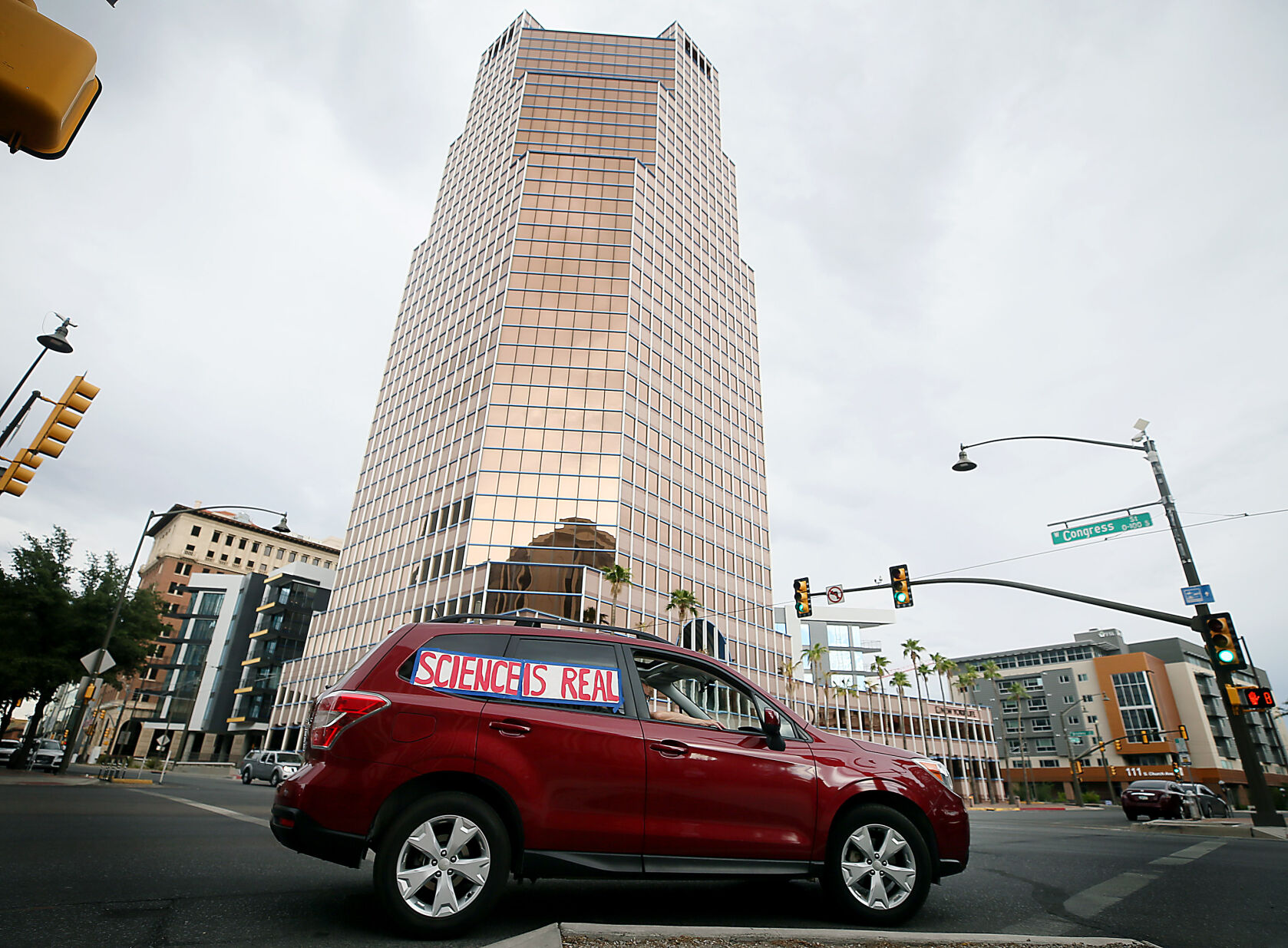
One of about 100 cars filled with Tucson Unified School District educators and supporters participate in a Motor March for Safe Schools in downtown Tucson on July 15, 2020.
Motor March for Safe Schools
Updated
About 100 cars filled with Tucson Unified School District educators and supporters participate in a Motor March for Safe Schools on July 15, 2020 in Tucson, Ariz.
Motor March for Safe Schools
Updated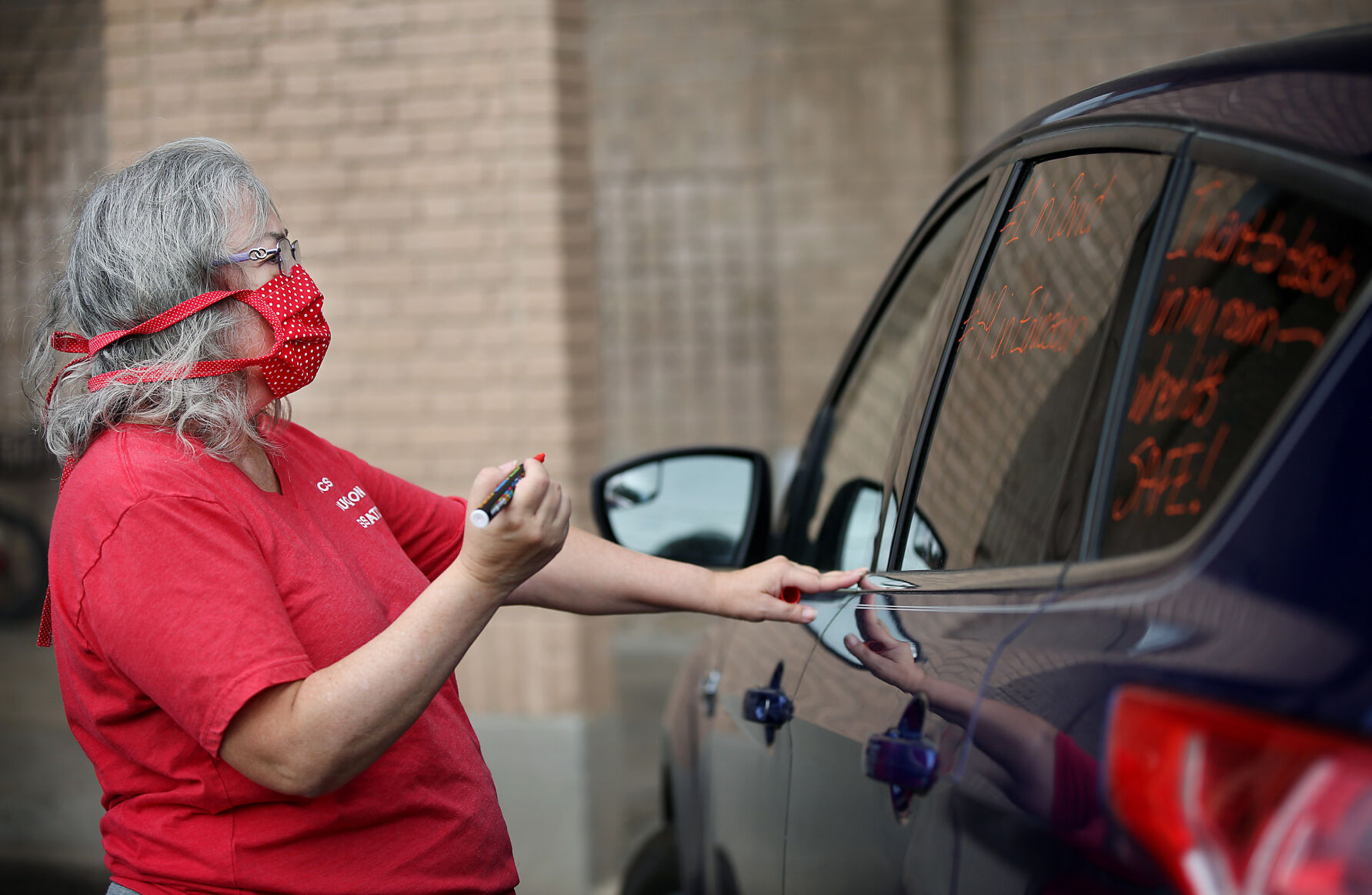
Lysa Nabours, a teacher and secretary at Tucson Education Association, checks out her decoration on a car before the start of the March for Safe Schools on July 15, 2020 in Tucson, Ariz.
Motor March for Safe Schools
Updated
About 100 cars filled with Tucson Unified School District educators and supporters participate in a Motor March for Safe Schools on July 15, 2020 in Tucson, Ariz.
Motor March for Safe Schools
Updated
About 100 cars filled with Tucson Unified School District educators and supporters participate in a Motor March for Safe Schools on July 15, 2020 in Tucson, Ariz.
Motor March for Safe Schools
Updated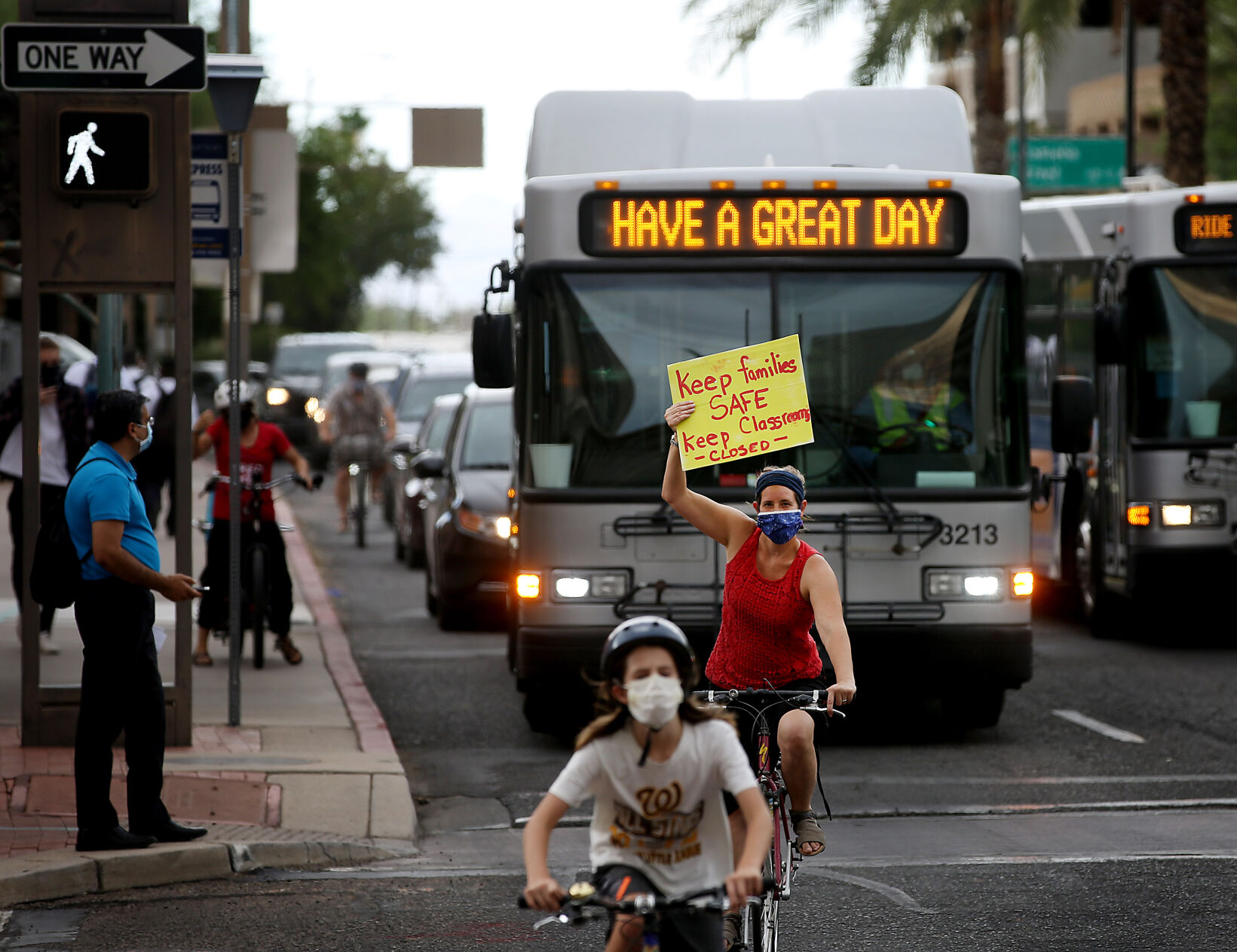
Tucson Unified School District educators and supporters participate in a Motor March for Safe Schools on July 15, 2020 in Tucson, Ariz. About 100 cars and a few cyclists showed up for the event that was part of a statewide initiative to make political leaders aware of their concerns about opening schools for in-person instruction during a rise in COVID-19 cases.
Motor March for Safe Schools
Updated
Ryan Kuchta, 13, middle, is joined by his parents, Mark and Sonya, as they show their support for educators during the Motor March for Safe Schools event on July 15, 2020 in downtown Tucson.
Motor March for Safe Schools
Updated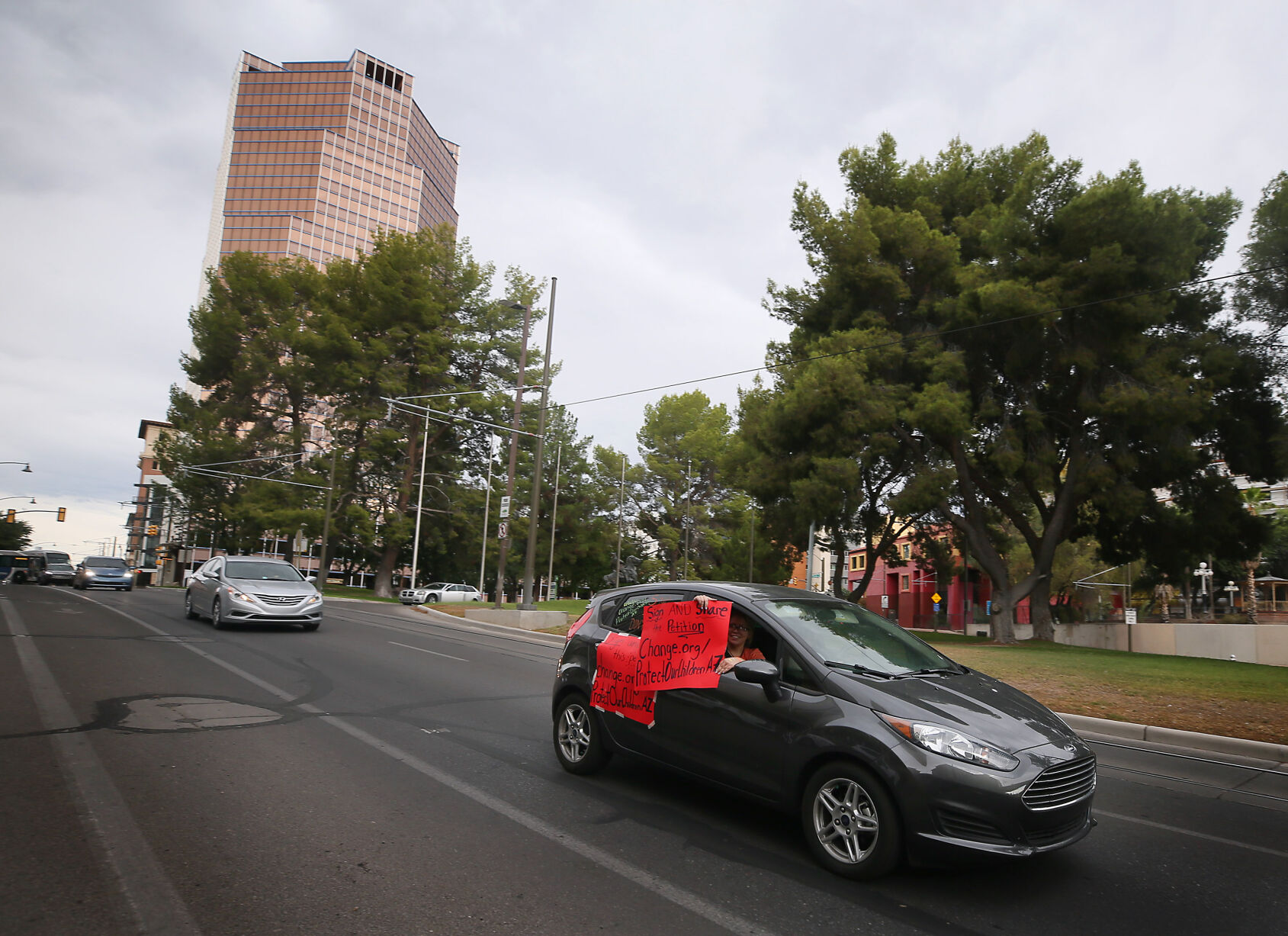
About 100 cars filled with Tucson Unified School District educators and supporters participate in a Motor March for Safe Schools on July 15, 2020 in Tucson, Ariz.

