



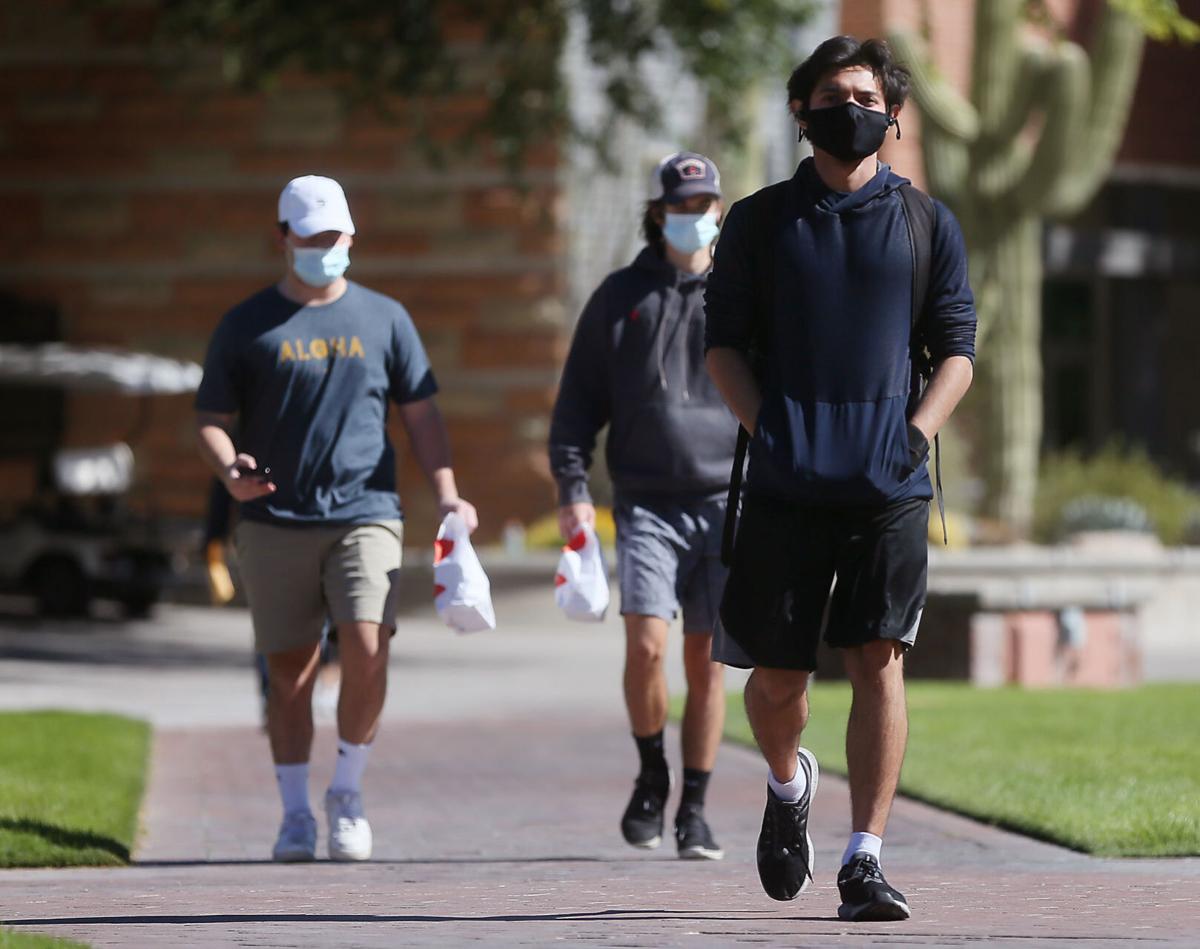
The University of Arizona gave details Thursday about how it plans to end the employee furlough program early after the school brought in higher-than-expected tuition revenue.
Since Aug. 10, the furloughs have led to pay cuts for employees making $44,500 or more.
Citing the better net tuition revenue, the administration said it is ending salary reductions in its furlough-based salary program by Feb. 21, 2021, four months earlier than anticipated. It has also reduced the required furlough days for nonsalaried employees, who were originally required to take those days by June 30.
Lisa Rulney, UA’s chief financial officer, said there was a “rush of enrollment” just before classes began this semester, giving the school more tuition revenue than it had expected.
“On the financial front, our picture is still very challenging. But it’s a 40% improvement for net tuition revenue over that moderate case,” Rulney said, citing the percentage increase over projections.
The furlough plan was supposed to last until June 30 — which is the end of the university’s fiscal year — to combat expected financial losses suffered during the pandemic. The school this week began allowing preselected classes of up to 50 students to meet in person and it expects to remain at this phased-in level until the Thanksgiving holiday. The school has seen its COVID-19 numbers decreasing.
The administration said it would look into data of those returning to school and other budget impacts before making decisions on the need for any future furlough plans.
The Coalition for Academic Justice at the University of Arizona, a 700-plus person group made up of graduate and professional students, staff and faculty, said it was “pleased” with the decision to end the furlough plans early.
“While we appreciate the shorter furlough plan, many staff and faculty still have numerous questions about how it will be implemented,” the coalition said in a statement. “Some employees have already taken all of their ‘furlough’ days, while others have yet to begin their furloughs. How will the university address this?”
President Robert Robbins said the furlough plan was designed to help prevent widespread campus layoffs.
“Our overarching goal was always that we would do this furlough-based plan in order to preserve as many jobs as possible. That was what we wanted to do, and I think we’ve accomplished that because all of those people who participated in the furlough, they definitely had a pay reduction, but at least they kept their job,” Robbins said.
Robbins added that “And the good news, at least the people that I’ve talked to, is they’re overjoyed by the fact that we can stop that pay reduction earlier than we had thought because we’re doing better with students than we thought we would.”
Still, the university has seen some of its 15,000 employees leave the school at a rate a bit higher than in normal times, said Helena Rodrigues, UA’s chief human resources officer.
“So far in fiscal year 2021, which began July 1, we have seen 89 layoffs and 20 nonrenewals which for this point in time is a little bit more activity than we would see in a typical fiscal year,” Rodrigues said. “It’s hard to know exactly how the year will turn out, but I think it is fair to expect that there will be some restructuring across campus because there are some real financial consequences as a result of the pandemic.”
The administration plans to share its revised budgets will all deans and vice presidents to plan their way through the next fiscal year.
“I think it’s really important that we help our community understand that we are not out of the woods,” Rulney said. “We are passing on this improvement in net tuition revenue but it’s still a significant decrease of $55 million over what our expectation would have been if we were not in the midst of a pandemic.”
Meanwhile, Robbins said while some efforts to keep the school operating have been “extremely complicated” and “contentious at times” it was to help students continue their college careers.
“I think we’ve set up a system that so far has worked and I’m hoping that students will come back in the spring, and will continue to advance their academic career, working toward a degree, deriving knowledge and learning skills, so that they can go on and go to graduate school or get a job and simply realize their hopes and dreams, so they can go out and make the world a better place,” Robbins said.
Photos: In Tucson, face masks are for more than just people
Face masks on objects
Updated
A Jeep sports with eyes like those from the movie "Cars" sports a COVID19 mask outside Alpha Graphics near the corner of Tanque Verde and Kolb, Tucson, Ariz., July 3, 2020.
Face masks on objects
Updated
The large Tiki head at the entrance of The Hut, 305 N. 4th Ave., wears a mask in response to the Coronavirus Disease (COVID-19) in Tucson, Ariz., on April 5, 2020.
Face masks on objects
Updated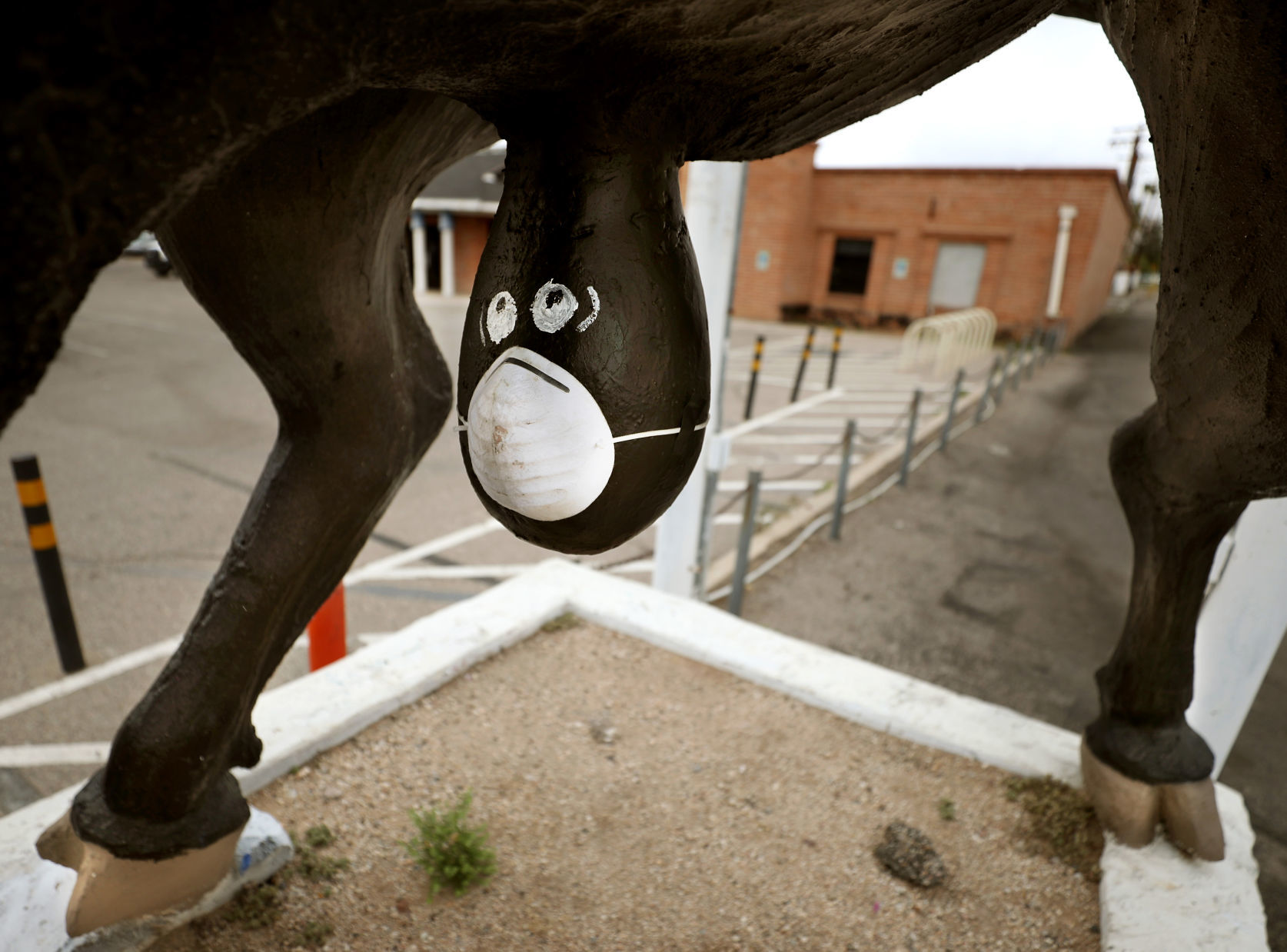
The noted bull testicles on the statue outside Casa Molina at Speedway and Wilmot, usually painted in various schemes and wild colors, are in these CONVID19 times now sporting a face mask, March 27, 2020, Tucson, Ariz.
Face masks on objects
Updated
A dinosaur statue over the doors of MATS Dojo at 5929 E. 22nd St., sports an athletic cup for a face mask in the second week of COVID-19 restrictions, March 31, 2020, Tucson, Ariz.
Face masks on objects
Updated
The venerable T-Rex outside the McDonald's at Grant and Tanque Verde comes around late, but strong, to the mask game, May 13, 2020, Tucson, Ariz.
Face masks on objects
Updated
The iconic Casa Molina bull and matador statue both sported masks on the first full week of the loosening of COVID-19 restrictions in mid-May.
Face masks on objects
Updated
Father Kino's horse practice safe social interaction by wearing a mask even if Father Kino himself isn't. The statue sits at Cherry Fields at 15th Street and Kino Boulevard, Saturday, May 2, 2020, Tucson, Ariz.

