


PHOENIX — The Tucson Unified School District won’t lose any state aid this year over its ethnic studies program.
But more than $14 million a year remains at risk because, while TUSD’s culturally relevant curriculum does not appear to violate state law, the Department of Education “remains deeply concerned that some TUSD teachers are not following the curricula.”
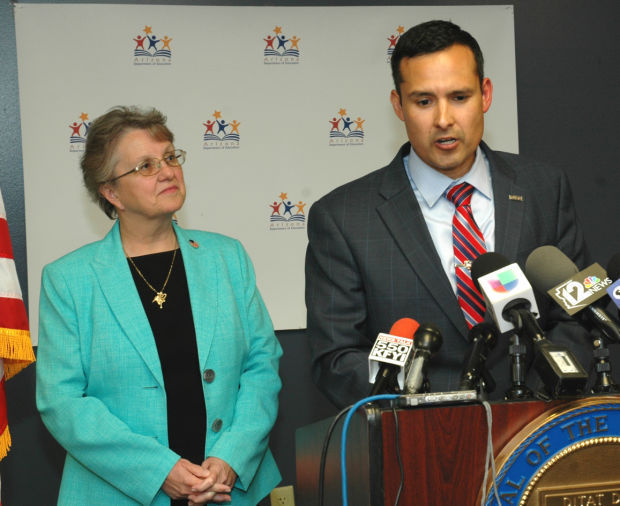
After reviewing TUSD ethnic studies courses for 60 days, Diane Douglas, the state superintendent of public instruction, said Tuesday that she now believes the “culturally relevant curricula” for Mexican-American students available at some district high schools complies with a 2010 law.
That law makes it illegal for schools to have courses promoting the overthrow of the U.S. government, building resentment toward a race or class of people, or advocating ethnic solidarity instead of the treatment of students as individuals. Districts that violate the law can lose up to 10 percent of their state aid.
Speaking at a news conference announcing the findings of the review, Douglas said the problem is that some teachers may not be following the revised — and now acceptable — curricula.
So, she said, she intends to monitor the district with both announced and unannounced visits to classrooms until the end of the school year.
“And where we will go from there, we will see,” she said. “We’re not going to make any promises today for what will happen when we get to May or June.”
In a prepared statement, TUSD Superintendent H.T. Sanchez said: “I appreciate the state superintendent’s willingness to work with our district throughout this process.
“Together we are able to avoid a costly loss of funding, and I remain committed to improving culturally relevant classroom instruction so that in the future monitoring will no longer be required.”
Speaking at the press conference, Sanchez later said the ethnic studies program is “not to teach division or hatred. It’s to teach appreciation and understanding.”
Douglas said the concerns that will be monitored through the rest of the year relate not to the curricula but to how the courses are being taught, including optional materials some teachers use in the classroom.
Douglas’ predecessor, John Huppenthal, who started the probe, specifically complained about the use of the song “Take the Power Back” by Rage Against the Machine, used in a Cholla Magnet High School class on U.S. history that was taught from a Mexican-American perspective.
Huppenthal also pointed to a visit from rap artist KRS-One, whose “An Introduction to Hip-Hop” was used in a Cholla English class taught from an African-American perspective.
He also questioned a handout that asked, “Why was American slavery the most brutal in history?”
Shortly after taking office, Douglas expressed her support for both the use of music in the classroom and the inclusion of ethnic studies as part of history standards and curricula for all Arizona students.
The problem, she said Tuesday, is “when it serves to separate us more than bring us together.”
“If it’s inciting bad behavior, for lack of a better term, then that’s not going to help our students be in a better place and reach the standards and the goals we want them to achieve,” she said.
Douglas, who decides whether a district is breaking the law — and whether to withhold state aid — acknowledged that can be a subjective standard. But borrowing a line that the late Supreme Court Justice Potter Stewart used to describe pornography, she said, “I know it when I see it.”
Sanchez said district policy still allows for “occasional supplemental use of materials.” But he said there are guidelines and criteria for what can be used.
“Certain times, things fall outside of it,” he said. When that happens, he said, it is the responsibility of the principal and the district’s leadership to “catch that and correct that.”
After Huppenthal found the district to be in violation of the law in 2012, TUSD elected to dismantle what was then known as Mexican American Studies and create an entirely new curriculum of culturally relevant classes in its place.
Sanchez said the materials Huppenthal questioned are not currently being used.
Getting rid of the program entirely is not an option, at least in part because the district agreed to the courses to settle a federal court lawsuit alleging discrimination.
Sanchez said the job of the district is to ensure the state standards that teachers can use to create their lesson plans are followed.
“Where we’re going to continue to focus is make sure that what’s written is what’s taught in the classroom, so there’s not a disconnect between what’s written and approved by the Governing Board ... and what occurs in the classroom,” he said.
“We know what they should be teaching,” Douglas said. “And we just need some ongoing monitoring to make sure that they are.”

