


A new farm to table experience has popped up in Tucson, open only to a select few.
But you won’t find the spot in a trendy downtown restaurant. The popular concept is being introduced at Manzo Elementary — the first school to incorporate student-grown produce into the lunch menu.
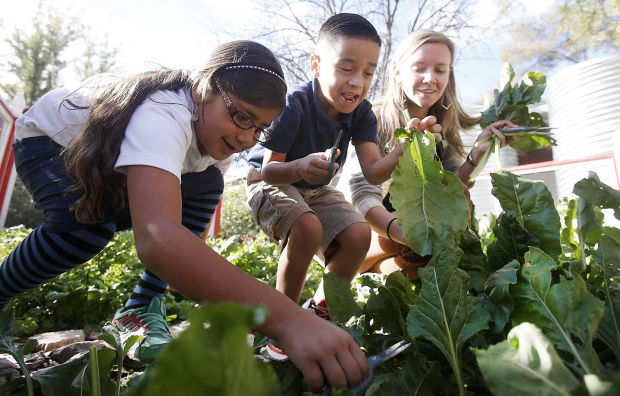
On Wednesday, the west side school’s 320 students harvested Swiss chard and other veggies for today’s lunch, which will feature different types of salad.
Second-graders Ben Cervantes and Shaila Garcia were confident that their classmates would enjoy their lunches today.
“We’re actually growing food that is healthy for you,” said 7-year-old Ben, who has tried squash from the garden and was impressed. “I think they will like it.”
While Shaila has worked in the school garden regularly she has yet to taste any of it, making her slightly nervous about how her classmates would respond, but excited nonetheless.
Manzo, near West Speedway and North Grande Avenue, is the first school in Pima County to obtain Arizona Department of Health Services certification to serve school-grown veggies on cafeteria trays.
Described as a challenging process that took over a year, the certification was sought out as a way to make the students’ work more relevant and to open the door for other campuses to engage in the same kind of opportunity, said Moses Thompson, ecology sustainability program coordinator.
Not only is the school subject to health inspections every six months, students also had to undergo training on food handling safety, proper hand washing, food storage and other techniques.
Manzo’s ecology program started eight years ago with intensive food production happening for the last four years.
“The program not only addresses health and wellness, but the gardens are also used academically to teach hands on functional math and literacy,” Thompson said. “It’s just a more potent form of education where our kids have a direct connection with the curriculum and that it is meaningful in the real world.”
In the Manzo garden you can find Swiss chard, kale, lettuce, basil, snap peas, spinach and sugar cane among other things.
In the past, the produce was sold in farmer’s markets for parents and used in food tastings for students, Thompson said. The school also sells to a local restaurant — Food For Ascension Café.
It is expected that students will be able to eat from their own garden three to four times a year.

