

A federal program that aims to train low-income people for well-paying health care jobs has had limited success in Tucson and elsewhere since it started five years ago, data shows.
About a third of the 1,800 locals who enrolled in the program at Pima Community College went on to work in health care and those who did earn an average of $12.44 an hour, initial results show.
The Health Profession Opportunity Grant program, authorized by Congress in 2010 under the Affordable Care Act, offers free healthcare job training, remedial help, transportation and other support services to public assistance clients and others in poverty.
The goal is to get participants into “high-demand careers in health care that pay well,” the program’s website says.
Nationally, fewer than half the program’s 38,000 or so participants are working in health care five years after the test effort began, data shows.
The national average for participants in health care jobs is $12.57 an hour, about $26,000 a year for a full-time worker.
MORE MONEY ON THE WAY
The U.S. Department of Health and Human Services recently announced plans to spend $324 million to extend the program for another five years. That’s slightly less than the $340 million tab for the first five years.
PCC, which has received $15 million since 2010, is on deck to receive another $15 million by 2020.
Congress authorized the effort as a “demonstration program” – in effect, a long-term experiment – to see what works best to get disadvantaged people into health care jobs expected to have shortages of workers.
PCC spokesperson Libby Howell said the extra federal spending is needed because conquering poverty is a long and arduous process.
Program participants often have troubled pasts, Howell said. They may come from chronically impoverished families, have little or no work history and have such low self-esteem that job hunting is “a daunting and difficult task,” she said in an email interview.
PCC’s results are “not uncommon” among the 30 or so other institutions nationwide that receive grant money under the program, Howell said.
She said some participants are so eager to work once they finish training that they grab “quick employment in a non-health care field” and end up staying because they lack confidence to change jobs.
PCC intends to tackle that problem in the program’s second five years by building self-esteem and self-sufficiency training into the program and by improving assistance for job seekers, she added.
STILL JOBLESS
Adrianna Martinez, 29, a single mother who enrolled in the PCC program, was released from federal prison last year after serving four years for drug-dealing.
While in custody, Martinez said, she vowed to better herself and started by earning a high school equivalency diploma behind bars.
“I made decision right then and there that I was going to change my life around,” she said.
Once released, Martinez applied for government aid for needy families and was told she’d need to take job training. PCC trained her as a medical records technician, but six employers have turned her down because of her criminal record, she said.
“They knew it was going to be a struggle for me,” Martinez said of her PCC program advisors.
“We hoped that if I tried to be myself and explain things professionally, someone might give me a chance. But unfortunately, it didn’t happen.”
Despite the roadblock, Martinez said she’s determined to find employment. She plans to take more training through the PCC program, this time in a different field such as social services, to improve her prospects.
Howell, PCC’s spokesperson, says while some health care jobs require a clean criminal record, others, such as medical records and behavioral health, do not.
Howell couldn’t immediately say how many people with felony records have trained for healthcare jobs at PCC, but she estimated the number is small.
SUCCESS STORY
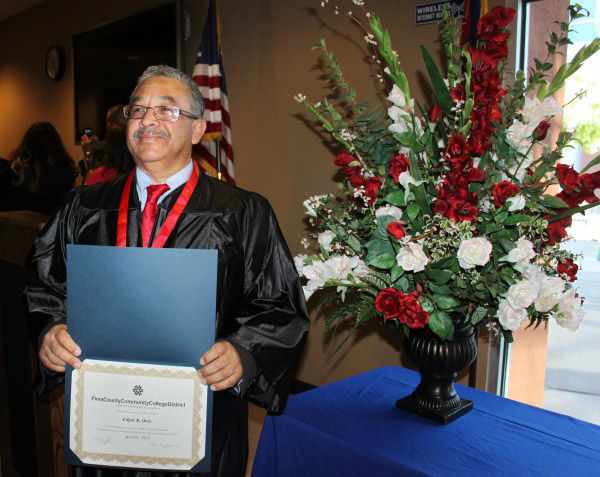
PCC claims Edgar R. Ortiz as one of its success stories, an example of what the program can do at its best.
The Tucson man’s quest to become a registered nurse is featured on a federal website that highlights achievements of program participants around the country. He could not be reached for further comment.
Ortiz, 61, found himself unemployed in 2011 when he was laid off after 20 years as the manager of a printing firm, the federal website says.
He’d always wanted to go into nursing, and the federal program at PCC gave him the chance. First he became a certified nursing assistant. He then trained to become a practical nurse, and plans to go back a third time to become a registered nurse.
Without the program, “I would still be struggling to find a meaningful job,” the website quotes Ortiz as saying.
“I was doing temporary jobs and there was no direction or a future. It was just something to pay the bills. Now I have a purpose.”
Like Ortiz, many program participants start out in lower-paid jobs such as nursing assistant. The hope is they’ll eventually come back and train for positions with more earning potential, officials said.
Kenneth Wolfe, a spokesman for the federal Administration for Children and Families, which oversees the program, said the effort is being closely evaluated to see how well goals were met.
At PCC, spokeswoman Howell said, the program has given hope “to many individuals who never thought they would be able to find a job, let alone enter college and have a career.”

