


The sharpest images yet of a supermassive black hole have been captured by University of Arizona astronomers at the Steward Observatory.
The team described how they captured the infrared image of the supermassive black hole using a Large Binocular Telescope Interferometer (LBTI), in their study published Friday.
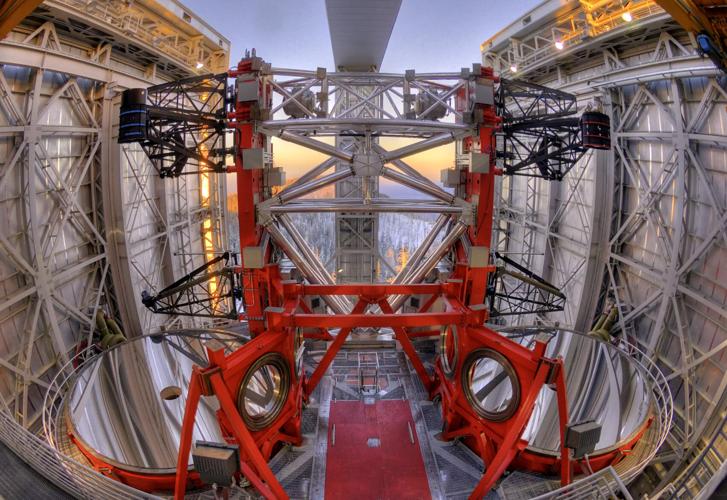
The LBTI is unique for its structure, containing two 8.4-meter mirrors that function separately. This is the first time constructive interference was used, which combines the mirrors to produce a higher resolution image, to capture not only the black hole, but the entities around it.
Supermassive black holes are referred to as active galactic nuclei (AGN) when they are in the center of a galaxy and active.
The more they consume, the brighter they are.

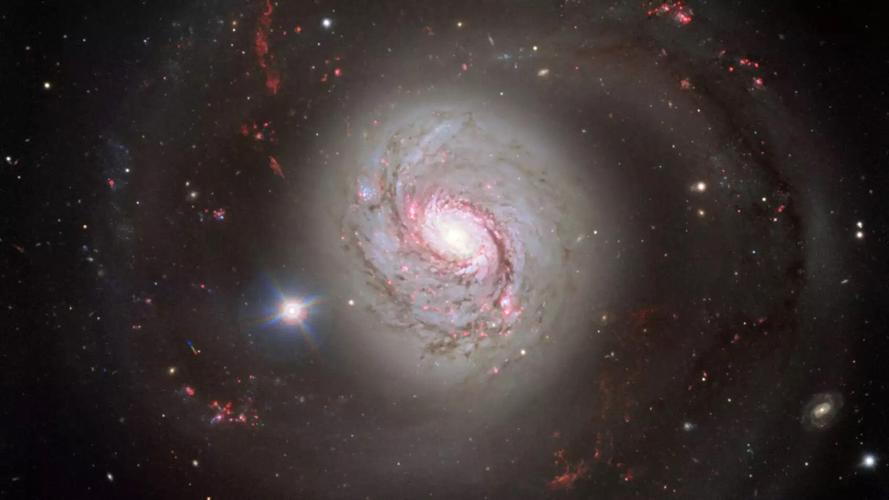
An image of the spiral galaxy NGC 1086 (Messier 77) obtained by the European Southern Observatory’s (ESO) Very Large Telescope (VLT). The galaxy has a distance of 14.4 Mpc (47 million light-years) and is one of the nearest galaxies with an active galactic nucleus.
Most galaxies have supermassive black holes, but the one in the Milky Way is inactive, meaning the galaxy is as well.
The extragalactic AGN captured by the researchers belongs to a neighboring active galaxy named NGC 1068.
The details visible in the sharp images will help discover more about the Milky Way because AGNs play a role in the creation of galaxies, said Jacob Isbell, a team member and post-doctoral researcher.

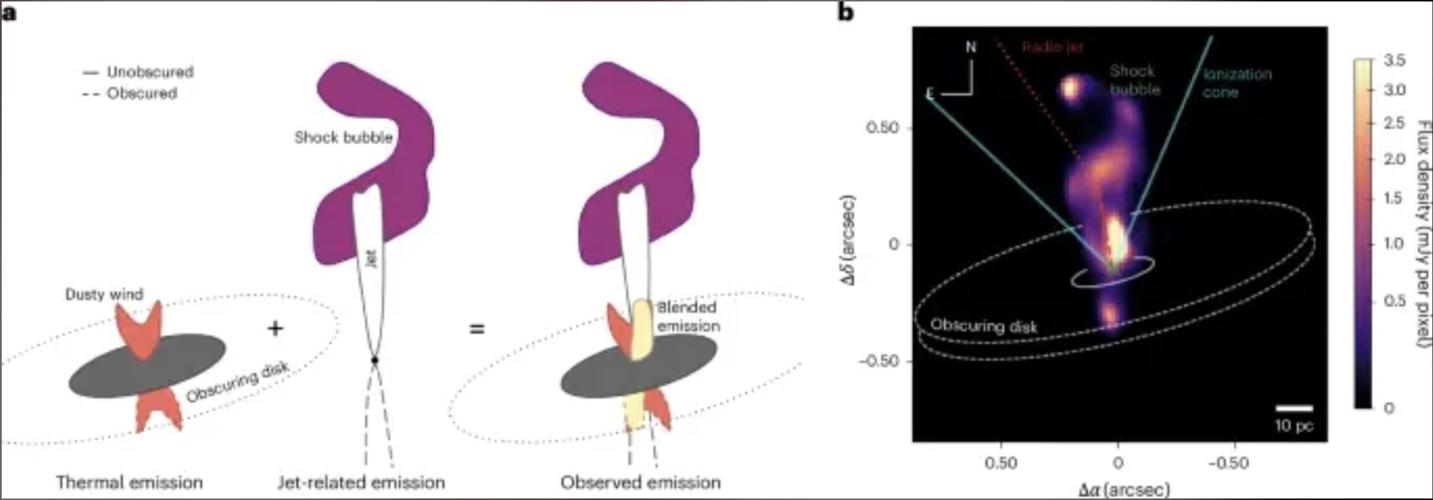
A thermal infrared image from the Large Binocular Telescope Interferometer (LBTI) shows the components of dust surrounding a supermassive black hole, confirming its identity as an active galactic nuclei (AGN).
“Fundamentally, we’re trying to understand how the Milky Way formed, and how our sun and our planet came to be here,” Isbell said. “By looking at how nearby galaxies grow up, we get a good picture of how ours did the same.”
In the images, researchers were able to see how different forces around this AGN interact. Isbell said they can see material that feeds the AGN and interacts with the galaxy in greater detail, providing insight into specific impact.
Prior to this discovery, feedback from radio jet and dusty wind would be indistinguishable in images of AGNs.

View from the dome of the Large Binocular Telescope (LBT) through the open dome doors. In the foreground are the two large primary mirrors with the support structure for the secondary mirrors.
Now, researchers can study them separately.
The intricate detail that the LBTI and imaging technique reveal will also help study other objects in space outside of AGNs. This will open doors to study interactions, objects and galaxies in more detail.
“We could basically look at any astronomical object that’s bright enough, and get the same quality of results,” Isbell said.

