

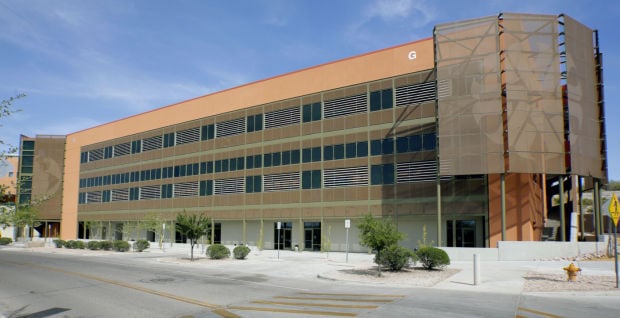
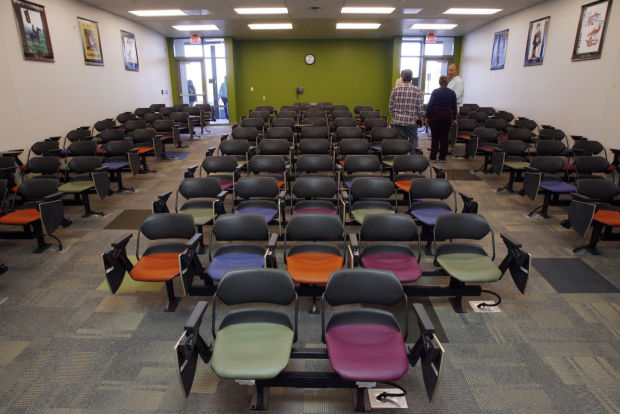

Pima Community College’s newest building has three floors, a legion of laboratory skeletons and a $12.5 million price tag.
What it doesn’t have is evidence the building is needed, proof that may have been provided had the school followed proper procedures to justify new construction.
The college’s former leader bypassed those procedures before the project was approved in 2010, an Arizona Daily Star investigation has found.
A key planning tool — one most schools update every five to 10 years to track the need for new space — has been untouched for nearly a quarter-century at PCC, records show. That left the college without a framework to assess its needs.
Cheers greeted the recent grand opening of the 55,000-square-foot facility at PCC’s Northwest Campus, a project that adds classrooms and high-tech science labs to a site where enrollment has plunged 33 percent since work began under former Chancellor Roy Flores. Few who gathered for a ribbon-cutting knew the tangled history behind the building they’d come to celebrate.
“Our community should be very proud of this state-of-the-art facility,” the college’s new leader, Chancellor Lee Lambert, told about 100 people who attended Thursday’s event.
The new space will allow the college to partner more closely with high schools, universities, the business community and others, he said. Lambert wasn’t around when the project was launched. In an interview, he said PCC “hasn’t done a good job of planning in general” and that facilities planning is one of many areas that need improvement.
ERA BEFORE EMAIL
PCC’s main building planning document is outdated to a degree virtually unheard of at a large educational institution.
Its Campus Facilities Master Plan was created in 1991, when the school had three campuses instead of six. Back then, the term “email” was so new that the plan mentioned it only in quotation marks.
By comparison, the University of Arizona updates its facilities plan every five years, and PCC’s peer schools across the country have plans created this century.
A facilities master plan assesses the space needs of an entire organization rather than a single area or campus. Many measuring tools are used, such as long-term enrollment projections, population growth studies, travel times between campuses, academic strengths and the demographics of likely users.
Flores, hired in 2003, resigned in 2012 after eight women accused him of sexual harassment. The college was placed on probation by its accreditor last year due in large part to what it called his leadership failings.
EAST VS. NORTHWEST
Sylvia Lee, one of four presidents in the last five years at the Northwest Campus, said Flores would dangle the promise of a new building for her campus then snatch it away when she displeased him by asking about it too often.
He’d often threaten to give approval instead to East Campus President Charlotte Fugett, who was seeking a new $9 million building for her campus at the time, Lee said. Fugett told the Star she wasn’t aware of talks between Flores and Lee.
Without a facilities master plan for guidance, campus presidents had to figure out for themselves when new buildings were needed and make pitches to Flores, who controlled the approval process with little oversight, Lee said.
“Flores made decisions to this magnitude all on his own. The board never questioned him on this,” said Lee, who retired from the college in 2011 and now is a member of the Governing Board.
The new building proposed for the East Campus was shelved for lack of funding and is still on hold.
It isn’t clear what rationale Flores gave the Governing Board for choosing one site over the other. A brief written report he provided the board before its April 2010 vote didn’t mention the relative merits of the proposals, records show.
The Northwest Campus was growing faster than any other when Lee started pushing for a new building. Since then, most of that growth has evaporated.
Between fall 2006 and fall 2010, the number of full- and part-time students jumped from about 4,300 to about 7,000. By last fall, it had dropped to less than 4,700.
THE PLAN THAT WASN’T
Not long after the Northwest project was approved, a team from PCC’s accreditor visited and came away believing the college had just adopted a new facilities master plan. That belief was mistaken, school officials now say.
The accreditor’s written report on the visit said PCC created a new facilities plan in July 2010 and posted it to the school’s intranet. It criticized the college for not doing more to publicize the new document and for not including employees in its creation.
“Many employees seemed to be unaware of its existence,” the accreditor said of the supposed new plan.
Bill Ward, the college’s facilities boss, said he doesn’t know how the accreditor got the wrong idea. PCC started work that year on a new master plan but didn’t finish it, he said.
Three of the four Flores-era board members still in office — Scott Stewart, David Longoria and Brenda Even — didn’t respond to questions from the Star about the Northwest Campus project and the school’s archaic master plan.
Board member Marty Cortez, who did respond, said she recalls the original Northwest Campus “was planned with space for expansion where the addition is now.”
HIGH HOPES
Whatever the Northwest project’s past, there are high hopes for its future.
“As an Oro Valley resident, I say congratulations to everyone at Pima Community College who made this happen,” said Dave Perry, president of the Greater Oro Valley Chamber of Commerce, one of several civic leaders who spoke at Thursday’s ribbon-cutting.
Perry said the town’s powerhouse employers — Ventana Medical Systems and pharmaceutical giant Sanofi — “were born in the rich environment of academe.”
“This is where minds can create. This is where an economy can grow,” he said of the new campus building.
Rafael Meza, of the University of Arizona, who toured the facility after the ceremony, marveled at its modern science labs. Pima students who study there will have an advantage when transferring to the UA, said Meza, senior director of transfer enrollment services.
“They now have labs that are comparable to ours, if not better,” he said.

