


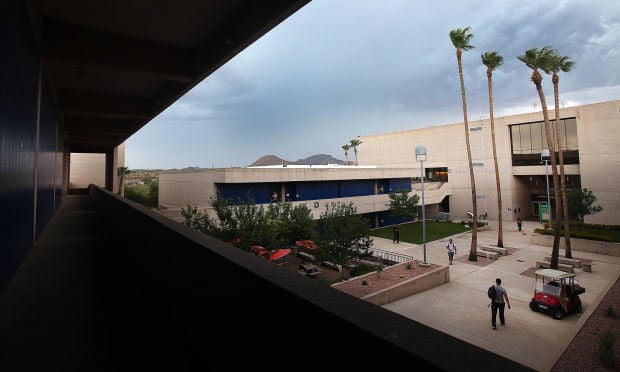
Accreditation inspectors are back on campus at Pima Community College for a visit that has high stakes for all involved.
A team from the Chicago-based Higher Learning Commission is putting PCC under a microscope for the third time in four years — and this time the commission’s performance is under scrutiny, too.
The two-day visit begins today and takes place amid mounting federal criticism that accreditors are too soft on schools that don’t meet quality standards.
“For the most part, accreditation organizations are the watchdogs that don’t bark,” former U.S. Education Secretary Arne Duncan said last year.
The federal government, he said, “must do a better job at holding accreditors responsible for their work.”
PCC has been under accreditation sanctions since 2013 for failing to meet, or just barely meeting, quality standards in several areas.
This week, school officials are showcasing recent changes in a bid to win back the accreditor’s full favor.
If they don’t succeed, PCC could face further sanctions, including the possibility of a show-cause order, which would give the school one more year to either turn things around or lose accredited status.
Commission reviewers have scheduled a general community forum for Tuesday from 12:30 p.m. to 12:50 p.m. in the Amethyst Room of PCC’s downtown campus, 1255 N. Stone Ave.
Long-term problems
PCC’s quality problems went undetected for years when past review teams failed to fact-check the claims of school executives and Governing Board members who said all was well.
In 2010, for example, the college received a clean bill of health even though it lacked the basic underpinnings of a modern educational institution.
Key policies, plans and quality-control systems either didn’t exist or hadn’t been updated since the era before email. Reports of sexual harassment and cronyism piled up, and those wronged had nowhere to turn because PCC had no complaint-handling system.
The shortcomings didn’t come to light until 2012, when news reports and citizen protests spurred the accreditor to action.
Since then, PCC has been trying to make things right, with varying degrees of success.
AREAS OF PROGRESS
The pile of problems the college once faced is smaller these days.
Sexual-harassment issues were dealt with and employees now receive more training than in the past. Many deemed complicit in past problems have quit or moved on.
Last year, the accreditor identified 11 remaining areas of concern including leadership instability, lax monitoring of program quality and a lack of proof that recent fixes, such as a new complaint-tracking system, are effective.
Some changes have a track record of success. A new financial oversight committee, for example, has attracted community experts who advise the college on money matters. Others changes have yet to bear fruit, such as a plan to battle plunging enrollment, which is down by more 30 percent.
Bruce Moses, PCC’s accreditation chief, acknowledges the school still has weak spots. But overall, he said, the college can now show that “the culture is starting to shift in the right direction.”
CRITICISM PERSISTS
For all its efforts, PCC still hasn’t won over its biggest critic, the citizens group whose 2012 complaint sparked accreditor action.
The Coalition for Accountability, Integrity, Respect and Responsibility sees the college’s current leadership as secretive and prone to exaggerate the level of progress being made.
The group recently filed another complaint with PCC’s accreditor, citing, among other things, the school’s repeated failures to comply with state laws that protect the public’s right to know.
“The board of governors and chancellor continue to engage in the suppression of critical information and key facts,” the Sept. 7 complaint said.
Group president Mario Gonzales said he plans to complain to federal officials if the accreditor doesn’t do a thorough job this time of fact-checking PCC’s improvement claims.
On the SAME PAGE
The team of seven reviewers on-site in Tucson today will be met by a workforce that’s been told repeatedly of the need to speak with one voice when the accreditor comes calling.
Fact sheets on PCC’s progress were distributed to every employee, and executives drove from campus to campus to drive home the information.
“We’re not telling them what to say, but showing them information so they understand the facts if they get asked a question,” Moses, the accreditation boss, recently told college’s Governing Board.
Having everyone on message is important, he said, because reviewers’ ears tend to perk up when management and employees aren’t on the same page.
“If management is saying ‘This is how we do things’ and people are saying the opposite, that’s when reviewers key in and drill down and want to ask more questions.”
Watching what happens
PCC supporters near and far are watching to see what happens next.
“This saga has been going on for too long,” said Tucson native Augustine Gallego, a past chair of the American Association of Community Colleges, the American Council on Education and the Institute for Higher Education Policy and the chancellor emeritus of the San Diego Community College District.
Gallego, who lives in Oregon but visits his hometown every few months, said he worries about PCC’s future and hopes the current accreditation team is up to the task ahead.
“I hope they treat this very seriously,” he said. “They owe it to the community and the students and the taxpayers of Pima County.”
The commission is to decide the college’s fate in February.

