

Students and faculty told the Board of Regents Thursday they are intensely angry and worried about the University of Arizona’s recently disclosed financial miscalculation that could lead to cuts in student aid, freezes in hiring and other spending cuts that UA President Robert C. Robbins has warned will be “draconian.”
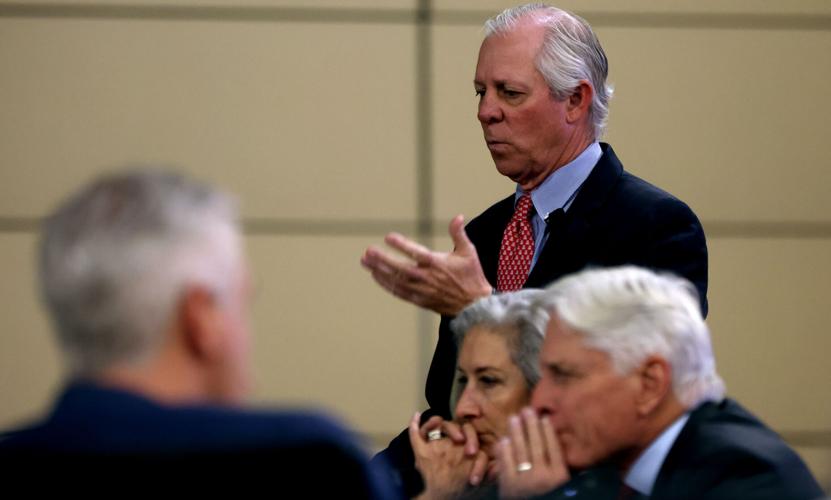
Robbins sat stone faced at the end of a table as speakers, one after the other, lambasted him for the $240 million miscalculation.
Robbins then spoke to the regents about the “State of the University,” an annual address scheduled before he disclosed the financial miscalculation to the board on Nov. 2, that typically highlights successes.
For the most part, Robbins ignored the financial situation.
“It’s not the time for me to go through and describe all the issues and our financial challenges,” he told the regents, while noting that his full report on how he plans to deal with the budget is due to the board by Dec. 15. Instead, he highlighted strategic investments the UA has made in this past year.
Though he avoided speaking about the financial issues, he repeatedly alluded to them. At one point, he remarked, “I’m often told about this ‘incredible administrative bloat,’ which we’re looking into for sure,” but he emphasized administration posts that are “critical positions to the success of serving students, faculty and our communities.” Many faculty have accused Robbins of over-hiring in staff positions.
Robbins also said in passing, “We have no interest in reducing need-based student aid,” but that merit aid cuts are under consideration.
“Students are sick and tired”
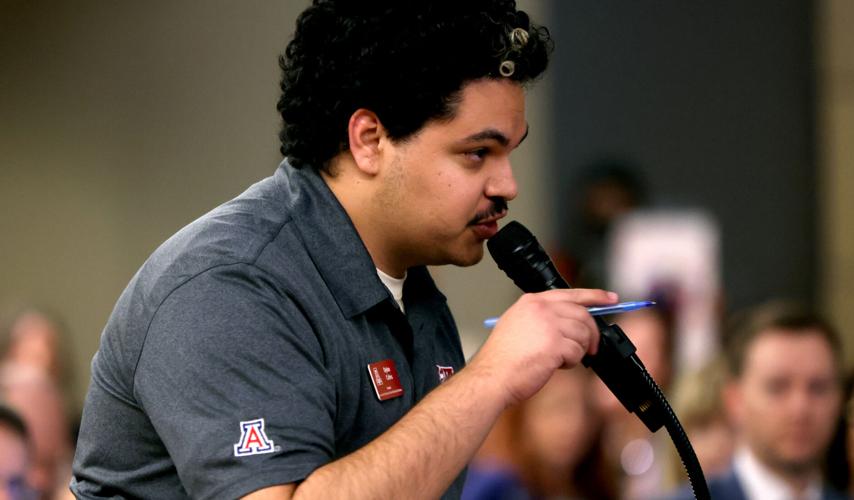
Earlier Thursday afternoon, Eddie Barrón, a sophomore and the executive vice president of the Associated Students of the University of Arizona, told the regents: “We are sick and tired of constantly footing the bill.”
“I was riddled with fear and anxiety” for students on financial aid, Barrón said, after Robbins previously stated he is considering cutting aid programs.
Megan Wong, a student senator in ASUA, told the board: “We ask for transparency but now we are demanding answers.”
She added: “I do not trust the university with my wellbeing anymore. The university has made it loud and clear that they do not care about us.”
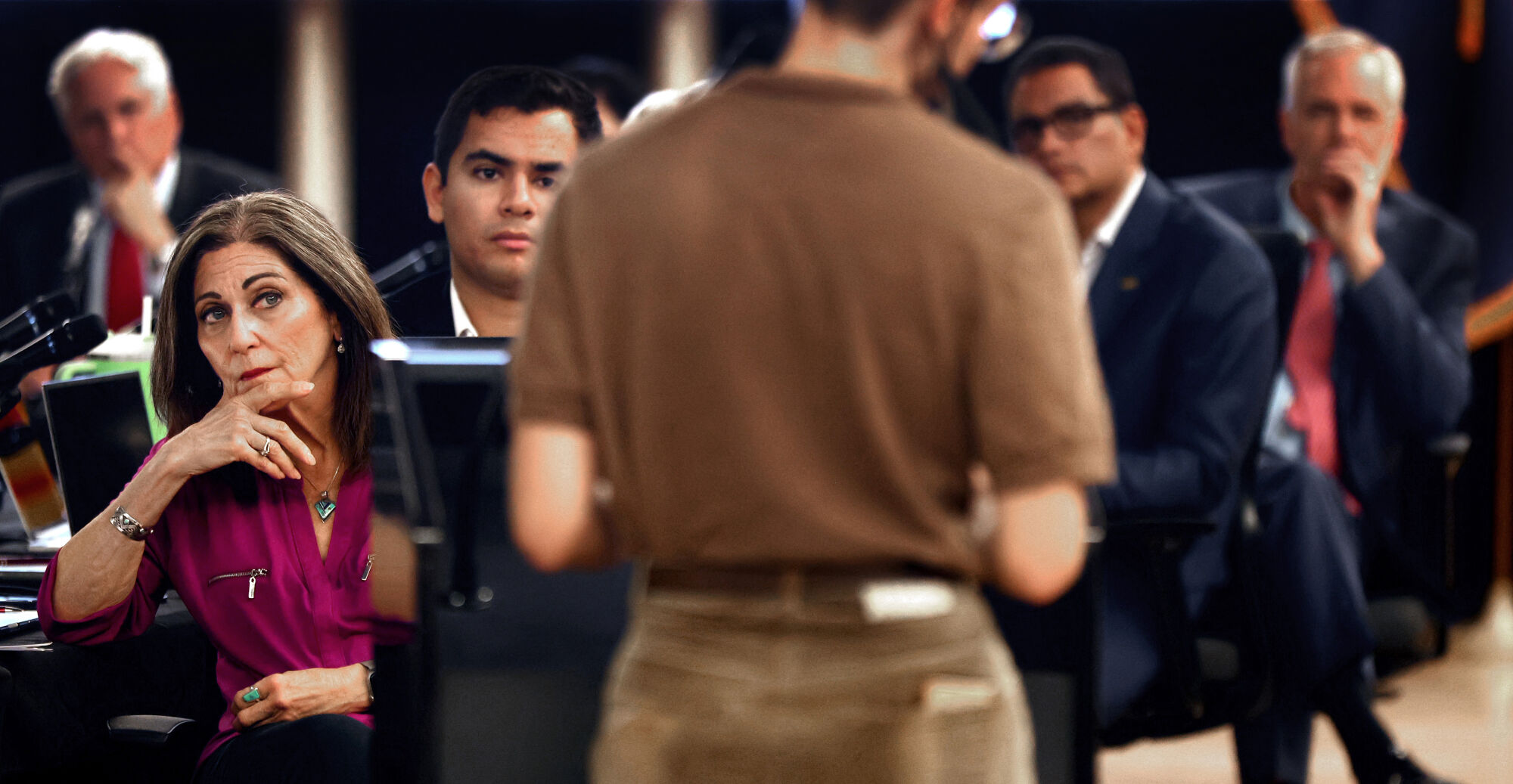
Among other statements made, often in raised, emotional voices at the “call to audience” at the standing-room-only regents meeting on the UA campus, were:
“Students are sick and tired … of the lack of management and accountability. This is on you, President Robbins!”
“Chop from the top!”
“You fail to support students. We demand that President Robbins stop his own bleed.”
From faculty members: “I find it inexcusable … especially when so many of us are living barely above paycheck to paycheck.”
Decisions you make about retirement benefits “will affect us for the rest of our lives. I did my job for 40 years. Now you do yours!”
Highlighting successes
Robbins spoke for slightly less than an hour about the “State of the University,” highlighting successes — “and there are so many” — including the UA-led NASA mission to the asteroid Bennu, OSIRIS-REx; UA’s recent “genius grant” recipients; and UA’s current status as the nation’s top producer of Fulbright scholars.
First, the university president highlighted the one-year student retention rate, which is currently 87.7%. The four-year graduate rate is 56.6% while the six-year graduation rate is 65.9%.
Racially, 49% percent of the first-year students who matriculated this fall are other than white, Robbins reported, while 30% are first generation to college.
There was a 22.4% increase in Native American students, a 4.8 % increase in Hispanic/Latinx students, and a 4.7% increase in Black students in this first-year class. Additionally, 1,348 of the first-year students had a 4.0 GPA in high school.
Robbins moved on to the scientific investments, though he acknowledged that in order to champion them, “We made significant investments from the strategic initiative investment fund that came from our central reserves.”
Those “key investments” include space science initiatives, the Center for Advanced Molecular & Immunological Therapies (CAMI), technology research initiatives and the Arizona Institute for Resilience.
Robbins joked that astronomers he has hired and supported are “almost as expensive as football coaches because they require so much equipment.”
The investment has paid off, according to the president, since the UA is number one in the nation in astronomy and astrophysics expenditures and number five in NASA-funded activity. Part of that comes from the Giant Magellan Telescope, which the UA under Robbins also invested in.
“I made a $15 million commitment to the Giant Magellan Telescope because during COVID, work kind of stopped and we needed to bridge that and have the resources necessary to move forward,” he said. “I think this was a really good use of our strategic investment funds.”
The CAMI, which Robbins said he was “very excited” about, is projected to have a large economic impact, with at least 20,500 potential new jobs and economic gains as high as $4.8 billion, he said.
“It will be a site for startup companies, whether locally or around the globe, or even multi-national drug companies and biotech companies to come,” Robbins said.
“Many of these investments we’ve made over the last five years have allowed us to grow these research expenditures,” Robbins told the regents. There is a projected $940 million in research expenditures for the UA this year. “This doesn’t happen without investment. You’ve got to be able to put seed money in.”
He didn’t shy away from discussing more ways he sought to spend money on behalf of the university, despite the financial situation.
“With the arts, we need a complete renovation of Centennial Hall,” he said. “Better seats, better sound (and) better amenities.”
Robbins concluded his presentation with a brief mention of the Fuel Wonder campaign, which has raised $2.05 billion, or 68%, of its $3 billion goal.
“This is a really important part of what we do at University of Arizona, and I think that we will definitely get to $3 billion,” he said.
None of that money, Robbins has said previously, will go to helping the UA’s financial troubles occurring in university operating costs.
Regents’ reactions
The regents were pleased with Robbins’ presentation.
“In light of the current controversy, this is so helpful,” Board Chair Fred DuVal said, “to know, when you say ‘we’ve been investing in mission success,’” about the details.
Earlier, DuVal thanked the audience members “for your powerful and impactful comments.”
Regent Larry Penley told Robbins “your love of students” is evident in the increases in scholarship money given and in diversity, including the focus on Native American students, and thanked him.
At the Nov. 2 regents’ meeting, Penley had told Robbins: “You’re going to have to terminate people, stop purchasing, or do something else. Clearly, you’re going to have to have a hiring pause.’’
“This is really going to hurt the university and hurt the faculty to do what is necessary to reach the minimum policy required days on hand of cash that you must have,’’ Penley said then.
Get your morning recap of today's local news and read the full stories here: tucne.ws/morning

