

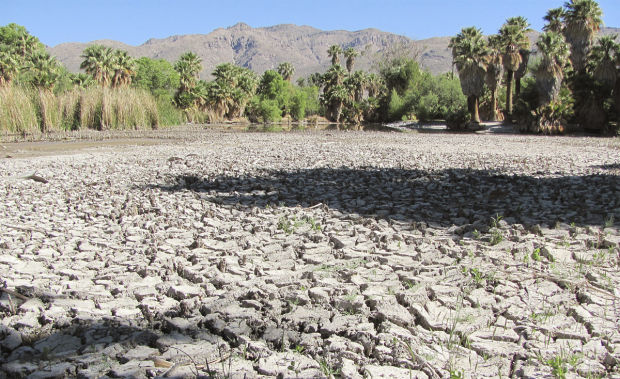
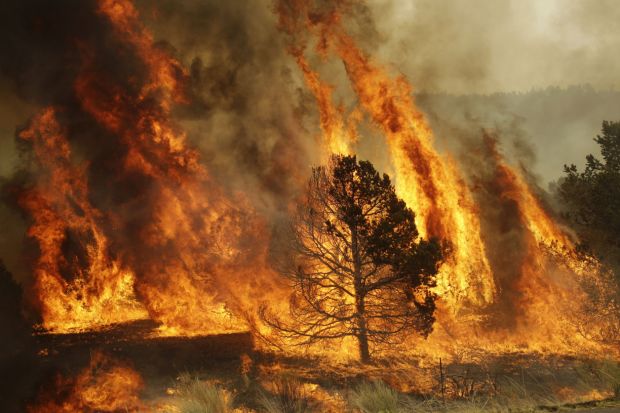


We’re going to have to adapt to more huge wildfires, prolonged heat waves, electricity brownouts, floods and severe droughts and other more extreme events in the future, thanks to climate change, says the director of a new University of Arizona research center that will try to help people do that.
“That’s really how people experience climate change,” says Kathy Jacobs, director of UA’s new Center for Climate Adaptation Science and Solutions. “The idea that climate change impacts happen slowly and incrementally is really the wrong way to look at this.
“People are confident in their ability to take off another layer of clothes or put on the thermostat. What is of greatest concern is extreme events,” said Jacobs, a longtime Tucsonan who recently returned here after working four years as a scientist for the White House in Washington, D.C. “People get caught by surprise all the time, but there’s no need to be surprised. We can actually be prepared.”
Being prepared is one of several key themes the center will focus on. Having started operations in January, the center’s basic purpose is to help people in Tucson, nationally and globally adapt to a changing climate by offering management options and practices aimed at protecting lives, property and the national environment from its impacts.
By taking advantage of UA’s large array of climate researchers and adaptation specialists, the center will try to connect with the public and with other researchers and officials around the world. One goal: Help people understand how variable year-to-year fluctuations in temperature and precipitation are.
“I think many people think climate change means it will be warmer every year and drier every year,” Jacobs said. “There actually seems to be a lot of variability in these trends.”
It also will be important for the center to frame climate change in ways that the community really cares about, Jacobs said.
“They may not care about climate change, but they really care about drought. They wonder why there are more potholes in their roads,” said Jacobs, since heat can cause asphalt to deteriorate faster. “We’re trying to have a tangible way of connecting science with resource management, water management and decisions about development.”
Jacobs, a UA soil, water and environmental science professor, worked in Washington, D.C., as a top aide to White House science adviser John Holdren. She was assistant director of the White House’s Office and Science and Technology Policy.
Earlier, she directed the now-defunct, three-university Arizona Water Institute, and spent 23 years working for the State Department of Water Resources. For 14 of those years, she ran the agency’s since-shuttered Tucson office.
The adaptation center’s other key areas of interest:
- Connecting the UA’s extensive climate science community with decision-makers, so ideas stemming from climate research have a better chance of becoming reality. “How do we make science useful?” Jacobs said.
- Helping manage risks that come with climate change, particularly a cascading series of risks such as public health problems from a major heat wave that damages the electrical grid.
- “Managing risk is the central nut we need to crack here,” Jacobs said at a recent public forum at the UA held to discuss the new center. “Risk is a very complicated, interdisciplinary problem — it’s hard to understand the factors for risk.”
- Trying to link adapting to climate change with climate mitigation, which tries to slash CO2 emissions with such measures as renewable energy or non-gas-guzzling vehicles.
Typically, people who work on adaptation and risk management, such as government emergency management officials or water managers, work separately from those working on ways to reduce emissions, she said.
“We’re really trying to identify solutions to both problems,” Jacobs said. “When you try to manage risk, don’t put in new facilities that increase it. When you’re generating energy, you try to limit the risk to that system.”
Also, if we don’t mitigate, we’ll have to adapt more, Jacobs said.
“As my boss in Washington said on practically a daily basis, we have three choices: adaptation, mitigation or suffering. And what I’ve actually said is, ‘We don’t have three choices. We have one:
“Which percentage of mitigation, adaptation and suffering do we actually experience?’”
Overall, adaptation is just risk management, Jacobs added.
“In Arizona, many of our opportunities probably will come from the fact that we are early adapters. We have so much focus here on drought and extreme temperatures that we’ve actually developed a lot of techniques to deal with them: artificial groundwater recharge, reuse of wastewater, conservation and efficiency.”
Today, she said, the new UA center will pick at least some of what it does based on what the community wants.
The center is a virtual center, with no formal office or headquarters, and with only Jacobs and an assistant as full-time staff. It operates out of the UA’s Institute for the Environment headquarters in the Marshall Building near Main Gate Square.
The center will draw on the work of climate experts spread around the campus, with a core of 11 faculty.
They include the highly visible, sometimes controversial UA Institute for the Environment Director Jonathan Overpeck, his co-director, Diana Liverman, and deputy director, Gregg Garfin, a researcher who last year was executive editor of an assessment of Southwestern climate change impacts.
“There is a lot of research in climate adaptation here,” Jacobs said. “I would say that the UA has one of the strongest groups of climate specialists in the country. UA is very well known for bridging the gap between science and decision-making.”

