


As parents grappled with concerns that their visually- or hearing-impaired children might now be mainstreamed in public schools in local districts, rather than taught at Arizona State Schools for the Deaf and the Blind, ASDB abruptly shut down a community meeting in Tucson Monday night, where questions were being shouted from the audience.
ASDB’s management had given multiple warnings to parents in the audience to stop interrupting their presentation by yelling out questions about what will happen to their children with the planned relocation to a new campus, to which it appears not all students will be moved.
“You guys should be ashamed of yourselves. You’re cowards,” said an audience member in the front row while walking out about an hour into the meeting.
This incited a roar of applause from the audience, which had listened to ASDB Superintendent Annette Reichman’s presentation on the school’s history, funding issues, declining student enrollment, and the different campus options it looked at before selecting an elementary school in Oro Valley that Amphitheater Public Schools is closing, Copper Creek.
Several parents told the Star they had come with questions about which students won't be part of the move to Copper Creek, and whether sites that take them will still have specialized teachers and equipment. One shared emotionally that his son is blossoming at ASDB but he worries he might be bullied in a regular public school.
Members of the school’s management team had walked onto stage about three times, warning the audience to hold off on asking questions until Reichman was done with her presentation.
“I’m going to ask you again to please hold. We are answering questions,” said Victoria Bond, a staff interpreter at the school who was interpreting from the front row what ASDB principal Paul Saunders was saying, while Reichman communicated it on stage through ASL (American Sign Language).
“If we don’t get to all of them, we will answer them on the FAQ (Frequently Asked Questions) on the website. This is intended to be a respectful dialogue and an opportunity for you to learn what is happening, and if you continue in this manner, the meeting will be concluded. If you continue in this manner, we will conclude the meeting now, and I don’t want to do that,” she repeated. “I want to answer your questions so please let us finish.”
Angry shouts from the audience of about 300 people erupted after Bond said, “All right, we’re going to have to wrap up.” An audience member shouted, “You don’t give a ---- about us, do you?” as people started rising from their seats and filing out of the auditorium on the West Speedway campus, the home of ASDB's Tucson branch for more than 100 years. The meeting ended after three questions from the audience were answered.
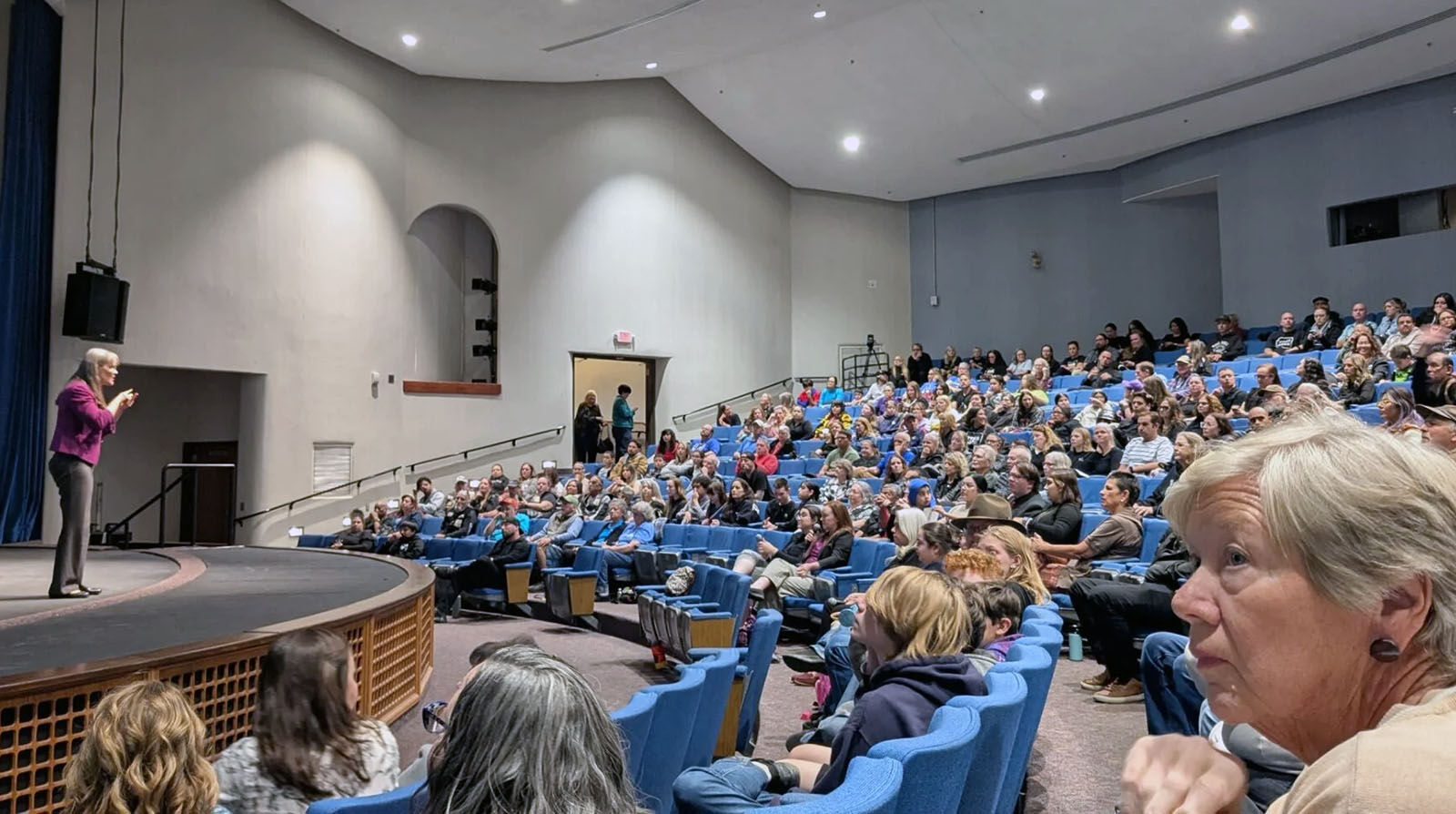
Annette Reichman, superintendent of Arizona State Schools for the Deaf and the Blind, gives a presentation to about 300 people at an emotional community meeting Monday night about the school's relocation and future.
From the brief Q&A and comments from parents about what they’ve heard, it appears that ASDB will offer a day program at the Copper Creek campus — but that some students will instead now attend “cluster sites” in local school districts, where they will be mainstreamed for much of the day without special visual or hearing resources. Until now, state-run ASDB has offered both a day program, for students who don't live on campus, and a residential program with dormitories at its West Speedway site for students from throughout the state.
The first question answered was about the “cluster sites,” which Reichman described as the school’s plan of finding a middle ground “between a campus program and itinerant services.” She discussed ASDB’s declining enrollment — it currently houses about 120 students on a campus built for 400 — and said enrollment is directly tied to funding, and that the school must realign its resources to better support students and staff.
“That led us to the idea of implementing cluster sites,” Reichman said. “For example, if we have a school district with five students — let’s say they’re deaf and hard of hearing students and there’s five of them — and they’re in high school,” she said, painting a scenario. “They typically each go to a separate school. Instead of them all being separated on different campuses, they will be coming to one high school and at that high school, there will be a special resource room for those five students to be able to go and receive additional supports from our teachers of the deaf. That resource room, students can be in up to 40% of their day. At least 60% must be in the mainstream setting.”
She said the special resource rooms will give deaf students the chance to socialize with their peers, to have social and emotional support and interact with their teachers, who will have expert content and knowledge in case they need it. It’s a partnership with the school districts, she said.
Asked how many of the teachers of visually impaired students will be at the cluster sites, Reichman said that will depend on the site and the area it’s in. In Tucson Unified School District, Reichman said they are planning for two resource rooms — one for middle school and one for high school, with two teachers in each site.
One of the questions was also if the students will have Braille transcription, a tactile writing system used by visually impaired people, on-site at the cluster sites. Reichman responded that all of the specialized instruction that is offered at ASDB will be offered in the resource rooms, including Braille instruction, assistive technology, specially designed instructions, and orientation and mobility services.
An audience member also asked if there will be classrooms for visually impaired children with additional disabilities at the cluster sites. Reichman said they are partnering with the school districts and providing additional supports for those students who have additional disabilities as per their IEPs (Individualized Education Programs, required by law for special needs students).
“We are doing this in collaboration with IEP teams, and with that process, any of the parents whose students are impacted are part of that IEP team and they will be in those meetings to have those conversations to ensure that the students’ needs are accurately identified and the services provided are addressing those needs,” Reichman said. “I can’t really make generalized statements about specific services or supports that are going to happen on the cluster site, because we have to start by having those IEP meetings to identify the services needed.”
Ron Sisco, parent to a hearing-impaired 5-year-old child who’s been educated at ASDB since the fall of 2024, said the parents first found out before Christmas that the school was going to cut transportation for students, and then, toward the end of the year, that the current campus will shut down and the Tucson branch will relocate. They didn’t consult parents about any of it, he said.
“All these things, we could’ve talked about before they made a decision, but from what I understand, they’ve already committed the money to this, which is ridiculous,” Sisco told the Star.
“On top of that, my child, and I know many others, have IEPs and they need to be provided transport to where they can get educated. That’s federal law and that’s a contract. I don’t think they can just decide, ‘Hey, we’re not going to follow the contract anymore,’” he continued. “I’m very sympathetic to the idea that they don’t have the funding, but the way they’re going about this, they’re even controlling the dialogue so much — they’re not just taking your questions, they want to make sure they can choose the questions.”
Sisco said his family lives in Santa Cruz County, nearly two hours from Oro Valley, and since he’s the only one in his family who drives, it will add an extra three hours onto his day to go there and back. He said there is another girl on the same transport as his son whose mother doesn’t speak any English and doesn’t drive, and he wonders how she will be able to advocate for her child.
“They didn’t do this as a community. They’re just handing it to us and they’re putting a happy face on it and saying, ‘Go talk to your representatives,’” Sisco said. “But that’s garbage. That’s not how community is supposed to work. We’re supposed to have some kind of conversation, some sort of dialogue and that’s not what’s happening.”
Maria Murphy, the director of government policy and relations for ASDB, told the Star after the meeting that the school has a relocation feedback form online where parents can ask questions and offer input. She said the responses they’d been getting on this form had helped to shape Reichman’s presentation Monday night, to address the most pressing questions parents were asking.
Murphy declined to answer the Star’s questions about which students will be moving to the Oro Valley campus. She said the individual IEP process for each of the “affected” students would decide their future course of action, and she couldn’t give any further information.
Drew Humphrey, CEO of Saguaro City Music Theatre, which uses a building on the current ASDB campus for performances, was also present at the Monday meeting along with about 65 members, parents and children, of his organization. It felt like an abrupt ending, he said.
“I know myself, it was very emotional sitting in that space, seeing all the people that are impacted by this unfortunate decision,” Humphrey told the Star after the meeting. “I really felt for the emotional turmoil that they (parents and students) were going through and how they needed some questions answered.”
He said while the case laid out by Reichman was very clear and he felt they were trying to be as open and transparent as possible, the one question he kept hearing from the audience was if their kids were going to be served at the relocated Oro Valley campus, and he didn’t think that question was answered. He said he hoped they will prioritize providing the answer to that.
Matthew Maynes, parent to a 14-year-old visually impaired and autistic freshman, told the Star after the meeting that it was “absolutely ridiculous.” He said as parents, they came to find out what’s going to happen for their children, but were left with more questions than answers.
He said while ASDB hasn’t publicly announced this, a teacher there who was let go during layoffs there last week said the visually impaired students will have a choice between being homeschooled or attending a cluster site in TUSD. He said he and a lot of the other parents of visually impaired kids would be happier if they were moved to the ASDB Copper Creek campus.
Maynes said he fears his son might get bullied in a public school with other kids who aren’t differently abled, and that he feels for him since he already has it hard enough as it is.
“They’re not going to feel like it’s their school, they’re going to feel out of place, they’re going to feel like outcasts there,” said Maynes, getting emotional and adding that his son is at a critical time in his education and has been at ASDB since the third grade. He said they love ASDB and the teachers there.
“My son plays the piano. He has blossomed into this beautiful, beautiful soul that is loved by a lot of the peers here. My son is known by everybody at the school because he’s a performer and he puts himself out there. And for them just to take it all away from him sucks.”

