

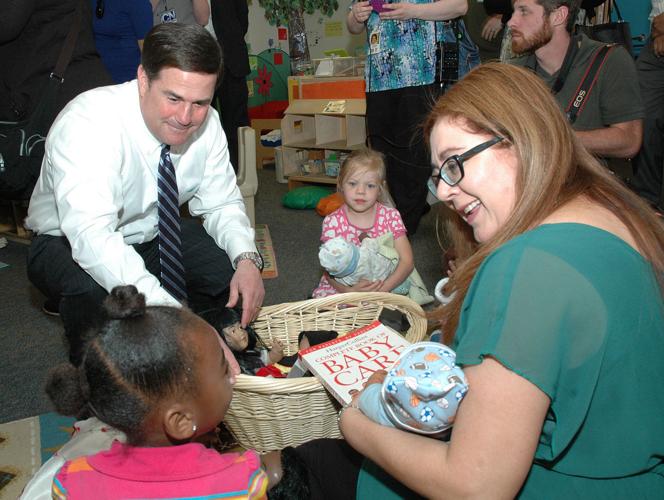
PHOENIX — Gov. Doug Ducey touted the importance of early-childhood development Tuesday but then defended the fact Arizona puts no money into those programs for most students — or even funds full-day kindergarten.
And the governor even refused to commit to backing congressional reauthorization of a federal law that has given some money for preschool programs in Arizona.
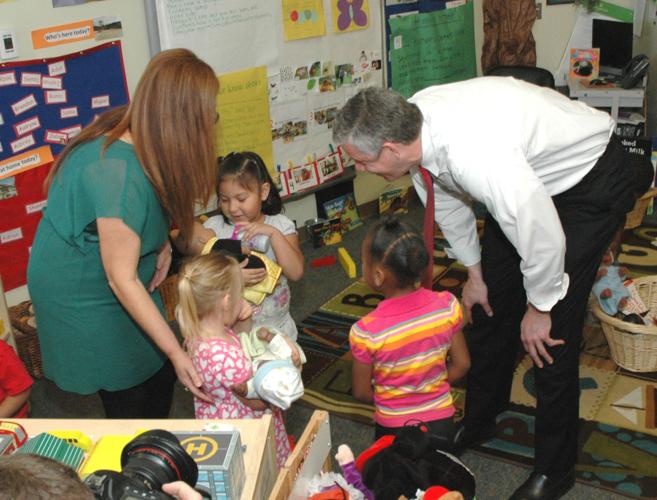
The comments came as U.S. Education Secretary Arne Duncan came to Arizona, at least in part to push for extension of the law, briefly touring a preschool class at Martin Luther King Elementary School in Phoenix.
“The challenge that all the educators here will tell you is that the average child in this country who comes from a disadvantaged community enters kindergarten at 5 (are) 12 to 14 months behind if they don’t have access to high-quality early learning,” he said. Duncan said there is a high “return on investment” in funds spent on such programs.
Ducey touched on the same point in his own comments.
“Research shows that a quality early childhood education experience can yield significant long-term benefits on overall development of a child,” he said. And Ducey made a particular point about children being able to read.
“It’s the most profitable investment we can make in their future,” the governor said.
But Ducey, in questions after his comments, said that does not mean Arizona intends to put some money towards such programs.
“We know that there’s a good return on investment,” he said. But Ducey said people need to recognize the state’s financial condition.
Even with that, he claimed that more money is being spent now on K-12 education than any time in the past. But that figure is true only when including what local taxpayers raised as well as federal dollars. State aid to education was close to $500 million higher in 2008.
“The state of Arizona of course can do better,” Ducey said. But, the governor acknowledged, he’s busy trying to refocus attention away from the dollars spent.
“I’ve tried to change the discussion from the level of spending to the results we’re receiving from the spending,” Ducey said. He also suggested there might be more money available if the more than 200 school districts might be consolidated.
“I believe there’s money in overhead, administration and bureaucracy that I would rather see inside schools like this,” the governor said.
Then there’s the question of the Elementary and Secondary Education Act. Duncan said the law not only needs to be renewed but also expanded.
He said 59 percent of the 4.1 million 4-year-olds in the country are not enrolled in any sort of publicly funded program.
In Arizona, the figure is 81 percent of the nearly 93,000 4-year-olds.
And even that is misleadingly low: More than half of youngsters in preschool are in federally funded Head Start programs.
Gubernatorial press aide Daniel Scarpinato said the only state funding that goes into preschool programs is for special-education students.
Ducey said he would not commit to backing renewal of the federal program — at least not the way it’s currently set up.
The governor said he’s all in favor of Arizona getting its share of the dollars that taxpayers here send to Washington.
“Somewhere, there must be some overhead because we don’t seem to be able to access the funds that we would like to or have the flexibility around them,” he said. Ducey said he would prefer block grants, where Arizona gets the dollars, without strings attached, “to give us the flexibility to invest in what we believe are programs that work, like early childhood literacy.”
Arizona began funding full-day kindergarten in 2006 when then-Gov. Janet Napolitano, a Democrat, cut a deal with the Republican-controlled Legislature. In exchange, she agreed to a permanent 10 percent cut in individual income taxes.
Since that time the state’s finances have tanked and lawmakers cut funding back to only half-day programs. School districts, however, remain free to offer full-day programs either using local dollars or with fees on parents.

