

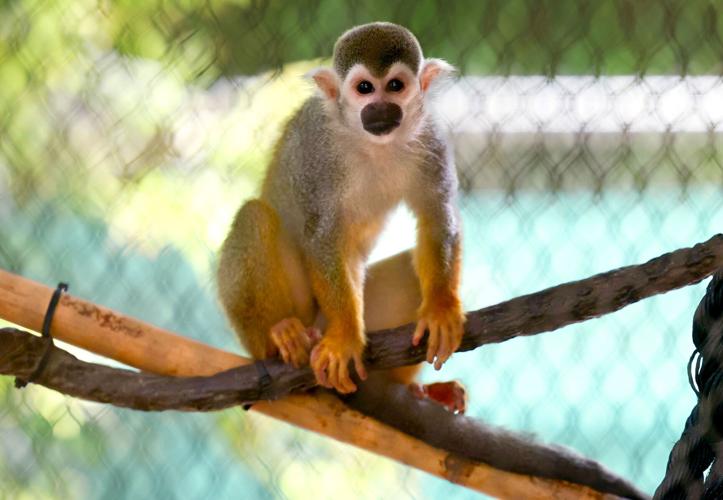


Toto, a tiny squirrel monkey residing at Reid Park Zoo, is slowly adjusting to life with his new troop.
He’s had to learn to be a regular monkey, after being rescued as a victim of wildlife trafficking a little over two years ago.
He was confiscated by Border Patrol agents when his captors attempted to take him into Mexico for sale in the pet trade and was eventually brought to the zoo in Tucson.

Toto the squirrel monkey runs around his enclosure at Reid Park Zoo.
Unfortunately, Toto is just one of thousands of animals that fall victim to wildlife trafficking each year. To raise awareness of the problem, Reid Park Zoo and Tucson International Airport are now teaming up to bring the Association of Zoos and Aquariums’ “I Travel for Wildlife” campaign to Tucson.
The campaign aims to educate the public on wildlife trafficking and the sale of wildlife products that are contributing to the depletion of wildlife populations around the world, and to reduce the demand for illegal wildlife products.
“From ivory figurines to pangolin products to live birds, endangered wildlife species are for sale around the world as products and as live animals,” Dan Ashe, president and CEO of the Association of Zoos and Aquariums, said in a written statement. “Just because something is for sale does not mean it is legal or ethical to purchase. Consumers hold the key to ending wildlife trafficking and this exhibit allows us to educate travelers while they wait for their flights.”
Tucson International is the fifth airport to join the campaign. New, informational displays have been installed around the terminals, featuring QR codes that direct travelers to information on how to make informed choices in the souvenirs they buy, why they should avoid purchasing exotic animals as pets, and resources to report wildlife trafficking.

New visual displays have been installed at Tucson International Airport to raise awareness of wildlife trafficking. The informational signs were created by The Wildlife Trafficking Alliance.
“The illegal trade of animals and plants is a significant global issue, posing threats to biodiversity, livelihoods, and public health, and all too often, airports are at the center of this issue,” Tucson Airport Authority President and CEO Danette Bewley said in a news release.
“We are committed to being stewards of change and awareness and are honored to be partnering with Reid Park Zoo on this initiative.”
According to the Wildlife Conservation Society, the yearly profits from wildlife trafficking are estimated to be between $7.8 billion and $10 billion, and that number is growing.
“In the United States as a whole, the U.S. Fish and Wildlife Service — over five years — had over 800 cases that involved 50,000 animals, so it is very much a large concern here in our country,” said Jennifer Stoddard, Reid Park Zoo’s director of education and conservation.
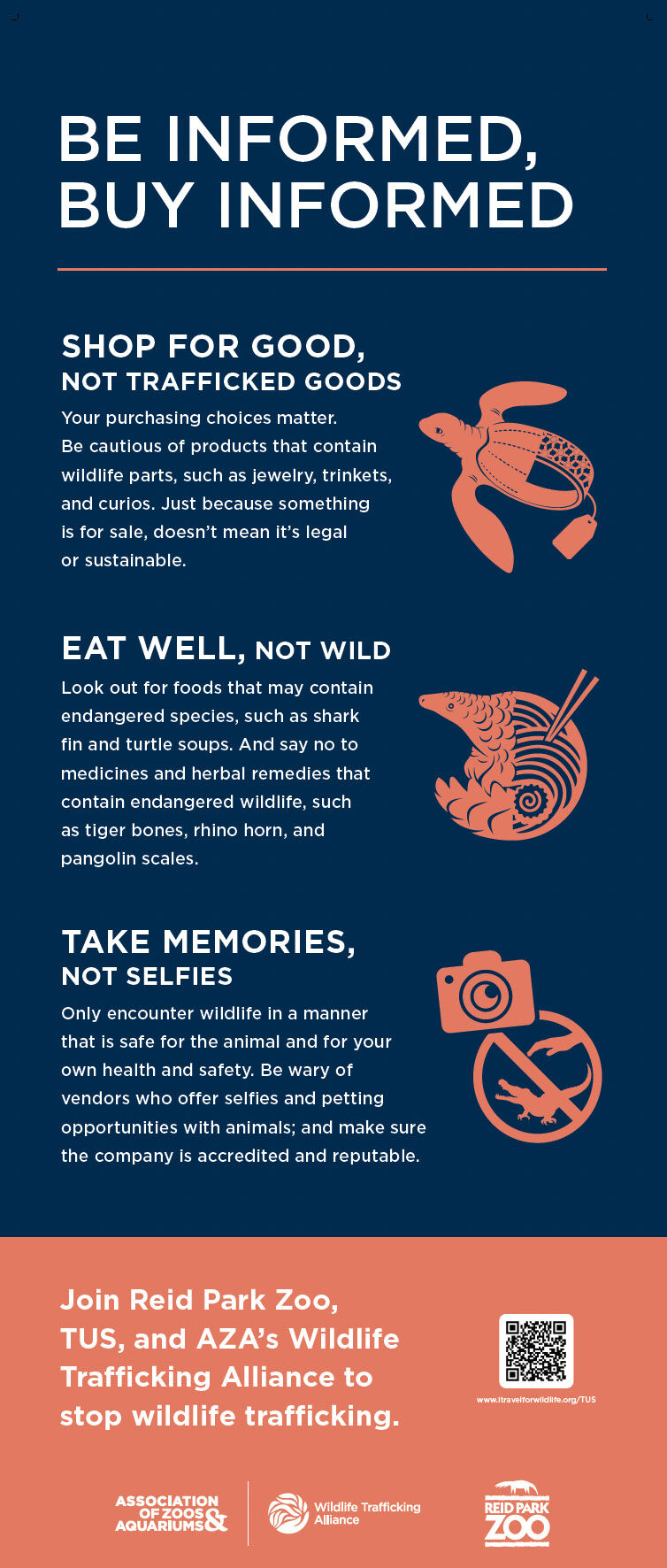
New visual displays, created by The Wildlife Trafficking Alliance, have been installed at Tucson International Airport.
For Toto, the journey to recovery has been a long one. Upon arrival at Reid Park Zoo, he required a number of dental surgeries and other medical treatments to restore him to health.
“He was malnourished,” said Adam Ramsey, director of animal care at Reid Park Zoo. “All of his canine teeth had been filed down,” a practice that is unfortunately common in monkeys like Toto that are sold into the illegal pet trade, he said.
“When he came here, we actually had to bring in a dental specialist and remove those teeth so he would be more comfortable,” Ramsey said.
On top of that, during his time in the pet trade, Toto lacked socialization with members of his own species, and according to Ramsey, he never learned many usual monkey behaviors.
“He really just didn’t know how to be a monkey,” Ramsey said. “It took us a very, very long time to get him acclimated to a troop and actually teach him those behaviors.”
Earlier this year, two juvenile squirrel monkeys — brothers Mango and Mateo — were brought to the Reid Park Zoo to teach Toto how to interact with other monkeys. Toto is beginning to thrive with his new troop, Ramsey said.
“They’re doing really well, and he’s learning to be a monkey. He watches them and mimics them, so he’s finally learning how to do those things,” Ramsey said.

Toto enjoys a snack inside his enclosure at Reid Park Zoo.
Wildlife trafficking comes in many forms, and can look very different from what people might assume, said Austin Wright, chief communications officer for the Tucson Airport Authority.
“It’s not just animals coming into our country, but also some of our native species, including some of our native Arizona species — such as our amazing reptile species, and even some of our plants and cactus — that are also being smuggled out of our country to other countries,” Wright said.
Some of the native Arizona species at risk of wildlife trafficking include Gila monsters for their skin, pronghorn for their antlers, and Sonoran Desert tortoises for their shells and their value in the pet trade.
“Southern Arizona is really unique in that we have 72 threatened, endangered or candidate species,” Wright said. “So we have a really unique climate for animals, where people may smuggle specific animals from our region, which is why it’s really important that Southern Arizona shares this message.”
“Toto’s story had a positive ending, but, sadly, many wild animals caught in wildlife trafficking are not faring well,” Stoddard said. “It’s important to be voices for wildlife who can’t speak for themselves and to work toward a more sustainable world where animals and humans can live together and thrive.”
For more information on the “I Travel for Wildlife” campaign and how you can help stop wildlife trafficking, visit itravelforwildlife.org.
Say hello to the newest (and feistiest!) member of the Reid Park Zoo family! Born July 8, this Grevy’s zebra foal is already chasing ducks, splashing in sprinklers, and keeping mom Anna on her toes. Video courtesy of Reid Park Zoo.

