


If you’ve ever sheltered in the shade of a large mesquite on a hot summer day, this new scientific discovery probably won’t surprise you much.
Dry desert cities like Tucson tend to benefit more from the localized cooling effects of shade trees than do other, wetter urban areas, according to a recently published, multi-year study led by the U.S. Geological Survey, the science arm of the Interior Department.
Researchers placed up to 100 sensors on trees in Baltimore, Denver, Las Vegas, Los Angeles, Miami, Phoenix, Portland and Tucson to collect hourly air temperatures over four summers starting in 2016.
They found that urban trees in cities do more to reduce the temperature of the surrounding air.
“All trees have a cooling effect, but trees in hot, dry areas can have a greater impact than in humid cities,” said USGS research ecologist Peter Ibsen, lead author of the new study, in a written statement. “Trees in areas like Las Vegas, Phoenix and Tucson are particularly effective at reducing heat.”
Such findings are encouraging — though not exactly surprising — to the city of Tucson’s top tree person: the woman in charge of carrying out Mayor Regina Romero’s pledge to plant 1 million trees in the city by 2030 to help mitigate the effects of climate change.
“It wasn’t a huge shock to me. I’ve been seeing versions of this (sort of research) over the past few years,” said Nicole Gillett, the city’s first-ever urban forestry program manager. “But it definitely reaffirms our position and what we’ve been working on.”
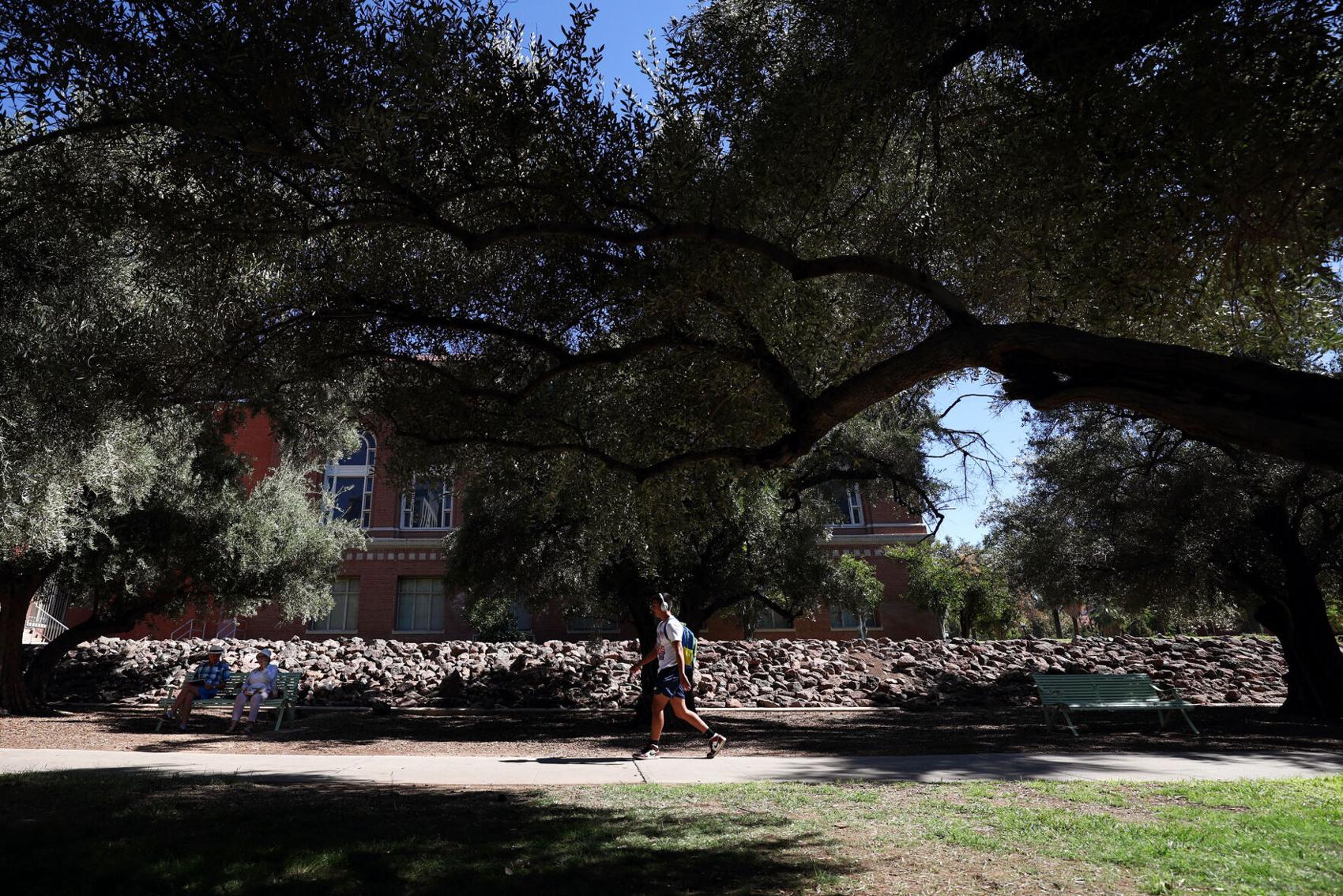
A passerby strolls along a shaded pathway on the University of Arizona campus. Dry desert cities like Tucson tend to benefit more from the localized cooling effects of shade trees than wetter urban areas, a new study led by the U.S. Geological Survey finds.
Gillett is just wrapping up her fourth year in a position that was created to help roll out the city’s climate action plan, of which Romero’s million-trees initiative is a sizable part. Since she assumed the role of urban forester on the day after the general election in November of 2020, about 120,000 new trees have been planted by the city and its nonprofit partner in the effort, Tucson Clean & Beautiful.
“That might sound like a drop in the million-trees bucket, but it was a huge ramp-up for us,” Gillett said.
She expects the pace of planting to accelerate in the coming years, now that much of what she called the “unsexy” infrastructure and planning work has been done to get Tucson Million Trees up and running.
For the initiative to be successful, the trees have to be thoughtfully placed and tended so they will survive to maturity. “It’s one thing to plop a poor tree in the ground; it’s another thing to take care of it,” Gillett said.
Strong headwinds
The program suffered a setback in July, when a series of unusually powerful monsoon storms swept through Tucson, uprooting some trees and seriously damaging others.
“We were hit very hard this storm season,” Gillett said, though she couldn’t provide an estimate for how many of the 120,000 trees planted to date might have been lost.
Most of the damage she saw involved large, mature, non-native trees planted 50 years ago or more, she said, when the community’s landscaping “palette” was much different. Arborists and urban foresters in desert cities like Tucson have learned a lot since then about what to plant and how to plant it, Gillett said.
Still, losing large older trees like that certainly dealt a blow to the community’s “canopy as a whole,” she said.
The USGS study noted that such a tree canopy served to mitigate heat in all study cities, but irrigation is crucial for maintaining those cooling benefits, especially in arid desert communities where extreme heat events can be more severe and water resources more limited.
Gillett agreed.
“Landscape and water are not two separate problems,” she said. “They’re all connected.”
Researchers also found that hot, dry conditions can cut both ways. In Tucson and other desert cities, the warming effects of buildings — also known as the “heat-island effect” — was more pronounced than in humid places like Baltimore, Miami and Portland.
Flat surfaces, meanwhile, produced more consistent temperature changes across the eight cities included in the study. Grass seemed to cool the air and pavement seemed to heat it to roughly the same extent, regardless of whether underlying conditions were humid or dry.
Powerful results
Ibsen and company published their findings in the Oct. 15 edition of the journal “Sustainable Cities and Society.” Co-authors include Lucila Corro, Kenneth Bagstad and Jay Diffendorfer from the USGS Geosciences and Environmental Change Science Center in Lakewood, Colorado, Benjamin Crawford from the University of Colorado-Denver, Brandon McNellis from the U.S. Forest Service’s Institute of Pacific Islands Forestry in Hilo, Hawaii, and George Jenerette from the University of California-Riverside.
Tucson Electric Power is already citing the new research in promotions for its discount shade-tree program.
Since 1992, the utility has distributed more than 178,000 discounted trees to homeowners and businesses to provide shade for buildings and improve their energy efficiency.
“Planting shade trees around your home, especially on the south and west sides, reduces heat gain, so your air conditioning doesn’t have to work as hard,” said Edith Garcia, a senior program manager for TEP. “That translates to a more comfortable home and a lower energy bill in the warmer months.”
Those same trees can act as a windbreak in the winter, keeping your home warmer and your heating bills lower, Garcia said.
According to the U.S. Department of Energy, such well-planned landscaping can reduce a home’s air-conditioning costs by as much as 50%.
TEP’s Trees For You program allows residential customers to buy two two-gallon trees for $5 each from a list of available varieties.
Gillett said efforts like that should help city officials reach their ambitious goal of adding a million trees to Tucson’s urban forest over the next five years.
Having some fresh research on their side, courtesy of the USGS, certainly won’t hurt, either.
“It’s always helpful to learn that what you’re doing is definitively backed by science,” Gillett said.

