



A potential funding cut by the city for a county-run early education program to assist low-income families has prompted worry among advocates.
Tucson City Manager Tim Thomure presented his fiscal year 2025-2026 recommended budget to the council last month. It included a recommendation that the city cut its funding for the Pima Early Education Program Scholarships, more commonly known as PEEPs.
Created in 2021, the program collaborates with existing state and federal programs to help children from low-income families attend high-quality preschool across Pima County.
The program funds access via three avenues: First Things First offers scholarships for low-income children to attend high-quality preschools enrolled in the agency’s “Quality First” program; school districts offer high-quality preschool to additional children; and Head Start preschool programs offer extended day programs at its locations in Pima County.
In its most recent public report, PEEPs said it currently serves more than 1,400 children across the entire program. And to-date, PEEPs has been able to serve about 4,100 children across 34 classrooms in six different school districts, said Nicole Scott, PEEPs program manager. High-quality care for preschool-age students cost about $12,600 per scholarship, she said.
Tassi Call, associate superintendent for elementary education at Amphitheater Public School District, says that she hears from parents of PEEPs children, who say the program has enabled them to work, changing the trajectory of family finances.
“Our families, they’re working, but they’re working when they’re supposed to be home with their kids ... It’s life-changing for families, because on the weekends, usually when kids are home, (the spouses) switch and one goes to work and one stays home. Now they’re home together as a family unit,” she said. “It’s funny, our first year, when the kids came from preschool to kindergarten, the teachers were just so amazed at what the kids knew.
“What it’s really done for the community, with PEEPs, is our families who have money have always taken their children to preschool, and now our families who don’t have unlimited access to finances are able to have the same activities and the same resources for their children,” Call said. “It’s provided equity for all kids and leveled the playing field, so everybody goes to school at the same level.”
The city’s $750,000 in PEEPs funding covers three Amphi classrooms and two more in the Sunnyside School District, Scott said.
Scott said the city funding represents about 6% of the cost to run the program.
“That doesn’t seem like a lot. However, (if it’s cut), that’s almost 100 children that won’t be able to be in those high-quality preschool environments,” Scott said. “If you think about it, that’s 100 parents that may have to reduce hours at work, or may not be able to work at all, or even may not be able to afford the cost of care.”
“If the city (cuts) funding, even if they (reduce) funding, it’ll be detrimental to the work that we’ve done these last four years in building the system up as a whole,” she said.
The return on investment into early childhood education “is a long-game, but it’s a winning game,” said Kelly Griffith, executive director of the Economic Center for Integrity, a Tucson-based nonprofit focused on research, public policy, education, outreach and advocacy work.

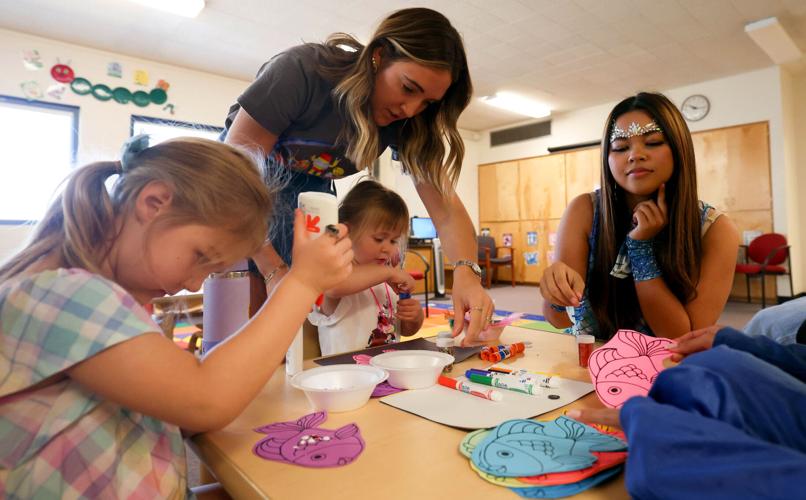
Kira Carpio, right, volunteers alongside other Ironwood High School students during a signup event Saturday for PEEPs Saturday at at Keeling Elementary. The early-education program helps children from low-income families in Pima County attend high-quality preschool.
“All the research in the data points to that ... It’s a little bit like saying we don’t particularly need to do more research on the fact that we know that smoking causes cancer, because the research is already there,” she said.
Each PEEPs classroom within Amphi is capped at 18 children. Each has a certified teacher, the majority of which have a master’s degree, along with an instructional aid and a caregiver, said Tiffany Bucciarelli-Fay, director of early childhood education for the district. Additionally, the district offers paid internship opportunities to high school students, so sometimes PEEPs classes have a handful of high schoolers helping kids and the teachers.
“We prevent neglect and unfed children because we feed them, we make sure they’re educationally prepared ... there’s a real big business side for the business community that is impacted by early childhood education. Better schools, better community, less crime, less poverty, spending less money on social services,” she said, referencing a recent opinion piece by Tucson Police Chief Chad Kasmar, who called early childhood education “a critical strategy for crime prevention.
“The dominoes that early childhood education affects is amazing ... We’re talking about generational change, not just this generation, but their children’s generation (and) their grandkid’s generation.”
But like the program’s benefits, funding cuts would not only impact those in-and-around the program now, but long into the future, Bucciarelli-Fay said. She likened it to dropping a rock in a lake and not paying attention to the ripples.
“We will not be able to have these schools and we will have to cut the program ... If I don’t have this funding, I will have to eliminate jobs and eliminate program. It’s as simple as that,” she said.
“It’s like, do you want to build prisons, or do you want to build preschools? ... Do you want to be proactive with your money, or do you want to be reactive with your money?” Bucciarelli-Fay said, referencing a 2013 opinion from New York Times columnist Nicholas Kristof.

Edie Lantz Leppert, director of adult language and literacy programs at Literacy Connects, hands out free books and flyers during a PEEPs signup event Saturday.
Elizabeth Moreno has been teaching second grade at Amphi’s Nash Elementary for two years. Her and her son Max, 3, went to an Amphitheater event at Keeling Elementary Saturday to enroll him into the PEEPs program at Nash.
“Putting him into preschool is not a light decision because my husband right now is the one that’s home with him, and we (wanted to) feel comfortable with the people they’re we’re sending him to,” Moreno said. “The other part is, we’d like my husband to be able to go back to work a little bit more than part time ... And Max also wants (more) friends. He wants to be around other kids,” she said.
If the city were to cut its PEEPs funding, the program at Nash wouldn’t be affected, Bucciarelli-Fay said. But if funding was cut, Moreno says parents and teachers would still be affected.
“Instead of taking away funding for parents, make it so they can feel confident and they don’t have to be scrimping and saving every little piece of money that they get,” she said. “(PEEPs) is a way for schools and education to be more accessible for underserved communities like this, it helps so that families are able to get more resources.”
Residents have already made their support known, according to the city’s budget survey for this fiscal year, in which nearly 52% of respondents prioritized funding early education.
City Councilman Kevin Dahl said during the the April 22 meeting that PEEPs-funded classrooms are where low-income families have found a place to do the “generational jump.” He said he’d like the city to keep its commitment.
“These spaces are valuable in helping children recognize and manage emotions, recognize and solve social problems, and learn how to be friends,” Dahl said Friday in his weekly newsletter. “Having a safe, stimulating, consistent place to leave your child every day alleviates so much stress for working parents.”
Supporters are making their voices heard, and intend to during the City Council’s Tuesday meeting, said Griffith, of the Center for Economic Integrity.
Griffith called PEEPs “the most positive and beneficial thing that has come down the pike in ages.”
“If you’re talking about classrooms at Amphi being eliminated, and they are because the city’s not going to pay, then I’m guessing the folks at Amphi are going to be pretty mobilized,” Griffith said.

