

PHOENIX — Saying electric customers paid too much for years, two Republican lawmakers have a plan to pay it back — sort of — over the next 20 years.
But the $2.3 billion that Reps. David Marshall of Snowflake and Ralph Heap of Mesa say is the overcharge figure would not come from the utilities that collected the money. Instead, it would come out of the money the state would otherwise collect in sales taxes on customer bills.
And that would cut state revenues by more than $687 million.
Heap defended the plan.
"We want to do things to help the ratepayers,'' he told Capitol Media Services.
"I think that's one of the chief responsibilities of the corporation commissioners,'' Heap continued, saying ratepayers "have had little defense over the past couple of years.''
But there's a political component. Marshall and Heap are running this year to be the GOP nominees for the two seats up for grabs on the five-member Arizona Corporation Commission, which is responsible for setting utility rates. Recruited by Sen. Jake Hoffman, the chair of the Arizona Freedom Caucus, they are trying to oust incumbents Kevin Thompson and Nick Myers, also Republicans.
Rules that were adopted two decades ago are central to the claim of overcharge. They set targets for utilities to get 15% of their power from renewable sources by 2025.
There were also separate requirements for utilities to meet energy efficiency standards.
More recently, the current commissioners — including Thompson and Myers — voted to scrap the standards, noting that most utilities already had met them.
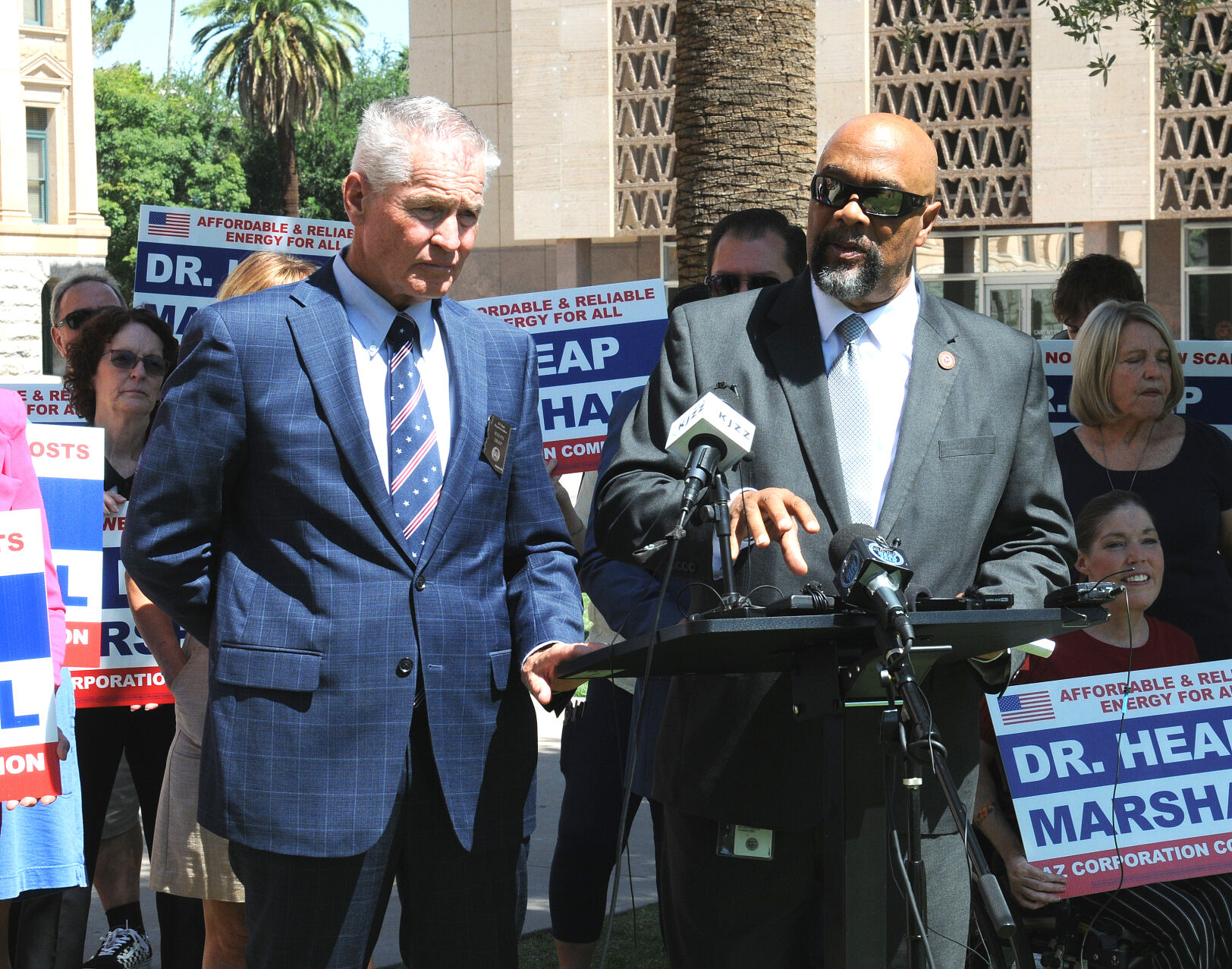
Republican state Reps. Ralph Heap, left, and David Marshall last year announcing they are running for Arizona Corporation Commission.
By that time, commissioners said the surcharges utilities were allowed to collect to meet the renewable energy standards had reached $2.3 billion. That is the money that House Bill 2269, proposed by Marshall and Heap, seeks to recover for consumers.
The method they have chosen is to eliminate the state sales tax paid by customers — added automatically to their utility bills — until they say the $2.3 billion has been "paid back to Arizona residents,'' or the end of 2046, whichever occurs first.
But it wouldn't be a refund — and not just because the $2.3 billion would not come from the utilities that actually collected it.
Many of the customers who paid the extra money utilities were allowed to collect are no longer here. Instead, the beneficiaries would be current and future customers.
"While we're unsure of any legal way to get ratepayers' money back, there are things we can do to help reduce costs today,'' Marshall said in a prepared statement. "In my opinion, the next best thing we can do is to provide justice by eliminating taxes on electric and gas going forward.''
Here, too, there's a political element.
Heap blames Kris Mayes, currently the Democratic attorney general and up for reelection this year, for the extra charges. Mayes, then a Republican, served on the commission and helped create the renewable energy and energy efficiency standards.
"Kris Mayes catered to outside special interests and adopted expensive renewable energy surcharges that cost ratepayers more than $2.3 billion over the last 20 years,'' Heap said. He said that created a "special interest slush fund (which) also led to foreign-owned boondoggles like the Solana Generating Station.''
The plant, built by a Spanish company and opened in 2014, was designed to use sunlight to heat molten salt to provide electricity for several hours after sunset. While still online and providing power to Arizona Public Service, it was beset with problems, including not producing the power promised, as well as various air quality violations.
Eliminating the sales tax could prove politically difficult: In the most recent fiscal year, utilities generated more than $687 million, according to the Arizona Department of Revenue.
That point did not go unnoticed by Mayes.
In a statement of her own, the attorney general pointed out she is interceding in current rate hike requests by both Arizona Public Service and Tucson Electric Power that she said "would squeeze hundreds more out of Arizona families."
"Reps. Marshall and Heap are pushing a bill that would blow a hole in the state budget,'' Mayes said. "That's not relief, it's a scam.''
Mayes defended the renewable energy standards, pointing out it was an all-Republican commission that approved them. She called them "common-sense energy policies that cut pollution and created tens of thousands of high-paying jobs.''
It may be the $687 million price tag, however, that is the biggest barrier to the new proposal.
Republican lawmakers are advancing a tax cut plan, one modeled after the "Big Beautiful Bill'' approved last year by Congress. It has an annual price tag in the $440 million range.
But Marshall said eliminating the sales tax on utilities, regardless of what happened in the past, is good public policy.
"Taxing electric and gas utilities creates a perverse incentive for the government to support increased rate hikes,'' he said.
"If rates go up, the state gets more money,'' Marshall said in his statement. "That leads some to view rate increases as a source of potential funds for their liberal pet projects.''
But Marshall did not immediately respond to questions about that claim, particularly as rate increases are approved by the commission without legislative input.
The legislation he and Heap are proposing is set up so that when the sales tax exemption ended — either when the $2.3 billion was reached, or 2046 — the levy would return automatically. At that point, Marshall said it would be up to then-current lawmakers to decide whether to keep the exemption.

