


Pima County should consider downsizing or closing five libraries across the region — including its main branch downtown, a cost-saving report from the library system says.
The recommendations were included in a draft report and attached to an Aug. 16 memo Jan Lesher, the county administrator, sent to supervisors.
Several factors are contributing to these potential changes, according to the draft report: rising costs, maintenance needs and lower usage post-pandemic. But the biggest factor is a critical shortage of staff, the report says. It suggests the closures occur before the end of the year.

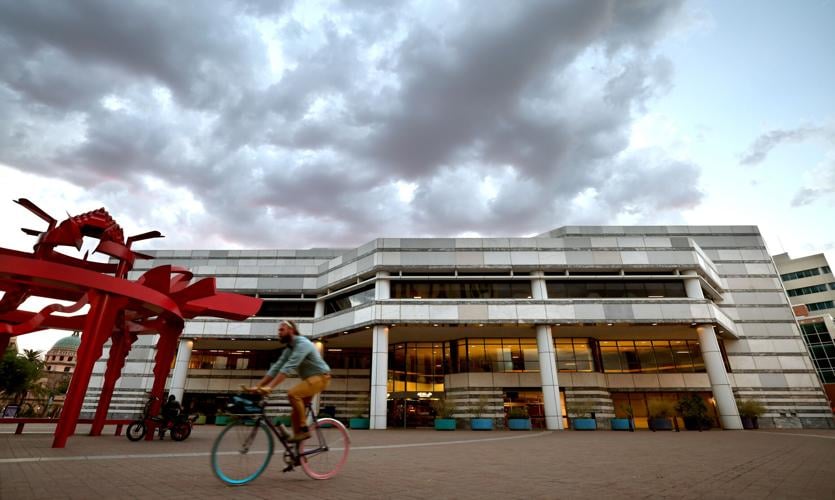
The Joel D. Valdez Main Library just before sunset on Thursday.
The draft report’s proposals will first be discussed at the library advisory board’s meeting on Thursday. The public can attend this meeting in person or online.
The recommendations — and their timelines — are nowhere near certain, county officials say, noting that supervisors will have final say before any closures, relocations or renovations occur.

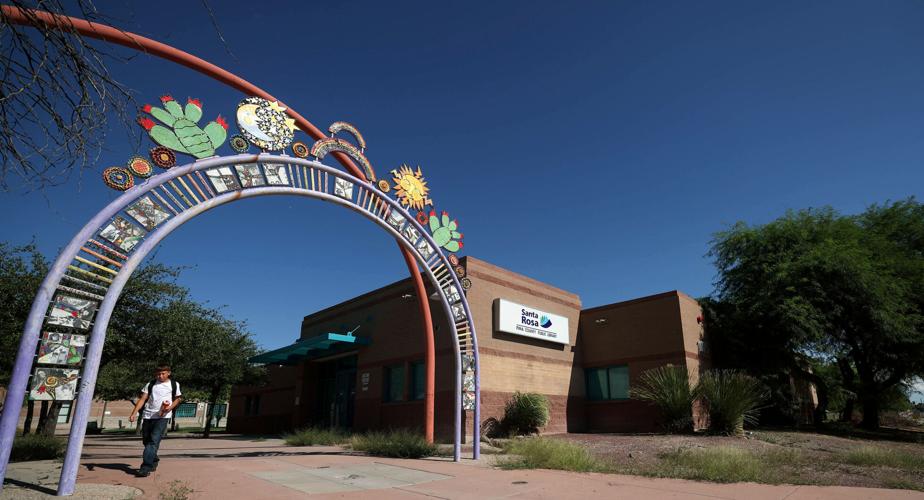
The Santa Rosa library is one of many Pima County libraries facing closure in the coming months, 1075 South 10th Avenue, Tucson, Ariz., Aug. 28, 2024.
“Any decisions about staffing or future libraries will go to the board for their decision making, and that’s not going to happen until 2025,” Lesher told the Star on Thursday. “What I look at is that, if this hasn’t even gone to the library advisory board until September, and it needs all the community outreach, feedback and work, I don’t know how we completely implement this before the end of the year.”
Lesher says the draft report marks the beginning of the conversation surrounding the future of the five libraries.
“We just don’t have enough input from the community to be able to make any decisions at this point,” she said of the suggested timeline to implement the closures before 2025.
No discussion between supervisors has been planned for the board’s meeting on Tuesday. Lesher said a presentation from the library system or the advisory council to the board could come as early as its Sept. 17 meeting or in October.
Supervisor Adelita Grijalva, the board chair, says significant public outreach at each of the five libraries, such as forums, will be necessary before she weighs in on any potential changes to the library system.
“Before I have a gut reaction, I want to get a lot more information, and also I’m not going to feel rushed to go make a decision,” she told the Star. “Some of the draft language says by the end of this year. If that’s something we’re not comfortable with (at) that point, then I don’t feel like we’ve done enough outreach to our community, then I’m going to advocate that we don’t do it.”
Grijalva said she will be advocating for public meetings at each of the five libraries ahead of any vote from the board “because we need to hear directly from our community.”
“I am the wife, sister and daughter of librarians. I am a strong advocate of our Pima County libraries because they fill a critical role in the lives of people in our community. I am understandably concerned about any possible reduction in access to necessary services for our constituents,” she said. “I believe that it is critically important to the patrons of each of these libraries discussed in this draft document to understand what these changes mean.”
Amber Mathewson, director of the county’s public library system, says that a community survey is set to go out in September. She says that the library system has hired a consultant to help form the survey, which will eventually be available both for online and in person in English and Spanish.
The library system is also planning to hold public forums on the recommended closures this fall, but a timeline for such discussions hasn’t been set, Mathewson said.
Mathewson told the Star that the proposed changes will hopefully allow for the library system to use its current staff and facilities more efficiently while not cutting back the services.
“We have significant numbers of people experiencing homelessness, people experiencing difficulties with drug addiction, and while these are not typically seen as things that libraries can solve, because we are public facing and we are one of the free places people can go, we spend time and resources in those areas,” Mathewson said. “It’s not that we want to stop doing that, but we want to be sure that we’re working well within other structures that are in the community, and not trying to supplant them, but just to make the best use of our facilities and be able to really stick with more of our core mission of providing access to information and supporting people’s learning needs and their informational needs, regarding job placement and things like that.”
Major renovations needed
Most significant of the proposals is downsizing the three-story Joel D. Valdez Main Library, a mainstay of downtown Tucson for over three decades. A single-story branch would be located elsewhere downtown, the report says.
The main library branch sits on city-leased property and “has extensive renovations needs.” The report estimates needed renovations would cost about $90 million. A new, smaller location in the area would cost about $20 million, the report estimates.
Renovations of the main library’s current building could ultimately occur, Mathewson said, but such a price tag means it would take years for the county to pay off.
“Any capital improvement program that comes into fruition has to go through what (the county) calls the Pay-As-You-Go method,” which would take years to complete, she said. “If we’re going to do a $90 million project, there may have to be some other mechanism. I know the county has not done any bond for a while, but that could potentially be one way to pay for it.”
If it’s decided to pursue renovation rather than relocation, Lesher echoed Mathewson’s thoughts about possibly going to voters to seek a bond or raising the library district tax rate to cover the expense.
But even if the main library were to move permanently, Lesher isn’t ruling out the possibility of the county still using the main library’s current building. It could be leased for a new use, including retail, she said. She added that the county could also look to use it for other departments that serve the public, although it is way too early to discuss specific options.
“I think that the draft report was the very beginning and the kickoff of some conversations ... from my perspective, (it) shouldn’t be read as the end of the conversation,” Lesher said. “Nothing is ruled out at this point.”
More closures considered
The draft report also recommends closing Dewhirst-Catalina Library − in Catalina − and replacing it with around-the-clock book lockers at nearby Catalina Neighborhood Park and Recreation Center.
Santa Rosa Library is also recommended to be closed. Visitors would still be able to access library materials at the nearby branches in South Tucson and the main library, which are both “less than 1.5 miles away” from Santa Rosa, the draft report says.
Southwest Library, near the Pascua Yaqui Reservation, would be temporarily closed for renovations after the Richard Elías-Mission Library is finished with its own upgrades, which is expected to reopen in the fall of next year.
Finally, the recommendation is to permanently close the Frank De La Cruz-El Pueblo Library, on the city’s south side, and replace it with a “Community Engagement Outreach Hub.”
Then no longer a public library, it would instead “absorb” many of the administrative and “specialized services” currently managed out of the main library, “such as Ask a Librarian, Book Bikes, and reference services,” and a multitude of other programs, the report says.
“While library buildings are very important to public spaces, there are a lot of people who are not coming into our libraries, and so we need to utilize our staff in ways where we can actually get out to where people are,” Mathewson said. “Outreach has been very critical to libraries throughout the decades, but right now, we’re having difficulty managing both of those things, having facilities open and getting out into the community, so (we’re) trying to be good stewards of all of our resources and balance those needs.”
Rising costs, lower usage
In all, the Pima County Public Library system is made up of 27 physical locations and its online library. About 20% of Pima County’s 1.4 million people have library cards, the draft report says, and about 57% of cardholders have used theirs within the last calendar year.
Supply chain issues and inflation “have contributed to much higher operation costs to run facilities, including higher costs for any capital improvements such as new or remodeled libraries,” according to the draft report. For example, the report says, “Books that cost $23 each as recently as 2014 can now cost up to $40 per copy.”
Rising costs haven’t only affected the library system’s physical locations, however. According to the draft report, it circulates about a 50-50 split between its physical and online libraries, but online materials are much more costly due to legal issues over “digital rights management,” according to the draft report.
The five libraries being considered for closure have also not recovered to pre-pandemic visitor levels. The downtown library, the draft report says, has a monthly visitor rate that “remains less than half of what it was pre-pandemic,” when comparing February 2024 to February 2020 numbers.
Catalina Library, according to the draft report, ranks 25th across the 27 libraries in terms of its visitor count. When it is used, it isn’t by county residents, according to the draft report, as over half of the customers come from outside Pima County, when “the next highest proportion of out of county cards is at the Oro Valley Branch Library at a rate of 3.45% and 20 library locations have rates under 1%.”
Southwest Library ranks 24th in terms of monthly users, El Pueblo ranks 18th, and while Santa Rosa Library is the ninth-most visited library in the system, it ranks last in physical circulation and “a significant portion” of its operational costs goes towards hiring daily security.
Major staffing shortage
Further, the county library system is facing a “Critical Staffing Shortage” as a result of various issues, the draft report says.
Over the past five years, the library system opened one new library and expanded two, bringing over 31,000 square feet of new library space. While library space expanded and the vacancy rate across all positions “has dropped considerably” in recent years, the number of staff within the public library system has not increased, according to the draft report.
The library system’s budget has increased in all but one of the last five county budgets approved by county supervisors. But the number of “full-time equivalent” positions funded in each of those budgets has decreased year-over-year. While its budget grew, the number of positions the library system has been able to fund has not.
Mathewson says this is primarily caused by rising costs of print-and-digital materials but also because of pay raises county employees received last year.
“(Because of) this last salary increase, which was much needed, we did have to relinquish 11 more positions, as well as some funding for our intermittent staff to provide for those salaries... that’s part of the story too,” she said. “Everything costs more. Digital materials cost more, print materials cost more now than they did in the past ... While we have fewer staff, we have about a 45% increase in the cost for staff than we did in 2019. So, our budget has increased, but our expenses have continued to increase as well.”
In total, the library system is budgeted for 65 fewer full-time employees this fiscal year than four years ago, according to the draft report. The library system also saw a net loss of 67 positions, full-time or not, from 2020 to now; that figure “alone equates to 5-6 fully operational libraries,” the draft report says. Across all locations, the library system has a deficit of 1,136 staffing hours.
Making these changes to the five libraries, in addition to the 26 hires made this year, would result in 62 staff members and approximately 1,260 service hours added back to the public library system, as well as a minimum of roughly $500,000 in budget savings, according to the draft report.
“What is incredibly evident after analysis of our staffing is that we cannot sustain high levels of service across all areas,” the draft report says. “However painful it may be, we cannot continue to support the full number of 27 library locations with our available staff.”
The top stories from Sunday's Home+Life section in the Arizona Daily Star

