


Immigration, mining and the war in Gaza were the issues that showed the widest difference between congressional hopefuls Adelita Grijalva and Daniel Butierez during a debate Tuesday evening.
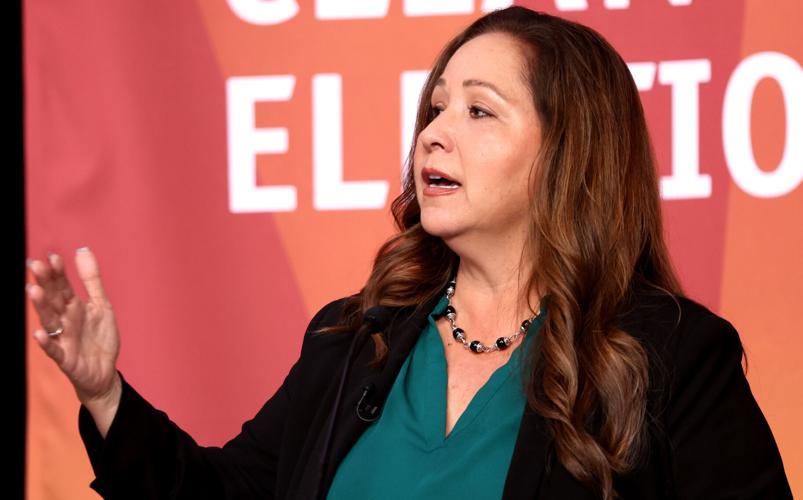
“Right now we have (Immigration and Customs Enforcement) that is using inhumane tactics of lying to people, misrepresenting themselves and targeting anyone that looks like me,” said Grijalva, a former Pima County Supervisor and the Democratic nominee in the Tucson-area congressional race.
“What I will fight for is comprehensive, humane immigration reform with a pathways to citizenship. We have people in our communities that have lived here for over two decades, and still do not have a pathway to citizenship. We have DACA recipients who do not have a pathway to citizenship,” she said. “And with this administration, the rules keep changing.”
Butierez, the Republican nominee, said the Trump administration’s tactics are not attacks on local communities, but are the result of actions that need to be taken.
“First off, the rules aren’t changing,” he said. “The laws are being enforced.”
“The ICE agents are doing what the law requires them to do, not what the administration is requiring them to do ... We’re asking for jobs and positions, to be makers of the law, not breakers of the law,” Butierez said.
“I believe we need immigration reform, we absolutely need to do that. And the gentleman that was in this seat prior to us spent the last two decades trying to do that. It didn’t work,” Butierez said. “It’s time for different leadership, different direction, and someone who who has built things, accomplished great things, to go in there and do that. That someone’s me.”
Butierez was referencing the long-term by Democrat Raúl Grijalva, who was elected 12 times to the House seat before he died in March at age 77.
Adelita Grijalva, Raúl Grijalva’s daughter, and Butierez both handily won their respective primary races in July.
The two differed on a wide range of topics, but also surprisingly aligned on several issues during Tuesday night’s debate in Tucson. It was the second post-primary debate leading up to the Sept. 23 general election to fill the Congressional District 7 seat, a Democratic stronghold for more than 20 years.
The winner will serve through 2026. Early voting begins Wednesday.
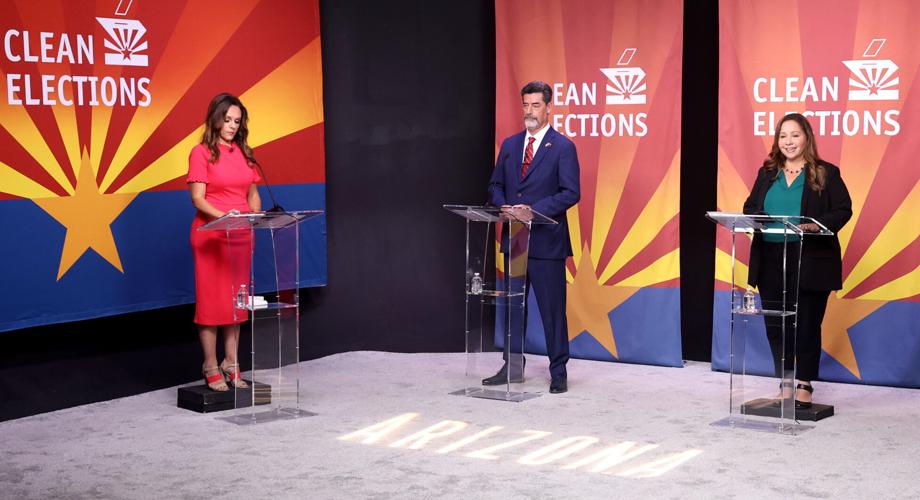
The debate, moderated by Nohelani Graf, was held in the Arizona Public Media studio in Tucson.
A bulk of Tuesday night was dedicated to the topic of immigration, from local programs and the environmental effects of border infrastructure, to drug trafficking and the opioid epidemic.
Since promising mass deportations in his second term, President Trump’s administration has pushed to make that promise a reality. This summer, Congress pushed through the Big Beautiful Bill, which, among other areas, provides billions for the U.S.-Mexico border wall and boosts immigration enforcement funding by nearly ten times.
Butierez said illegal immigration is “costing us trillions of dollars.”
He said Pima County spent $50 million to $60 million on asylum shelters, “and now, they’re in a spot now where they don’t have any money to run our city.”
“The busses are all paid for, and they want to increase our taxes,” he said
Grijalva said Butierez’s comment was “a conflation of a lot of different issues.” Shelters for asylum seekers were paid for with federal funds, not local tax dollars. Further, Grijalva said, free bus fares here is a city matter.

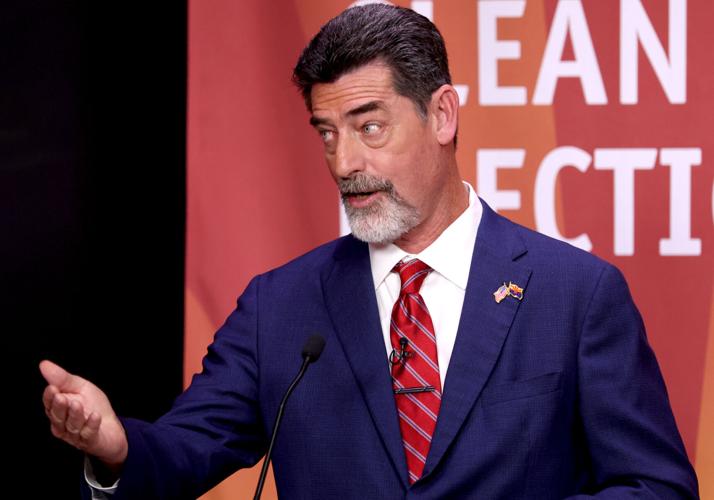
ICE needs to “get all those who came here during the last four years” and prioritize deporting them, while delaying the deportation of “those that came in here the right way,” Republic Daniel Butierez said in a debate Tuesday night for the open congressional District 7 seat.
Butierez said he would push for the completion of the border wall. He said that ICE needs to “get all those who came here during the last four years” and prioritize deporting them, while delaying the deportation of “those that came in here the right way” and move them “to the back of the bus, per say.”
Grijalva said, when it comes to the physical infrastructure around the border, environmental impact studies are needed prior to any building and that new infrastructure should not create barriers for tribal lands that cross into Mexico.
Cracking down at the border will also limit drug trafficking, Butierez said. Grijalva countered that a focus on limiting the customers on this side of the border through prevention and substance abuse programs is needed.
Foreign policy: Israel and Ukraine
The topic of foreign policy, and U.S. involvement in overseas conflicts, produced both some agreement — and stark contrast — between the two candidates.
Over the weekend, the Integrated Food Security Phase Classification, or IPC, announced there is an active famine in Gaza. It’s the first time the IPC has confirmed a famine in the Middle East, the Associated Press reported.
In the Middle East, a two-state solution of Israel and Palestine is necessary, Grijalva said, despite it not being a “perfect” option. She cited the United Nations’ famine designation and their reports that Israel is committing “genocide” in Gaza, she said.
“Our goal should be one of creating an opportunity for peace and a two-state solution, where humanitarian aid must be restored to the Gaza Strip and all hostages must be returned (to Israel) as well,” she said. “I think it’s important that we understand that there is a systematic attack on people.
“I just don’t understand how people … when you look at children who are starving, can sit back and say, ‘I’m not going to take a position,’” Grijalva said.

“Right now we have (Immigration and Customs Enforcement) that is using inhumane tactics of lying to people, misrepresenting themselves and targeting anyone that looks like me,” said Adelita Grijalva, the Democratic nominee for congressional District 7.
And while the U.S. has to combat the rise of islamophobia and antisemitism domestically, “we need to get away from this idea that if we’re critical of the Israeli government, that we’re antisemitic. The same way that I can condemn Hamas, I am supportive of the Palestinian people,” she said.
Butierez, however, says the U.S. needs to support Israel unequivocally, despite humanitarian concerns.
“I stand with Israel ... we’ve tried diplomacy, Israel has tried diplomacy. As long as Hamas is in there, controlling that country, we’re not going to get anything accomplished,” he said. “Israel takes the food in, Hamas takes the food from the people ... I’m completely against war, but the only thing we can do there is back Israel.”
He said nothing else can happen: “You’re not going to get Hamas to the table, they’re not going to sit down.”
But Butierez did criticize Israel for their attack on Iran, despite accidentally saying first he didn’t believe that Israel should’ve attacked Hamas. He quickly backtracked.
Butierez has been consistent in his support of Israel. But he did say that his stance on the Ukraine-Russia War has changed over time.
“I was against sending (support to Ukraine), especially when they wouldn’t tell us where it was spent, I had a problem with that. But at this point in time, we’re too far into this,” he said. “Russia can’t continue on. We need to get in there and support them.”

Nohelani Graf, left, moderated a debate Tuesday night between Republican Daniel Butierez and Democrat Adelita Grijalva. Immigration was a big topic leading into next month’s special election for the open congressional District 7 seat.
He quickly clarified that he was referring to the Ukraine, not Russia, after being asked by moderator Nohelani Graf.
Grijalva, too, said support for Ukraine needs to continue. But the way the Trump administration has doled out that support needs to change, she said.
“Russia declared war on Ukraine. So when they did that, it made us all more unsafe,” she said. “That was another actual promise that Trump made, that there was going to be peace in Ukraine, day one. Well here we are, and the only acccomodations Trump has made is to offer aid in exchange for basically all the mineral resources that Ukraine has ... support is always conditional on ‘what do I get back?’”
“I believe that the United States has to stand in solidatory with Ukraine, provide them the humanitarian aid that’s necessary, and provide them the strategic support in order to push back on Russia,” Grijalva said.
Mining, water conservation
The candidates did not share as much common ground when it came to the topic of mining.
Butierez said that he would support mining at Oak Flat so long as there were safeguards in place and replacement of any damages to the land, “other than the mine itself,” he said.
Grijalva, in clear opposition, said it’s a sacred site that Apache Stronghold deserves to keep. Mines use incredible amounts of water, even more than what was projected for Project Blue, Grijalva said, the proposed data center project near Tucson that has enraged a large group of Tucsonans throughout the summer.
Project Blue was an area where both candidates had some common ground: Butierez and Grijalva both said Tuesday night, and have previously said, they were against the data center campus coming to Tucson.
But Grijalva took it a step further, when, after the debate, she said she “absolutely” would intervene at the federal level to try to stop the project, if it were to move forward again in Tucson.
Party politics and term limits
Those foreign policy topics are divisive not only across the aisle, but within the two parties represented on stage Tuesday night.
Congressional District 7, which stretches from Douglas west to Yuma and into parts of Pinal and Maricopa counties, is a Democratic stronghold by roughly a 2-1 margin.
There are about 262,060 registered voters in the district, according to the Pima County Recorder’s Office, and of those 110,467 registered Democrats, 54,276 Republicans and 92,741 independent voters.
Butierez said that 20 years ago the country was a more united front, until recently, where now “the parties have become so split within themselves that we’re fighting with each other, we’re fighting with our own parties.”
He said he never wanted to be a politician, but he got into this race to reunite the community, “so that we can sit down together with our relatives and have dinner” again. He said he feels confident in his ability to peel off Democratic voters and has even had Democrats knock on doors for his campaign.
Moderator Graf noted that Grijalva’s father was the first Congressman to call on former President Joe Biden to drop out of the 2024 presidential race, and that young voters are calling on generational change. Her question to Grijalva was a little different: whether or not Grijalva would support imposing term limits on members of Congress.
Grijalva, saying she would not support term limits, noted the obvious: that her father served in Congress for two decades and overall, over 50 years in elected offices at various levels.
“We have young voters who have never experienced a functioning democracy in their lifetime ... We have a generation that has been disillusioned by both parties, because they feel that nobody is speaking up for them,” she said. “I believe that every community deserves the right to elect their own representative. They get to decide who is the best speaker, for them.
“I don’t believe that has to do with age. I think it has to do with integrity, and values, and who is speaking truth to power for your community,” she said.

