

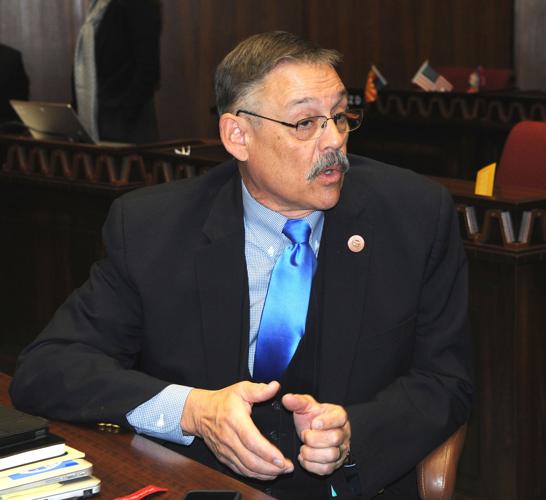
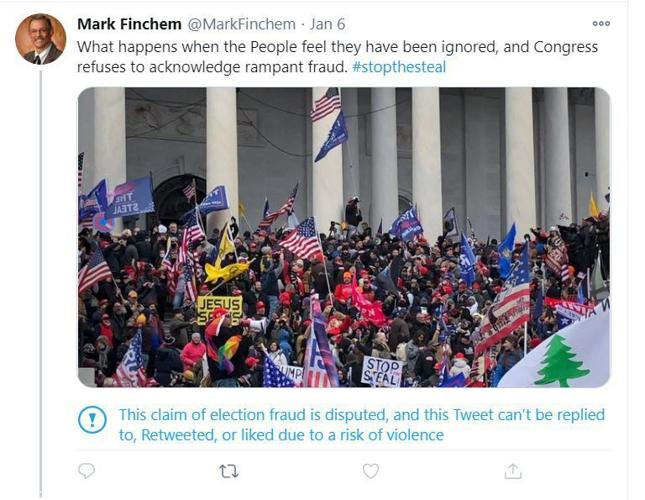


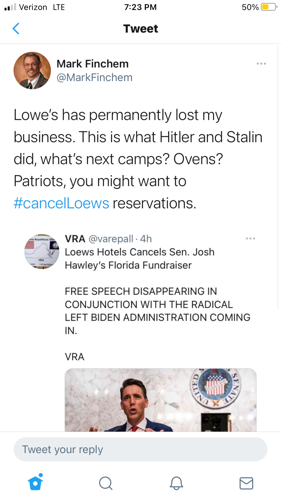

State Rep. Mark Finchem says he arrived at the U.S. Capitol about 1:45 p.m. on Jan. 6.
He says he left about a half-hour later.
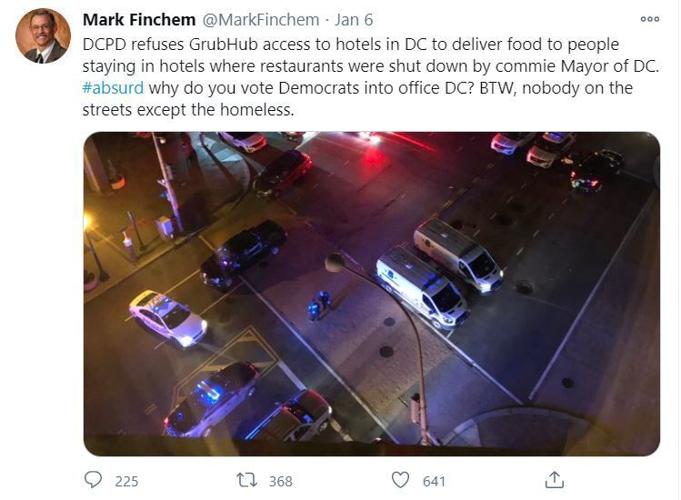
Violence began at the Capitol around 2 p.m., but somehow, Finchem says, he didn’t learn about it until 5 p.m.
What did Finchem do between 2:15 and 5 — the crucial hours when the Capitol was stormed, members of Congress fled for their lives, and deaths began, eventually amounting to five?
This is among many questions members of the Arizona Legislature ought to know the answer to as they consider their colleague’s future.
Rep. Cesar Chavez, a Phoenix Democrat, and dozens of residents of Legislative District 11 have filed complaints with the House Ethics Committee about Finchem, a fourth-term Oro Valley Republican.
But Rep. Becky Nutt, the Clifton Republican who chairs the committee, has given no indication she’ll ask the committee to deal with any of them.
Seeing the lack of action, Rep. Athena Salman, a Tempe Democrat, filed a resolution this week asking for the House to expel Finchem.
Most House Democrats co-sponsored the resolution, but no Republicans did, and it’s hard to believe many of them have the stomach for expelling Finchem based on this resolution alone.
“There’s been absolutely no action whatsoever that the (GOP) majority has taken to even investigate wrongdoing by the legislator, let alone hold him accountable,” Salman said in an interview Tuesday.
On Monday, she unveiled House Resolution 2006 arguing that enough evidence exists already to expel Finchem, a move established by the state Constitution.
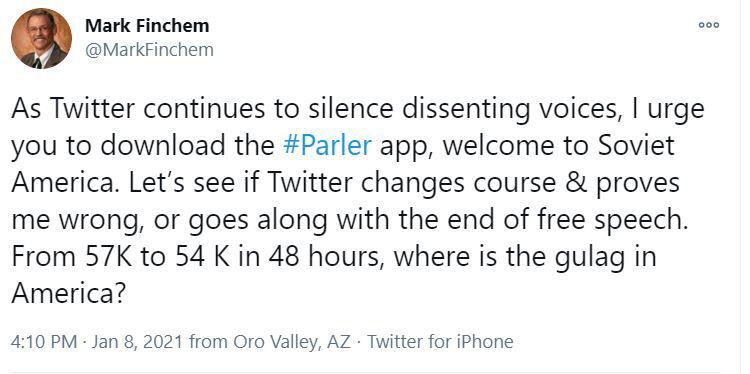
The argument, in short, is that Finchem violated his oath of office by inciting and attending the insurrection Jan. 6, feeding the fire by lying repeatedly that the election was stolen from Trump.
“We know that Mark Finchem has violated his oath of office, he has violated the Arizona state constitution and he has violated the constitution of the United States,” Salman said at an event Monday. “And we know he is unfit to serve in elected office.”
Maybe so, but there is so much we don’t know.
It just came out, for example, that Donald Trump’s reelection campaign paid Finchem $6,037 for what the campaign termed “Recount: legal consulting.”
Finchem is not an attorney, though he likes to style himself a “constitutional scholar.” He retired from the Kalamazoo, Michigan, public safety department and now works as a real estate agent.
Finchem told The Arizona Republic the payment was a reimbursement “for crowd control and security costs” at the public meeting he organized Nov. 30 at a downtown Phoenix hotel. That’s the one, attended by Rudy Giuliani and receiving a call-in from Trump, where Finchem tried to lay the groundwork for disenfranchising Arizonans by claiming “election fraud.”
What other money has been coming to Finchem and leaving his accounts is not totally clear. He paid more than $600 in campaign funds twice in December, on the 11th and the 18th, toward American Airlines. Perhaps those campaign donations were paying for his trip to D.C.
Several news organizations have also made public-records requests for emails, text messages and other communications to try to figure out exactly what Finchem has been doing since the election.
Finchem’s attorney denied that any messages sent on private devices were public records (a contention that has been ruled against in previous cases) and said Finchem’s constitutional rights supersede state law.
“Even if the records you seek are public records, which they are not, the threat of criminal prosecution gives rise to certain Constitutional rights that may overcome the duty to disclose otherwise public documents under Arizona’s public records law,” Alexander Kolodin said in a letter to news outlets.
Nutt, the chair of the ethics committee, has the power to get to the bottom of these questions. In fact, the Legislative District 14 representative is the best positioned of any legislator to get to the bottom of what exactly did.
I asked Andrew Wilder, the House Republican spokesman, about alternative paths to an investigation, perhaps motivated by Salman’s expulsion resolution, but he said the ethics committee is the only logical place for one to occur.
Tucson is well-represented on the committee: Nutt’s district reaches the southeast side of the metropolitan area, and Tucson Democratic Reps. Alma Hernandez and Domingo DeGrazia are also members.
But it’s Nutt alone who has the power. She can ignore the complaints against Finchem altogether if she wants. She has scheduled a hearing for Wednesday, Feb. 10, but the agenda shows it is only an organizing event.
What she should do, though, is hire an independent investigator to delve into Finchem’s actions. Few if any Republicans will be convinced by Salman’s arguments that Finchem has already earned expulsion.
But we don’t know what independent investigators will find and how that could change opinions.

