



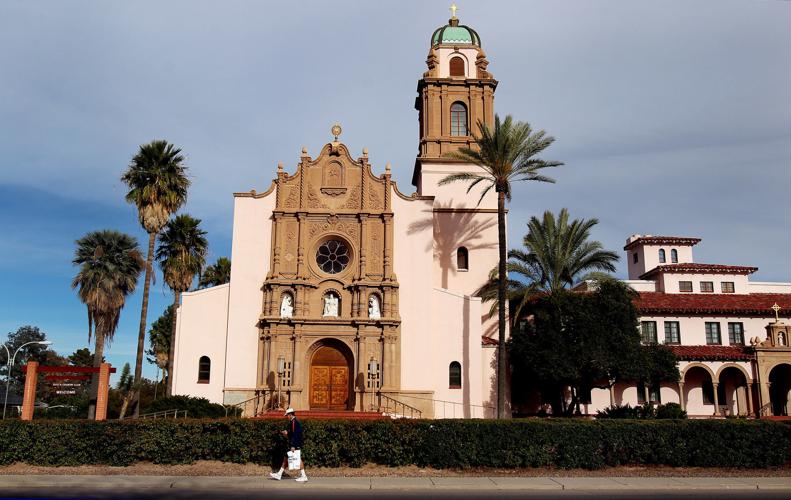

The future of the iconic Benedictine Monastery buildings on North Country Club Road may come down to leverage.
The neighbors have some leverage — they can protest the developer’s plan, cajole and convince him, and get their city councilman to intervene.
The new owner, Ross Rulney, has more leverage. The strongest lever he can pull, if he chose to use it: Threatening to tear down the historic monastery.
It’s his right — he owns the property and there is no legal restriction that would stop him. But of course, it would be a crime — not illegal, but a crime against Tucson’s history and identity. And that amounts to leverage, too.
Rulney, a local developer who was sold the property in part because he’s from here, is not making such a threat, even though people have accused him of it.
But the reason people are accusing him of it is that he isn’t making firm commitments about preservation, either, and that leaves an implied threat to the buildings in place. When I asked Rulney if he is committed to not tearing down any of the historic buildings, designed by famed local architect Roy Place and completed in 1940, he wrote in an email:
“The PAD (Planned Area Development) that we are seeking will likely include provisions designating and protecting the monastery as a Historic Landmark through City of Tucson’s Landmark Nomination Designation.”
By hiring renowned local architect Corky Poster, Rulney has shown a seeming commitment to preserve the historic buildings with care.
But it’s possible, he said when we spoke later, that he will not end up being the developer of the project — if it becomes student housing. So he wouldn’t make any irrevocable commitments on behalf of a possible future developer.
This tension is what makes the monastery redevelopment project such a high-stakes controversy. Councilman Steve Kozachik told me — and a neighbor confirmed this — that he told Rulney in an earlier meeting, “If you are the guy who demolishes that chapel and builds student housing, you will burn in hell.” Rulney said he has not heard such a remark from Kozachik, but I liked it.
Any local person who presides over the destruction of the monastery should be forced into exile in some purgatory like Phoenix or Las Vegas.
While some critics have rained hellfire on Rulney, it’s important to remember the Sisters of Perpetual Adoration who ran and maintained the monastery for decades did not legally protect the structures.
They could have pursued a historic landmark zoning designation from the city. They could have put a restriction on the deed requiring that any potential buyers preserve the buildings. But that would have significantly lowered the value of the property — sold to Rulney last year for $5.9 million.
In that sense, it’s not Rulney’s fault that the buildings remain in some, at least theoretical, danger. The nuns, whose care made the monastery the sanctuary it was for decades, left it unprotected.
So, change is inevitable on the property. It will never be the sanctuary it was.
And Rulney’s first choice was to build student housing there.
Yes, student housing, the scourge of midtown, in that sacred space. He explained when I asked him about an earlier comment to my colleague Gabriela Rico that this was considered the “highest and best use” of the property:
“Prior to the property being marketed for sale, the Sisters had the property appraised seeking a price consistent with the ‘highest and best use.’ This term is used to determine the highest economic benefit or value of a property. Student housing is an approved use as currently zoned and has been determined to generate the highest economic return.”
Neighbors in the Miramonte neighborhood appealed to Rulney not to put student housing on the site, and he and Poster came up with a plan to put luxury apartments there instead. But the tradeoff is they would be around seven stories high, much taller than the surrounding neighborhood of one- and two-story homes.
“Luxury multi-family housing may not be the ‘highest and best use,’ but it is my preference and something that I would develop instead of a student project assuming the PAD is approved,” Rulney wrote to me in an email.
So there’s the rub for neighbors: Accept a couple of tall high-rises, and he’ll agree to preserve the monastery via a rezoning. Reject the high-rises, and who knows what might happen? Student housing at best — a razed monastery at worst.
It’s leverage that could force the neighbors to compromise and accept luxury high-rises on the property. But of course, the neighbors and public have a final lever of their own — shaming. It could work as long as a local guy is developing the project, but would probably fail if he chose to sell to another developer.
We already know outside developers of student housing are shameless.
In a sense, then, the threat to turn the project over to some other developer who could raze the monastery may be what ultimately preserves it. It’s what could bring Kozachik, neighbors and Rulney together to find a good compromise plan.
I’m not convinced seven-story high rises are a good compromise on a narrow street that is far from the center of high-rise development along the streetcar route. But the neighbors will have to pull the right levers to prevent that.

