

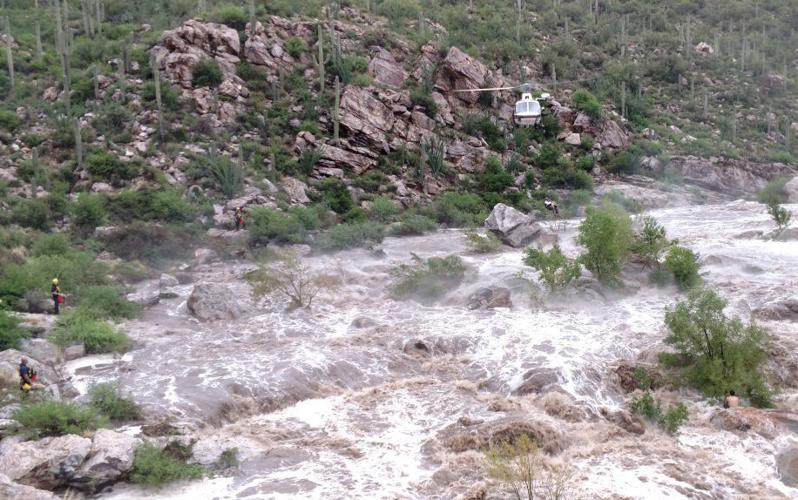

A crew of rescuers was carrying a dehydrated woman down the trail from Seven Falls Saturday and had just crossed the stream when Shelley Littin noticed a bad sign.
“I saw that the water had changed color. It had changed from clear to a dirty, muddy black.”
Littin and her fellow crew members from the Southern Arizona Rescue Association knew there was a risk of a flash flood. Now she warned her fellow crew members: “Clear the stream!”
Quickly, the water level rose. What was knee deep became waist deep, then turned into full flood. Instead of wheeling out the injured hiker in what’s known as a litter basket over five more stream-crossings, they had to call in a Pima County Sheriff’s Department helicopter. Then the dozen rescuers scrambled out of Bear Canyon over the ridges.
Another flash-flood drama in the series that has struck the Tucson area since drenching monsoon storms began July 11.
The next evening, an Arizona Department of Public Safety helicopter carried 35 people across a newly flooded Sabino Creek. They had been stranded on the wrong side of the creek by floodwaters. Earlier, 17 were pulled from Tanque Verde Creek, some of them trapped on rocks amid the torrent.
When the rains come, you just can’t keep Tucsonans from our local swimming holes. It’s such a delicious treat: Beautiful cool water to dunk in and relieve the summer swelter. But the same rain that fills the holes and streambeds brings floods that could kill us. You can’t have the pleasure without the danger.
The risks became obvious to all of Arizona July 16. That’s the day 10 members of a family celebrating a birthday at a swimming hole north of Payson were drowned in a flash flood. That disaster hit me and several friends especially hard. We have spent many July days at the same swimming hole, on Ellison Creek next to the Cold Spring Ranch, which is owned by my friend Tyler Pierce’s family members. We also narrowly averted being hit by a flash flood there in 2015.
Still, the temptation to plunge into the cool tea-colored pools is overwhelming for many of us. Last week another friend invited a bunch of families to join him in Sabino Canyon at a popular pool with rocks to jump from, upstream from Anderson Dam. The invitation was for Sunday. And you saw what happened Saturday: Widespread heavy rain in the mountains and across the Tucson basin.
Sunday morning it was raining lightly, and we considered our options: Simply skip it and be safe, or weigh the risks and maybe enjoy the pools. We weighed the risks.
It turns out many guidelines and tools can help you at least reduce the chance of getting caught in a flash flood while playing in or near our seasonal streams.
One is to consider the time of day: Most flash floods happen in the afternoon and evening hours, heading into nighttime. Aaron Hardin, a National Weather Service meteorologist in Tucson, told me most of the flash-flood warnings around here happen between 1 p.m. and midnight. Morning is typically the least likely time for a wall of water to come down.
Another key step is to consider the terrain you’re heading into: Narrow stretches of canyon are more dangerous than broader floors. That’s because the water rushes through them fast and deep, leaving little time or room to escape.
Of course, you should check the weather. Not only does the forecast matter — and you should avoid times when thunderstorms are forecast — but you need to check what’s already happened.
It can take hours for water that has fallen on the Catalina mountaintops to gather into a flood and hit downstream playgrounds like Sabino Canyon and Bear Canyon. In places like the Ellison Creek pools, it’s hard even to see the upper watershed, where heavy rains could fall without you knowing it.
Here, Pima County Flood Control’s online Alert system displays rain gauges that are all over the mountains and valley floor. You can check them to know whether it’s been raining upstream from the waters you want to swim in.
That’s what I did Sunday. I checked the weather forecast and the rainfall, and we got to the pools about 11:30 a.m. with a plan to leave within two hours. I also checked with an employee at the canyon visitors center. Our arrival was later than I wanted, but conditions seemed OK, and we took the plunge. The deep, cool water was delightful.
But by the time we fled down the canyon, about 1:30, saturated gray clouds were blossoming over the peaks. As usual lately, it poured on the mountains. We were long gone when, at 3:08 p.m., the weather service issued a flash-flood warning for the area and warned people to get out of Sabino and nearby canyons. It was 4:41 p.m. when a stream-flow gauge at the Sabino Creek dam registered a big spike in the flow — the flood had arrived.
After that, you were stuck if you were on the wrong side of the creek, and many were. That evening, the Sheriff’s Department called in the DPS helicopter to ferry people over the stream because they were worried those stranded would risk their lives trying to cross before the water went down. Videos from earlier last week show people forming human chains to cross waist-deep water in Sabino — a terrible idea. The stream-flow gauge shows the water didn’t recede to near normal till about 5 a.m. Monday.
I’ve visited Tanque Verde Creek before with my friend Eric Shepp, the county’s floodplain administrator, and our sons. He told me Tuesday, just back from an out-of-state trip, that he would consider going to local swimming holes even during a flood-prone period like now, but only in the morning, not in narrow canyons, and only after checking the weather forecast, precipitation and stream flows on the Alert system.
My friend Tyler, though — he bowed out of Sunday’s visit to Sabino. He’s been talking to his brother, Nelson, who was at Cold Spring Ranch when the disaster happened. Nelson helped officials load out the bodies.
“To a very real degree you can manage risk,” Tyler told me Tuesday. “But a lot of times nature has its own plan.”
He’s imagined what was going through the minds of the family members lost at Ellison Creek. Did any of them think they should get out of there but not speak up?
“I could see myself being one of those bad decision-makers,” he said.
So, for now, he’s playing it safe — a justifiable approach in the circumstances. But at the least, those of us who can’t resist the waters should be using the commonsense guidelines and amazing online tools that will help us reduce the risk of being stranded — and of disaster.

