

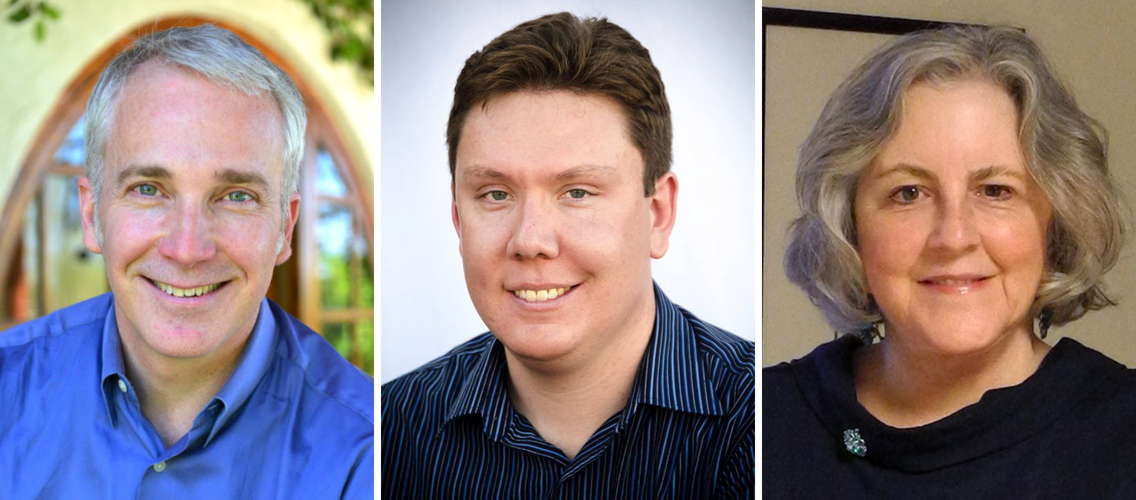



Three Democratic candidates will face off in the primary race for two state House seats in Legislative District 9.
Both incumbents are running for re-election, with Randy Friese running for a second term and Matt Kopec for his first full term, alongside Democratic activist and blogger Pamela Powers Hannley.
In January, Kopec was appointed by the Pima County Board of Supervisors to fill Victoria Steele’s vacant seat after she resigned to run for Congress, beating out Powers Hannley.
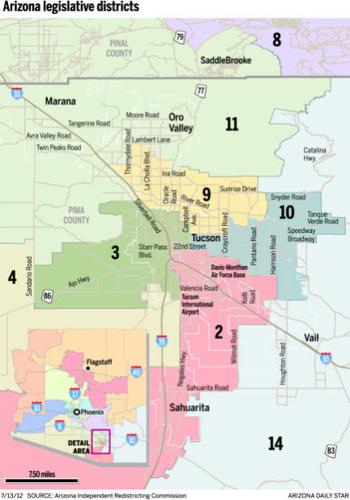
The district includes parts of midtown, the Flowing Wells area and the north side, Catalina Foothills and the Casas Adobes areas.
The two Democratic winners in the primary will be up against Republican candidate Ana Henderson in the general election. Henderson is unopposed in the GOP primary.
Early voting begins on Aug. 3 and primary election day is Aug. 30.
Why are you running for the Legislative District 9 House seat?
Friese: “One of the reasons I was interested in running for public office is because I am interested in public education. In Arizona, public education has been cut … while corporate tax breaks have been increasing. The state’s role is to improve our public schools. Education is the equalizer. Education will not only improve your life but your children’s lives and then their children’s lives. So, public education is one of the reasons that I wanted to go in and it’s another reason why I want to go back — I think we have a lot of work to do. But also as a physician, I’m also concerned about public safety and public health. I think gun violence is a public health issue.”
Kopec: “Having served a session, I’ve learned a lot both about the process and the people. So, I think that going forward I will be able to start a new term with that background. With the new speaker and the new members, I think I will bring that and some experience. The reason I got involved in politics was education. That’s going to be my No. 1 focus for the two-year term if I get re-elected. I think students in Arizona should have the same opportunities that I did and I see that slipping away and I want to make sure we do what we can so those opportunities do exist for Arizona students.”
Powers Hannley: “One of the big reasons I got into this race is that I look and see the benefits that I grew up with because both my parents had full-time jobs, they both had health insurance, they had paid sick time, and workers in Arizona, they don’t have anything like that today. There’s jobs around here but they’re low-wage jobs. Women in particular are hit hard because there is a huge pay gap between men and women in the Tucson metro area. … (Women) have terrible jobs. You see that they are day-care workers, fast-food workers and home healthcare, all those really low-wage jobs are predominantly women in those jobs.”
What is the biggest challenge in Legislative District 9?
Friese: “I think an issue for LD9 is gun safety because of what happened in our district in 2011. We had, for the first time in a hundred or so years, that a sitting Congress person had an assassination attempt and many, many community leaders were killed, people were wounded. So, I think the gun safety issue is a big one for our district.”
Kopec: “Well, we do have a diverse district. There are different school districts so there’s a lot of different dynamics going on. We have some economically distressed areas and some economically prosperous areas. So, for me being able to bridge all those gaps and listen to and understand and represent all of the different people in my district is the most important thing.”
Powers Hannley: “LD9 is pretty diverse economically. The midtown area is much more racially diverse, the Foothills are richer and whiter. I don’t know if there is a lot of cohesion in LD9. I think the challenge would be for the midtown folks, they are the ones living in poverty. There’s also a lot of businesses that appear to need help because they have a lot of boarded-up storefronts.”
How will you work with neighboring districts and representatives to improve Tucson and the state of Arizona as a whole?
Friese: “It’s an issue of understanding infrastructure issues and making sure we support them as the city needs. Another thing we do as a group for Tucson is protect autonomy for the city. I’m a strong supporter for local control for Tucson and cities and having the state not reach in and pre-empt.”
Kopec: “What I saw this year is that Tucson representatives really do stick together. We talk to each other constantly, we do have a really good working relationship. The Democrats from Tucson do a very good job of making sure we are all kept up to date on information and all know what’s going on. I suspect that will continue.”
Powers Hannley: “There are crossover issues on my platform, especially the public banking idea that’s been proposed more times by Republicans than by Democrats. Also, my small-business issue, I think that’s a crossover issue. I think that some of these things are going to appeal for the people in the Foothills of 9, but then also appeal to some of the more business-oriented people like in (Districts) 11 and 10.”
What is the one policy change that you would make regarding Arizona gun laws and how do you plan to compromise with your Republican counterparts?
Friese: “You come up with ideas and you negotiate compromise. When you put an idea into the system you have 90 people in total having to agree with your idea for it move forward and they might want to change it. So, yes, you have to negotiate compromise. What I would like to see would be a system of comprehensive background checks for all gun purchases. Not just at the federally licensed gun dealers but at gun shows, at personal gun sales. … Some of the compromises that we have already woven into it is relatives — if your father wanted to give you a gun, that doesn’t require a background check.”
Kopec: “I believe that we should have background checks at every gun sale. I think the city of Tucson did the right thing in requiring background checks at gun shows on city property. Getting there is tough with the current legislative makeup, but it’s something that we (have to) continue to try to do. We can’t continue to have weapons of war on our streets and wonder why our streets look like war zones.”
Powers Hannley: “I back the things Randy Friese has proposed as far as getting rid of loopholes in the background checks and things like that. The other thing that I am in favor of, which I think is more of a national policy, would be to bring back the Brady Bill, you know, to ban assault weapons. My dad was a hunter and he was a member of the NRA and we had guns around the house — growing up I didn’t know where those guns were, he didn’t have guns lying on the table. There’s too many accidents. Guns need to be stored properly. … You can prevent a lot of these accidents with safe storage. I think that would be something I would talk to them about.”
As a Democrat in a majority Republican House, what strategies do you have to overcome party barriers?
Friese: “Over the past two years, I have been able to talk to my Republican colleagues because we respect each other. When I stand up in a committee, people see my passion and I think they respect that. In my mind, the first step toward being able to negotiate and compromise is respect and then the next step is trust, and once we get past the trust we start to strike deals. … When I say ‘deal’ I don’t mean ‘I’ll vote for your bill if you vote for my bill,” I mean ‘what can I do to make my bill more palatable for you?”
Kopec: “For me, it’s identifying folks I can work with. Sometimes it’s just just issue by issue. I may be able to work with one Republican legislator on one issue but they might be on the total opposite end on another issue. It’s building relationships, earning trust and being respectful. That’s something I’ve done in my first year in office and I look forward to being able to do that. As a Democrat you have to be able to work on legislation and come up with good legislation, but you have to be able to part with the credit. Because often times, the number of Democratic bills are so few, that if you have a good idea if you can work with Republicans on a good idea, you have to be willing to step down and not worry about credit.”
Powers Hannley: “I think with the economic reforms I am talking about, with equality and with (my stance) on opiates — you know, everybody knows somebody who has been on heroin or addicted to opiates, everybody has a family member, a friend or a story — I see those as common issues and they are not Democrat or Republican issues.”
Describe one bill that you would introduce, if elected, and how it would help your district.
Friese: “I would like to incentivize home health a little bit more. What I am imagining is that people get admitted into the hospital and get discharged but if they get readmitted within days or a week, that’s a problem. So, we somehow can incentivize providing home health that will help patients avoid getting readmitted by making sure they are taking their medicines appropriately, by making sure they are keeping their follow-up appointments and things like that.”
Kopec: “One thing that I am looking forward to working on with my colleagues on the transportation committee is our funding model, how we can reform that. It’s been since the early ’90s since it’s been visited and it’s time to revisit that. We have to make sure our roads are in good condition and the transportation system is in good condition. And I think it’s something that has bipartisan recognition of its importance. I think that is going to be the issue that’s right for action and I look forward to working on that.”
Powers Hannley: “The Equal Rights Amendment was introduced to Arizona Legislature in the 1970s by Sandra Day O’Connor. Victoria Steele proposed it every year that she was in (office) and I worked with her in the background on that as a blogger and an activist. I think we only need three states left to pass it and Arizona is one of the states that never passed it. I vow to put the Equal Rights Amendment up there and I want the Republicans to explain to me why their wives and their mothers and their sisters and their daughters don’t deserve equal pay and don’t deserve equal protection under the Constitution.”

