


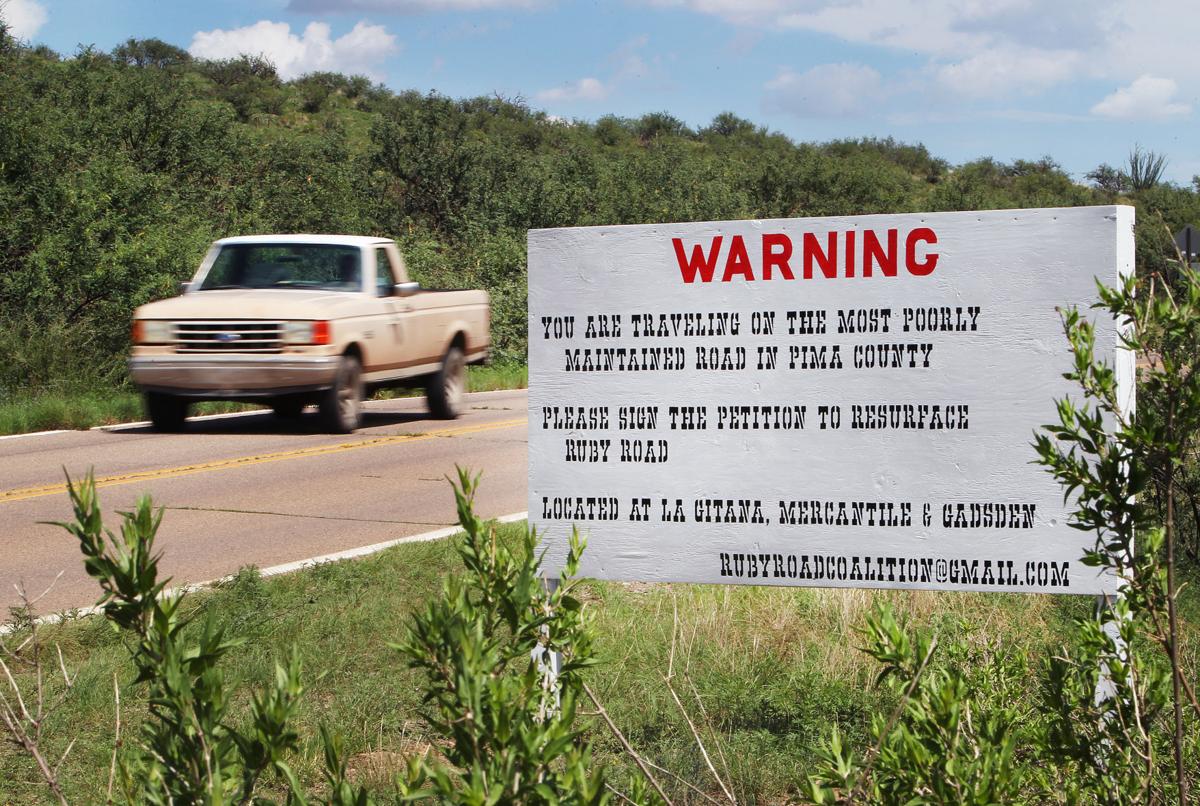
Regular readers may recall the woeful state of Ruby Road, which this column explored last summer and which was then described by many Arivaca residents as “the most poorly maintained road in Pima County.”
But it would not be fair to say that things haven’t improved — however modestly — since then. In response to a growing number of requests for pothole repairs, the county transportation department has patched roughly two miles of the just over 5-mile stretch of Ruby Road inside county lines that sees the heaviest local traffic over the last year or so.
It doesn’t look pretty, but it’s indisputably smoother than the cratered road that had raised the ire of hundreds of area of residents, according to photos of the repairs posted to the Ruby Road Coalition’s Facebook page.
Joe Kleinholz, a coalition member, said he’s “happy” with the county’s work .”
Nevertheless, that far-from-permanent and far-from-cheap fix is already starting to degrade.
“If you drive it at night, your headlights show how it’s sinking back into original potholes,” said Ruby Road motorist and coalition coalition member Donald Willett, echoing Kleinholz. “It’s getting pretty rough again already, and it’s only been less than a year.”
“The only real solution is to fill the potholes and then resurface over that,” Willett added later.
Since 2012, the county has spent just shy of $360,000 on Ruby Road, largely on pothole repairs. Nearly half of that — $172,000 — came in 2016, according to spending data. With another year like that, the costs would approach the $550,000 a double chip seal is estimated to cost and start inching toward the $1 million price tag of a full fix.
Priscilla Cornelio, county transportation director, is aware this is not the ideal solution, and even described the pothole patching as a “Band-Aid approach.”
However, her department is in a bit of a bind. When residents complain about potholes and the county doesn’t do anything about them, the county and taxpayers can be on the hook when vehicles are damaged on those roads. As the Road Runner previously reported, that is one of the criteria used to decide when to pay out on such notices of claims, as is whether the road in question has received regular maintenance.
Depending on the damage done, those bills can be steep.
Pothole and other maintenance work in Arivaca — a small, rural community well over an hour’s drive from Tucson — is also a more expensive endeavor than it is in more urban areas. On average, it costs about $7,250 for maintenance on each of the 2,150 miles of county-owned roads, and as little as $1,000 per mile for new, high-quality roads. Last year, that figure worked out to $32,633 per mile for Ruby, according to calculations provided by Cornelio.
On top of it all, the county’s total budget for pavement preservation, which is where funding for resurfacing projects come from, is around $4.5 million for the current fiscal year, meaning just the Ruby project would eat up over 20 percent of it.
Last summer, the county conducted vehicle counts in Arivaca and found that near the midpoint of the road, between 113 and 135 vehicles used it daily, many of which are Border Patrol vehicles. With so many other county roads in poor condition, many with significantly higher daily traffic counts, it might be difficult to justify spending so much in Arivaca.
“The bottom line is, if I had the money in hand to do a permanent fix, I have many, many other roads that would be a higher priority,” she said.
Ken Buchanan, another coalition member, said he understands the county “has to spend the money where the traffic is,” but other residents took a dimmer view of Cornelio’s explanation.
So, if not the county, who should pay for Ruby Road, which was last paved in 1997?
Arizona’s senate delegation thinks the Border Patrol might have a role to play there, and along other border roads in the southwest. That’s why Sen. John McCain and Sen. Jeff Flake, whose office has heard a number of concerns about Ruby, sent a letter in December 2015 requesting that the Government Accountability Office look into the federal agency’s use of border roads like Ruby.
“There appears to be a dearth of information to determine the overall extent of Border Patrol’s recurring use of state, local and private roads or property for border security operations, and the maintenance costs incurred by these property-owners that may result from such routine use,” the senators, joined by Wisconsin Sen. Ron Johnson, wrote in their letter.
To fill that vacuum, the requested study, a little over a year later, just got going. As a part of the work, a GAO representative met with county officials and Arivaca residents earlier this month.
In a written statement provided by a spokeswoman, Flake said he is “pleased” with the study, which is expected to be finished in the fall, and that “we need to make sure that the federal government doesn’t unduly burden Arizonans with the maintenance costs associated with that use.”
Buchanan agreed, saying it’s the Border Patrol that “uses it more than anyone.”
A Tucson Sector Border Patrol spokeswoman did not respond to requests for comment, but last summer the agency said while the condition of Ruby Road has “negatively impacted Tucson Sector Border Patrol’s fleet by increasing maintenance and repair costs,” the agency “does not provide funding for county-maintained paved roads.”
In early February, Felix Chavez, the Tucson Sector’s acting chief patrol agent, wrote to Cornelio to tell her basically the same thing, according to a copy of the letter Road Runner obtained.
Arivaca residents who attended the GAO meeting said they were skeptical the study, and any congressional action it might eventually spur, will change things for them in the near future. And without a source of funding, Cornelio said, the status quo of fairly expensive patch jobs is likely all the department can do, though she did say they are still pursuing federal funds authorized by the 2015 FAST Act for roads like Ruby.
But Linda Willett, Donald’s wife, said that “dragging” the issue out and waiting for a likely long-off federal solution doesn’t serve anyone’s interest, and that Ruby Road is “ultimately (the county’s) responsibility.”
“Fix it right,” Willett said. “Quit throwing this money at quick fixes.”

