


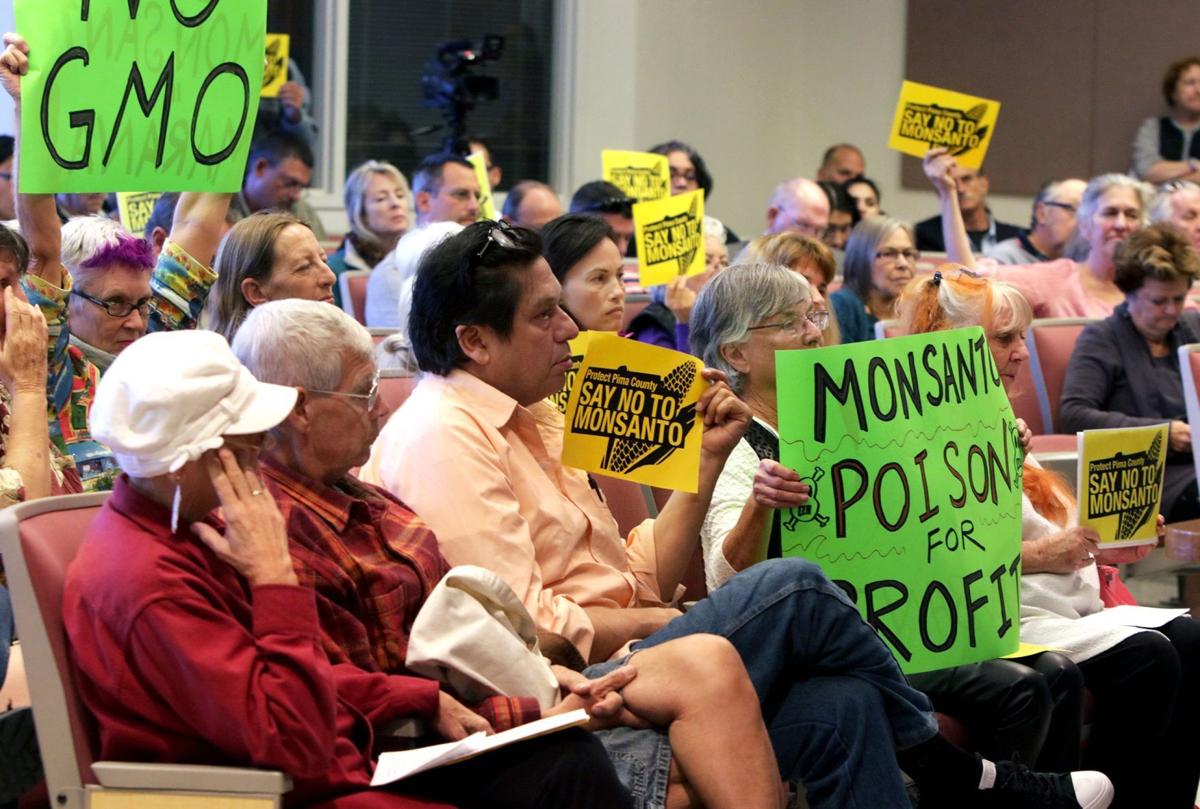
With a handful of exceptions, the several dozen speakers who addressed the Board of Supervisors on Tuesday spoke in opposition to agribusiness giant Monsanto’s plans to come to Pima County.
Opponents, many of whom were holding yellow signs that read “Say no to Monsanto,” were hoping that the board would shoot down the deal, something several officials said the county has no power to do. They didn’t get that, but the supervisors did unanimously decide to delay consideration of a property-tax plan with Monsanto until February.
The board also agreed to establish an agricultural science advisory commission to address some concerns raised by the speakers, many of which centered on what they called potential health impacts of Monsanto’s plans to use genetically modified seeds in a 7-acre greenhouse. It would be built on a 155-acre parcel near Marana.
Supervisor Ramón Valadez proposed the delay.
“I will tell you that you’ve raised a number of questions,” he told the crowd. “A number of questions that deserve answers.”
Supervisor Ally Miller agreed, adding later that “we all have unanswered questions.”
Supervisor Richard Elías requested that public hearings on Monsanto’s plans be held in all five districts represented by the board before the measure comes back for a vote.
“It’s a good opportunity to address some of the issues brought up by many of the commenters,” George Gough, Monsanto government affairs director, said after the vote.
“We’re excited to be in dialogue,” company spokeswoman Christi Dixon later said. “We’re trying to engage differently and more openly.”
What the supervisors will consider in February is whether to support Monsanto’s application for foreign-trade-zone status, which would substantially reduce its property tax burden over the next 10 years. In exchange for receiving that support, the company would commit to spending at least $90 million on the development and hiring at least 50 people at an average salary of roughly $44,000.
A foreign-trade-zone designation would drop the property’s assessment ratio from 15 percent to 5 percent. The annual difference in property taxes paid to the county after $96 million in development would be around $370,000 lower with the FTZ rate, documents show.
The U.S. Commerce Department, not the county, approves FTZ applications. The property tax reductions are established by state law, according to a memo from County Administrator Chuck Huckelberry to the board.
Criticism of providing the Fortune 500 company with those tax breaks was one of the most common themes during the lengthy public comment session.
“Marana is a poor farming community,” speaker Wendy Wiener said, echoing many others. “Why don’t we give them tax breaks?”
In an October memo to Miller, Huckelberry pointed out that if the land were to remain undeveloped, it would bring in roughly $20,000 in all property taxes, but $11 million if the development proceeds, even with the FTZ designation. Additionally, the company’s move is estimated to bring roughly $284 million in economic impacts between 2016 and 2025, according to Sun Corridor Inc., an economic development agency.
Citing those benefits, as well as what he described as Monsanto’s “demonstrated history of innovation,” Tucson Metro Chamber CEO Michael Varney was one of a handful to speak in support of approval.
After placing what he said was genetically modified cotton on the table, Jack Mann, head of the Arizona Farm Bureau Federation in Pima County, lent his voice in support as well, saying the greenhouse presents an “opportunity to try to develop and improve our production.”
“We need to be able to grow and be able to provide food,” he added.
Steve Christy, who was elected to the Board of Supervisors on Nov. 8 and will have taken over District 4 Supervisor Ray Carroll’s seat by the February meeting, said he was supportive of slowing the process down, providing forums to air concerns and allowing for public hearings.
“Through that process, if everything goes satisfactorily, at this point I would be inclined to vote for the designated foreign trade zone,” Christy said in an interview Tuesday.
Dan Contorno, chief financial officer of the Marana Unified School District, said he and other officials are “excited about some of the educational benefits this facility will bring to our community.”
The district’s board recently approved an arrangement with Monsanto in which the company will give a one-time donation of $500,000 to a foundation affiliated with the district and pay a smaller annual property tax bill. The deal would save the company roughly $3.4 million over 10 years.
Monsanto has already purchased 155 acres near Marana, at the intersection of Twin Peaks and Sanders roads. The company had intended to break ground on the 7-acre corn-growing greenhouse before the end of 2016, according to Huckelberry’s memo.
However, company spokeswoman Dixon said it was too early to tell how the Tuesday vote “will affect the timeline.”
The proceedings were far more emotional than at typical board meetings, with several speakers crying while addressing the board. Another, who would not provide her name to the Star, addressed Carroll directly, shouting: “Look at me! I’m speaking to you!”
She went on to say she would personally participate in civil disobedience to block the project, citing ongoing clashes surrounding the North Dakota Access Pipeline as an example.
Seven-year-old Katie Fox told the board that she opposes the project because of her love for bees, adding: “I don’t like Monsanto because it kills bees,” seeming to reference the claim of critics that some agricultural chemicals may be linked to the phenomenon of hive collapse. Her mother, Carrie Fox, and 10-year-old brother Gabriel Fox also spoke in opposition to Monsanto.
Like many others, Carrie Fox expressed concern about the secrecy surrounding the county’s negotiations with Monsanto and about potential environmental damage.
In his Nov. 22 memo to the board, Huckelberry wrote that the county has not “identified any negative air quality, water quality, water supply, transportation capacity, or natural resource impacts from the development of the facility.”
Before moving to delay the vote, Valadez suggested that the tax deal would be the only way for county residents to keep informed about Monsanto’s activities.
Huckelberry told the board that the county has no power to regulate agricultural activities and is not in a position to stop Monsanto’s plans. He also said that two proposed commissions, including the one activated Tuesday, along with a memorandum of understanding with Monsanto are “the best approach to basically obtain information” about the company’s local activities.
Supervisor Sharon Bronson asked Huckelberry if Monsanto could “build without our permission,” which he confirmed. Huckelberry added that without the support of the county in its FTZ application, the company likely would not sign the memorandum with the county, which sets the terms for public sharing of information about Monsanto’s activities.
“It would be a black box,” Bronson said.

