



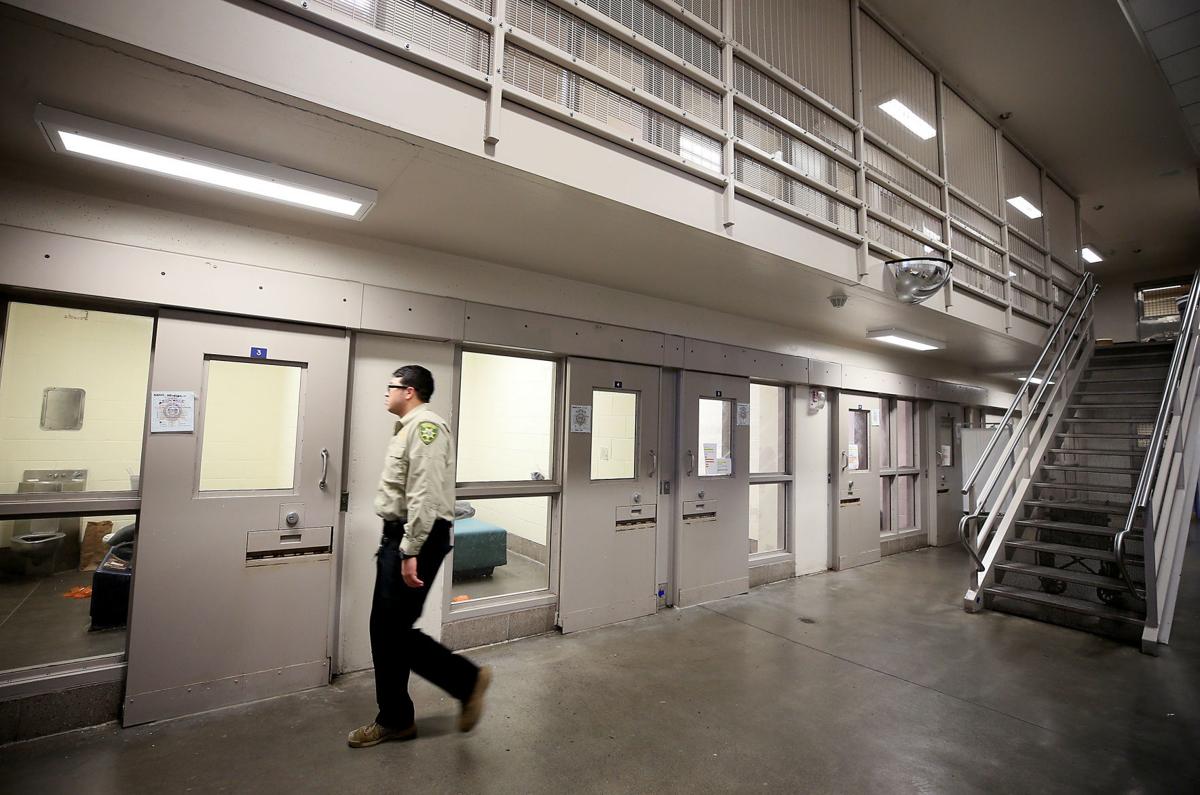
The Pima County Attorney’s Office has resumed charging simple drug possession cases after a more than two-month pause on the policy put in place to lower the county jail’s population amid the increasing spread of COVID-19.
County Attorney Laura Conover announced on Dec. 14 her office would no longer charge people for simple drug possession, paraphernalia or related personal-use cases. On Wednesday, she sent a memo to Southern Arizona’s law enforcement agencies announcing the reversal of that policy.
The jail’s population was 1,671 on the day the policy went into place, and 1,673 on March 9, Conover wrote in the memo. She said law enforcement personnel were still bringing people to the jail for the charges Conover announced she would no longer prosecute, resulting in the policy having little effect on the inmate population.
In December, Conover asked law enforcement to deflect people to drug treatment — such as CODAC, a behavioral health care center, or the Crisis Response Center — instead of arresting them. But arrestees were still crowded in the initial holding area of the jail, or the “pit,” waiting to find out if they’d be booked, she said.
“People were simply still brought to the jail on simple drug possession. They were booked and went into the pit for hours before they finally get to the initial appearance where my deputy could dismiss the case,” Conover said. “So we didn’t see signs of increased deflection.”
While the Tucson Police Department has had “years to grow accustomed to deflection,” the county attorney said, other local law enforcement agencies don’t have the same experience.
“They’re going to do what they’ve been doing for 20 years. Everyone does the best they can,” Conover said. “But the result was frustrating.”
Sheriff Chris Nanos acknowledged his department’s deputies can use opportunities to cite and release or deflect at their discretion, but said he wishes there were more social services available outside city limits in the wider area his department patrols.
“We try to encourage our deputies to understand in our training processes that not everybody needs to go to jail. There are other ways to deal with the situation,” he said. “But I’ve got $18 million a year spent in my jail on mental health and drug addiction issues. Can we not give that $18 million a year to those who are better equipped to handle that?”
And although he supported the effort to reduce the jail population, Nanos said he wanted to focus on getting the hundreds of inmates booked for probation violations and other petty charges out of the facility.
“I didn’t really need (Conover’s) help to reduce the jail population because of COVID. I mean, that’s an honorable thing to do,” he said. “But I stressed to her and to the courts and the judges: What I needed their help to do was to reduce the jail population because we have people in our custody who don’t need to be there.”
Conover acknowledged this idea in her memo to law enforcement and said Nanos “is dealing with some 200 inmates held on unspeakably violent crimes and trying to also manage non-violent sick people who should not be in the jail at all and are at risk for violence, and illness, and overdose.”
The county attorney asked law enforcement to continue to use deflection, adding, “I don’t need the jail to help me hold non-violent people accountable. I can and will do that through charging.”
“Brutal choice”
Former County Attorney Barbara LaWall made a similar decision to halt simple drug possession charges in March 2020. Conover said she resumed prosecuting those cases as her office launched the nation’s first pre-charge drug court, STEPs, or Supportive Treatment and Engagement Program, with the goal to divert nonviolent people with substance use disorder away from the criminal-justice system.
“It seemed safe to move people quickly from arrest, out of custody, into the STEPs court. So I lifted it,” Conover said.
But when Conover stopped simple drug charges as a COVID-19 mitigation measure again in December, the STEPs court wasn’t able to fully serve its purpose.
“The court had made it clear that the STEPs court was going to die on the vine because I hadn’t put anyone into the court since the (December) memo. So it was empty now,” she said. “It was a brutal choice because at the end of the day, I’m not convinced that adding criminal-justice system involvement to a person already suffering from substance-use disorder, I’m not convinced yet that that that makes it better and in fact, worse.”
Joel Feinman, the county’s public defender, is set on the belief that the criminal-justice system fails to help those with substance-use issues.
“Criminalizing minor drug possession use has never worked in 100-plus years of the war on drugs. It never will work,” he said. “Substance abuse is not a criminal-justice issue. It is a mental health and a public health issue.”
Conover said those suffering from substance use and mental health issues can attend the STEPs court to receive treatment instead of spending time in jail.
“It seemed to be the better of the two options. … STEPs court I don’t think really even has a full six months of data yet,” she said. “I think everyone worked so hard to launch it. It’s absolutely worth testing and seeing if we can’t get results, especially maybe post-COVID.”
But Feinman argues reinstating the policy to charge simple drug possession negatively affects those who need treatment by continuing to criminalize them.
“At the end of the day, you are still arresting people for crimes and charging them with felonies. You’re still treating it like a criminal-justice issue,” he said. “It doesn’t mean creating specialty courts and behavioral health courts within the criminal-justice system. It means not doing the same thing slightly different.”
For now, the idea is to see if the STEPs court can fulfill its purpose and help divert those with substance use disorder away from jail.
“It deserves a real test. And then we’ll do just what we did here, review again,” Conover said. “Is deflection still better than STEPs? We need to set up these markers to figure out how to get the best results.”

