


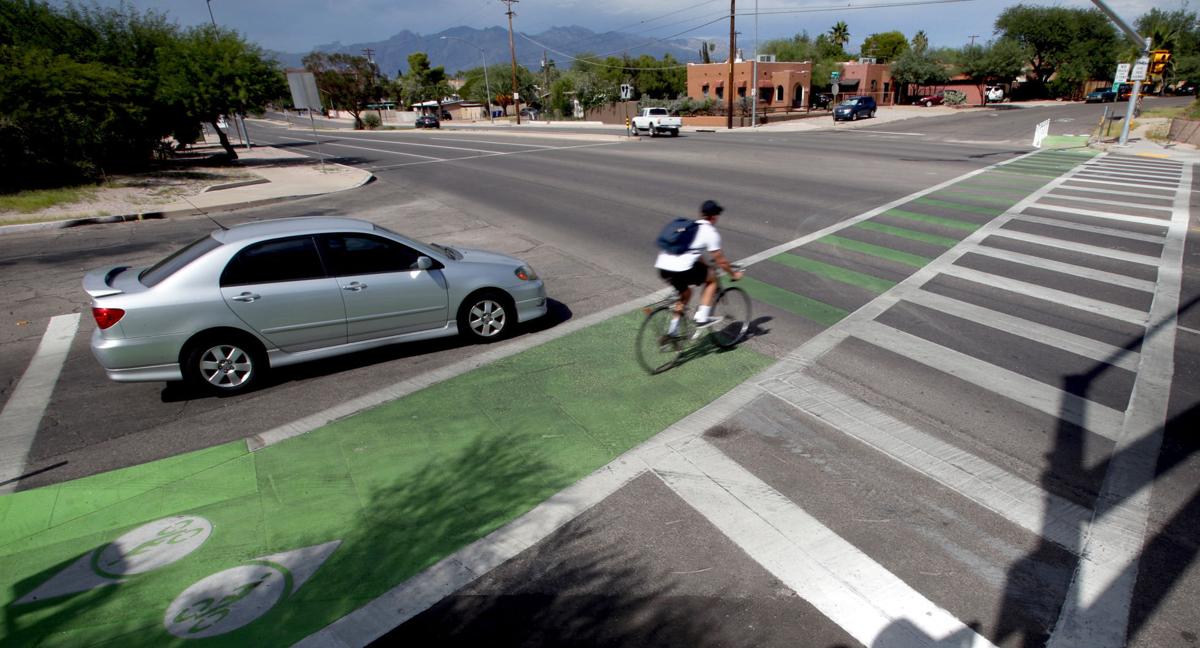
Tucson was the site of an intervention of sorts last week.
Federal administrators, consultants, community activists, local elected officials, law enforcement representatives, transportation planners and dozens of others packed a conference room at the downtown Tucson Fire Central on Tuesday. What they and all Pima County residents share, as many speakers put it, is that at least every now and then we — your humble columnist included — walk to get where we are going.
“Everyone is a pedestrian,” Tucson Mayor Jonathan Rothschild said during the opening of the Developing a Pedestrian Safety Action Plan event.
And being a pedestrian in Tucson isn’t as safe as many would like.
As with fatal and serious bicycle-car crashes, the Tucson metro area has less-than-rosy pedestrian safety statistics.
Between 2011 and 2015, 101 pedestrians were killed and 252 were injured in an incapacitating way in the Tucson area, according to statistics presented last week. Between 2011 and 2013, there were an average of 3.81 cyclist or pedestrian fatalities annually per 100,000 residents, giving the city the dubious distinction of being the 11th most dangerous out of the country’s 50 largest cities.
The average among those cities for that period was a flat 3 per 100,000, meaning Tucson, in the eyes of the Federal Highway Administration, is a so-called “focus city.” Those are places where the agency wants to use its “resources to drive down fatalities and serious injuries.”
And those resources were on hand all of last week as feds and locals sat down over three grueling days and hashed out a framework for Tucson’s own Pedestrian Safety Action Plan. The draft is still very rough, and will be for the foreseeable future, according to Ann Chanecka, coordinator of the city’s bicycle and pedestrian program. However, once it’s completed and adopted by the City Council, it will serve as a guiding document for pedestrian safety planning and could open up avenues of federal funding to help pay for a more pedestrian-friendly Tucson.
It should be pointed out that it was certainly not all doom-and-gloom last week. Karla Petty, the federal highway division administrator , spoke Tuesday about the many things Tucson is doing well to improve pedestrian safety.
As evidence, she cited the fairly new city of Tucson Pedestrian Advisory Committee, ongoing deployment of the locally developed HAWK pedestrian crossing beacons, an active safe routes to school program, law enforcement training and pedestrian refuges on wide thoroughfares.
“Here in Tucson, you are already doing some good things,” she told the crowd last Tuesday, but added later that the city and Arizona as a whole have “more pedestrian fatalities than what we would want to see.”
“When we start comparing it to other cities, we definitely have an opportunity to make our roadways safer.”
And how might that be accomplished?
Peter Lagerwey, a federal highwat consultant who literally wrote the book (it was actually a manual), “How to Develop a Pedestrian Safety Action Plan,” was on hand through the week to provide guidance. On the first day, he said successful plans have a number of elements in common, including “good design,” “stakeholder involvement,” “speed management,” “targeted education” and “purposeful enforcement.”
Speed management was a big focus of the conversation, as was making sure as many local people and groups are involved in the conversation around the plan , Chanecka said.
Unsurprisingly, the faster cars are moving when they hit pedestrians, the more likely pedestrians are to be killed or seriously injured. (The Road Runner is a strong advocate of citing sources: A 2011 AAA study found that the risk of death for pedestrians is 25 percent if the vehicle is traveling at 32 mph upon impact and doubles to 50 percent if the car is going 42 mph. Death is almost guaranteed above 58 mph.)
During his presentation, Lagerway said there are a lot of “myths” about speed and traffic efficiency. What the data show, he said, is that “once you hit 35 mph, you are not gaining any more mobility.” Chanecka said that with “emerging technologies” cars can “get through the city just as quickly” at slower speeds.
Both Chanecka and Lagerway said patterns in serious pedestrian incidents are more difficult to discern than in vehicle crashes, but there are nevertheless some patterns in the Tucson data.
When mapped as points, many serious incidents form clear lines along Tucson’s major corridors, like Grant Road and 22nd Street, where posted limits are up to 40 mph (and, let’s be honest, many drivers add 5 or more miles per hour).
Sgt. Mikeal Allen, a Tucson Police Department motor patrol supervisor, provided a breakdown of the 10 serious pedestrian incidents his department has investigated so far this year, which also provides some insight into commonly seen circumstances. (Chanecka, who has regularly — and rightly — advised the Road Runner to avoid drawing strong conclusions from short periods of data, had similar advice with Allen’s figures.)
With that in mind, in seven of the 10 incidents, pedestrians were crossing roads mid-block or away from established crosswalks or pedestrian beacons, while the remaining three occurred in crosswalks. Seven also occurred at night; only one involved an impaired driver.
Allen said his department is trying to increase the number of motor patrols at night, when many serious pedestrian incidents occur. The department also has a grant-funded program to enforce laws that pertain to pedestrian safety, which can mean citing motorists who don’t yield to pedestrians or citing pedestrians who cross streets away from beacons and crosswalks, among other infractions.
A Star breakdown of the 25 pedestrians killed in Tucson in 2013 shows similar circumstances to those seen so far in 2016: 16 victims were not in crosswalks and 15 were struck at night, and half of those were in unlit areas. The figures suggest additional pedestrian crossing infrastructure, education for both motorists and pedestrians, and improved street lighting could all have positive impacts. Among many other recommendations, those items are included in the 2014 Pima Association of Governments Regional Pedestrian Plan.
If these measures increase the number of pedestrians on Tucson streets, that in itself can improve pedestrian safety: Somewhat counterintuitively, data suggest that more people walking to work and elsewhere decreases the rate of pedestrian fatalities. Lagerway explained this phenomenon by saying that as motorists accustom themselves to seeing more pedestrians, pedestrians become a part of drivers’ “visual screen.”
So, how might we pay for these improvements?
“Safety also includes infrastructure, and infrastructure costs money,” Rothschild told attendees last week. “Surprisingly more than you would think.”
Beyond the federal grants and other support that an action plan may facilitate, Rothschild said a reauthorization of the sales-tax-funded Regional Transportation Authority in the next couple years, which would need countywide voter approval, and a proposed city program he called Back to Basics, which would also rely on a sales tax, could help.
Both include plans for significant improvements to bike and pedestrian infrastructure, he told the Road Runner, something he said was “a priority for me, and I think the rest of the council.”
And local government support is going to be important, because one of the guiding visions that will likely be at the heart of the pedestrian-safety action plan is about as ambitious as it gets.
“Our vision is that there will be zero fatalities,” Chanecka said.
Though there’s no clear timeline for the draft plan at this point, Chanecka said there will eventually be efforts to gather public input, and the Road Runner will try to let you know how to participate.
DOWN THE ROAD
There’s a fair amount of roadway happenings starting soon, so the Road Runner will keep it brief, and bulleted:
- Work that started over the weekend to install new girders on the Ajo Way bridge over Interstate 19 will continue through the week, resulting in interstate traffic restrictions from 9 p.m. through 5 a.m. Monday through Thursday. The work is part of a $40 million project to replace the existing interchange.
- The section of Church Avenue just south of Sixth Street will be closed through late September to accommodate utility work. The work is part of the Downtown Links project.
- Four radar speed signs will soon be installed on South Alvernon Way, south of its intersection with East Ajo Way, and South Mission Road, south of its intersection with West Irvington Road. The signs will be paid for with a $20,000 grant won by the Pima County Department of Transportation. The two locations have a high number of speed-related crashes. The signs are “informational” and intended to get drivers to slow down if they’re speeding.

