



No one wants to pay more than they have to.
That’s especially true if you’re making a sizable outlay on something expensive and socially beneficial, like rooftop solar panels.
But some homeowners associations say they have a right to charge residents a fee so they can review the plans for new solar panels.
How much is too much for a homeowners association to demand? That’s what Carol Fiore is fighting about with her HOA, at Tucson Mountain Reserve in unincorporated Pima County on the northwest side. Coincidentally, it’s Pima County Administrator Chuck Huckelberry’s home subdivision, though he apparently has nothing to do with this situation.
Is $20 too much for the HOA review? $100? $500?
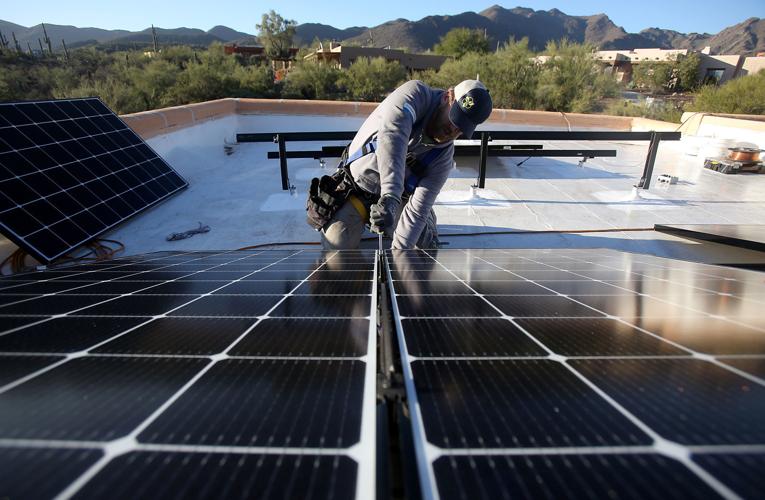
That’s what this HOA wants, $500, to have an architect review Fiore’s plans for a new array of 14 solar panels from Net Zero Solar. The association also wants a $1,000 refundable deposit to ensure the installation happens as submitted. So that’s $1,500 total on top of the approximately $13,000 cost of the installation that Fiore, a climate activist and the widow of a former Air Force F-15 pilot, says she’s been working for.
“I saved for years for these solar panels,” she said. “I had to give up other things in my life to have them. I did it because I care about the planet.”
The idea of the $500 charge is that it pays for the architect to check whether the planned panels conform to the HOA’s design criteria, which aren’t especially strict in Tucson Mountain Reserve. Residents have paid it before, and there are several solar arrays in the subdivision. But Fiore argues that they can’t legally make her pay anything extra.
State law seems to back her up. Arizona Revised Statutes 33-1816 specifies that HOAs can’t ban “the installation or use of a solar energy device.” Of course, the Tucson Mountain Reserve HOA isn’t trying to do that.
The same law goes on to say that HOAs “may adopt reasonable rules regarding the placement of a solar energy device,” but only if, among other conditions, those rules don’t “adversely affect the cost or efficiency of the device.”
“Adversely affect the cost” — that’s the phrase this is all about. Fiore says in her view, any additional fee charged by the HOA is an adverse effect on the cost of her solar panels. State law doesn’t specify a threshold amount.
Louis Woofenden, a co-owner of Net Zero Solar, said he’s seen a variety of approaches from HOAs.
“Most HOAs these days do very little paperwork for solar. There may be a 20-50 dollar processing fee,” he said. “I can’t recall anywhere with a fee that high. It’s very, very rare to see anything with a fee bigger than $50.”
HOA President David Freund would rather not be involved in this at all. He noted, when I met him at his home last week, that he’s not even on the design review committee that is responding to Fiore. But the association checked with their attorney, and the attorney thinks Fiore is reading the law wrong.
Freund, who is himself a retired attorney from Indiana but not licensed in Arizona, says that the first part of the law, allowing for “reasonable rules,” on placement of panels should have some bearing on how you read the second part of the law.
“If you can have rules and regulations about the placement, then you have to have somebody look at it,” Freund said, referring to outside professionals. “The members of the design review committee — they don’t have any expertise. That’s why we have the architect, who does have significant experience.”
It’s an interesting point — if you can have reasonable rules, then how can you enforce them without hiring an outside expert? And if the resident installing the solar doesn’t pay for the review, then who does? The rest of the residents must, through their HOA fees.
Of course, Fiore’s planned installation is about as noncontroversial as it could be. She lives on a 3.3-acre site, and the panels would be on her flat rooftop behind a parapet, visible only to those who live on hills further to the south.
In a May meeting, the design review committee rejected Fiore’s request that the fee and deposit be waived. One part of the discussion really rubbed her the wrong way — the expressed idea that since she lives in a well-to-do subdivision, she ought to be able to afford the $1,500.
Fiore bought her house in 2016 for $442,000, which in that neighborhood of houses reaching toward $1 million and beyond, is a below-average home. She also lives outside the subdivision’s gates. So she thinks there might be a bit of eye-rolling at her questioning what other residents view as a small fee.
When I spoke with Freund, he brought up the question of proportionality — what proportion of a solar system’s cost should be considered an adverse impact?
“If you’re putting in a $20,000 installation, is $500 going to adversely affect that?”
Unfortunately, perhaps because the financial stakes are relatively low, the courts haven’t had a chance to decide the issue of what is an adverse effect on the cost of an installation. Who wants to sue over $500?
But Fiore is pursuing an appeal of the rejection of the fee waiver and has sent the HOA a $25 check as a processing fee — and a gesture. If the design review committee rejects her appeal, then her plan is to cancel the installation altogether. Every day past June 25, the original installation date, is a day when she will be paying Tucson Electric Power when she could have been producing her own electricity, Fiore said.
That, she figures, is really an adverse effect, one that might force the issue.

