


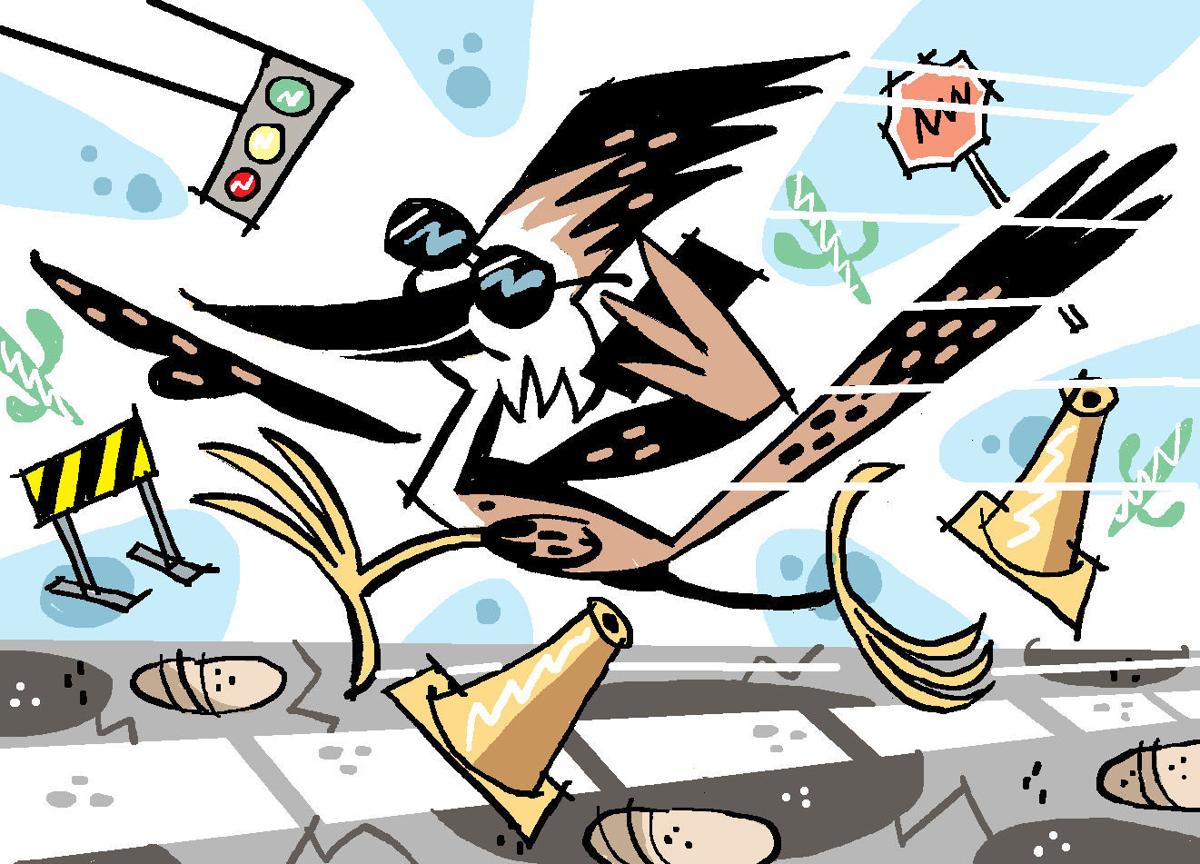
Have you ever counted the traffic lights you drive through on your daily commute? I have.
Depending on the route I take, I might pass 30 traffic lights in each direction.
It’s made me wonder, and many people have asked, why doesn’t Tucson have a crosstown freeway system?
Most metro areas Tucson’s size, and even smaller, have freeways, loops or parkways that speed commuters through the region.
Not Tucson.
Unless you happen to live within a mile or so of Interstates 10 or 19 and your final destination lies the same distance away, chances are the only time you use the freeways is when you’re leaving town.
Instead, driving surface streets through dozens of intersections is the only way to get across this ever-growing region.
So whose fault is that?
In this country, we’ve been conditioned to blame our political leaders.
After all, we elect them to make decisions on our behalf. But this might be one of the few cases where they deserve a pass.
Instead, we probably need to look in the mirror to see who’s to blame.
Numerous times over the decades, Tucson-area voters have rejected plans to build freeways, parkways and grade-separated interchanges to facilitate increasing traffic flows.
Voters in 1984 rejected a $15 million bond question to fund studies for a 13-mile Rillito-Pantano Parkway extending from the northwest side to the Tanque Verde Valley on the far east side.
Then in 1986, voters again rejected a transportation plan, this one a half-cent sales tax to fund 22 miles of new highway and 16 grade-separated interchanges, among other improvements.
A 1990 proposal, again funded by a half-cent sales tax, would have brought grade-separated interchanges at Grant and Campbell; Swan and Grant; Craycroft and Grant; Broadway and Kolb; 22nd Street and Kino Parkway; 22nd and Sixth Avenue; and Sixth Avenue and Ajo Way.
Not exactly freeways, but the plan was to limit the stop-and-go of surface streets and keep traffic moving.
Proposals in the 1970s similarly failed or never got past planning in the face of overwhelming opposition.
If three of those proposals had ever been built, they would have undoubtedly changed the growth patterns and character of the region in ways we can’t imagine today.
Included among them was the Butterfield Expressway, which would have taken the route of what is today Golf Links from Kolb Road to the train tracks, then west to meet with I-10 just south of downtown.
A portion of that is what we today call Barraza-Aviation Parkway, which looks a lot like a big middle without beginning or end.
Another was the first iteration of the Rillito-Pantano Parkway, which would have intersected with Butterfield on the east side.
The final, Interstate 710, would have begun at the Butterfield near Campbell and run south to Tucson International Airport.
Plans to build these freeways and parkways were hugely controversial, with opponents concerned about environmental losses, pollution, property condemnations and sprawl.
Here’s an example of the concerns of the time: “For instance, building a Butterfield to southeast Tucson will shorten the 30-to 45-minute drive from downtown to Pantano Road to about 10 minutes. Providing such easy access, the critics complained, only encourages more people to move even farther out,” Arizona Daily Star reporter Joe Gold wrote in 1974 as part of a series called “The Shrinking Desert.”
Concerns over sprawl seem quaint today considering we never got the freeways. But we sure got the sprawl.
So is there ever a chance to get a crosstown freeway, or has the idea become Tucson’s El Dorado?
We have the Regional Transportation Authority plan that’s adding capacity to surface streets but lacks the crosstown freeway or parkway element.
As an interesting note on that, Jim DeGrood with the RTA said about 30 percent of the current RTA projects to expand road capacity were initially identified in Tucson’s 1951 streets and arterial roadway plan.
There’s also the possibility of renewing the half-cent RTA sales tax in 2026 for a second round of capacity improvements.
But the truth is, the freeways and loops that bisect and encircle other regions may never be a reality in Tucson.
With the path of any serviceable route cutting through heavily developed areas, the costs of property acquisitions to build a freeway would be astronomical.
The RTA briefly considered reviving the Rillito-Pantano Parkway idea for the 2006 plan, but quickly dropped it when it was determined the costs to build it would have gobbled up almost the entire $2 billion plan.
So as you drive around town, counting stoplights and wondering why there’s not a faster way, remember who you can blame. The decisions we made yesterday are the driving legacy we live with today.
Down the road
The repaving work on Broadway from Pantano Road to Camino Seco will begin on Monday.
Tucson Department of Transportation crews will work each weekday from 5 a.m. to 5 p.m. through July 10.
At least two lanes of travel in each direction will be maintained during the work.
Pima County Department of Transportation and the RTA will be paving Valencia Road at the intersection of Wilmot Road on July 7 and July 8.
Nighttime travel restrictions near the junction of I-10 and I-19 junction are planned this week to allow crews to conduct lane striping work.
I-19 will be reduced to one lane in both directions between Ajo Way and I-10 from 9 p.m. Sunday until 5 a.m. on Monday.
The northbound I-19 on-ramps in that area will also be closed.
Use Sixth or 12th avenues as alternate routes.
The left lane of I-10 will be closed in both directions between the junction with I-19 and milepost 260, 2 miles west of the I-19 junction from 9 p.m. on Tuesday until 5 a.m. on Wednesday.
The offramp at eastbound I-10 at Sixth Avenue (Exit 261) and the I-10 offramp to southbound I-19 will also be closed during that time.

