


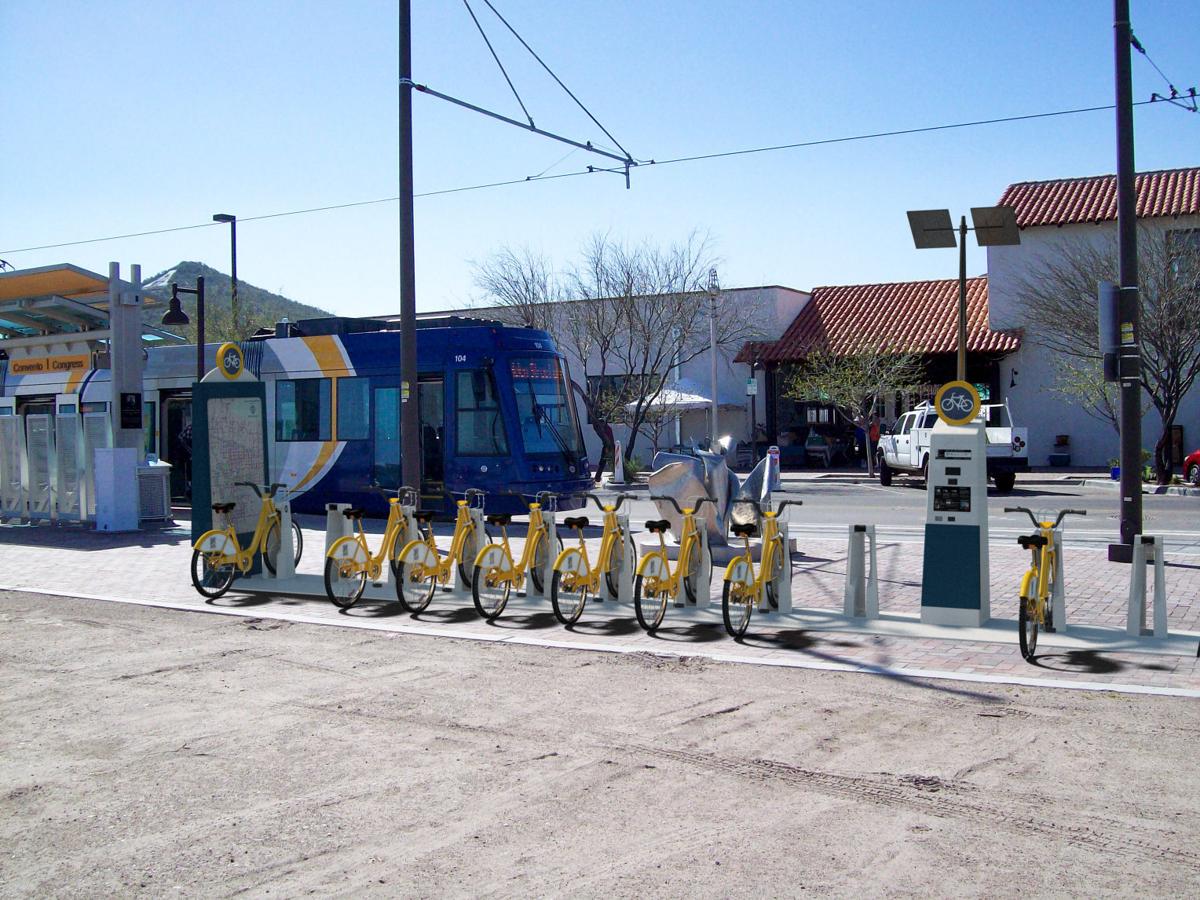
Before the next “Star Wars” movie releases, Tucsonans will have the ability to ride shared bikes across town.
Bike share is a public transportation system used by dozens of large cities around the world. The city plans to make about 300 bikes available at 30 self-service kiosks throughout Tucson, where users can check out a bike and ride it across town to another station near their destination.
The exact start date is dependent on many factors, but the program should be rolled out some time in 2017.
Some of the kiosks will be located from St. Mary’s Hospital and the Mercado, all the way to Reid Park and back to Main Gate Village. The city hopes that they will be accessible to all Tucsonans.
While Tucson is still in the planning stages, Andy Bemis, a bicycle and pedestrian planner for the Tucson Department of Transportation, says the bikes will be typical bike-share bikes — a sort of hybrid between mountain and road bikes with a basket and an “upright frame for ease of riding for people of all ages and abilities.”
The program is not yet in the stage of discovering how helmets and locks would be made available for rent.
The city won $1.3 million in federal grant funds to pay for the materials needed to start the bike-share program, including bikes, kiosks and racks. $800,000 will be used this fiscal year and $500,000 next fiscal year.
The operating cost of the program will not be coming from taxpayers. The costs will be paid from user fees and sponsorships.
“We are committed to not moving forward with bike share before we can cover those costs,” Bemis said.
Bemis said theft and vandalism is “pretty well managed” with bike share, noting that in the first year that Phoenix had a bike-share program, there were two attempted thefts.
Bemis said the new bike-share program might be similar to Tucson’s neighbor.
“In Phoenix, if the bike is stolen, it goes into lock mode or power-saving mode, and it pings its location,” Bemis said. “If a bike is not checked out and it starts moving, the bike knows.”
Maintenance on the bikes will be done frequently to ensure safety. But since the plan isn’t final, details haven’t been worked out, Bemis said.
The program has benefits for health and the economy, Bemis said.
“People who are riding tend to spend more money locally than people driving,” Bemis said, highlighting the program as a tourist attraction.
Duncan Benning, the owner of Transit Cycles, supports Tucson’s bike-share program.
In other cities, Benning said, many bike shop owners were concerned about the bike-share program having a negative impact on their business.
“The shops actually see more people buying bikes and accessories” after bike share is implemented, Benning said. “Bike share gets people experimenting with bikes and it puts cycling on their radar.”
The University of Arizona already has about 300 bikes checked out every month from its bike-share program on campus, and the city and university have been working together closely, said Florence Ochoa, a spokeswoman for University of Arizona Parking and Transportation Services.
“We know that the university has a large number of people who will use the program,” Ochoa said, “and we want to be sure that it works well.”


