

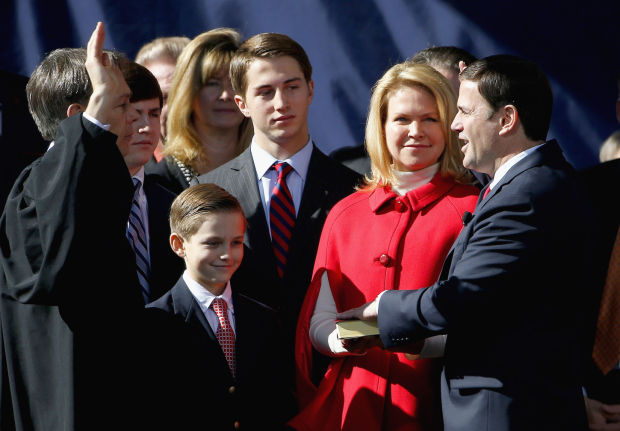
PHOENIX — Wasting no time after being sworn in, Gov. Doug Ducey immediately took the possibility of higher taxes off the table to balance the state budget, even on a temporary basis.
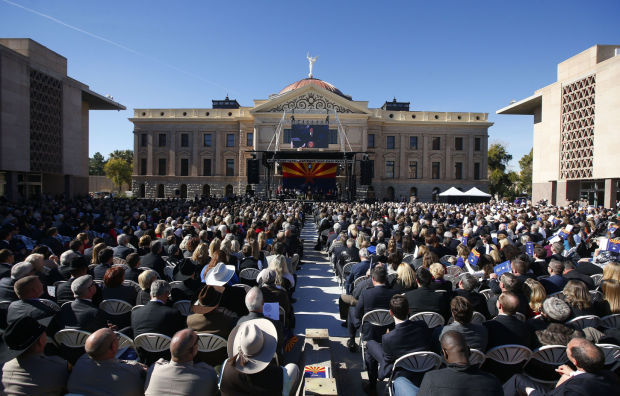
In his inaugural speech Monday at the Capitol, Ducey acknowledged the fiscal problems facing the state as he takes the reins. That includes an immediate $500 million in red ink for the current fiscal year and another $1 billion deficit for the new budget year that begins July 1.
But Ducey derided those who contend the only solution is to increase revenues in Arizona.
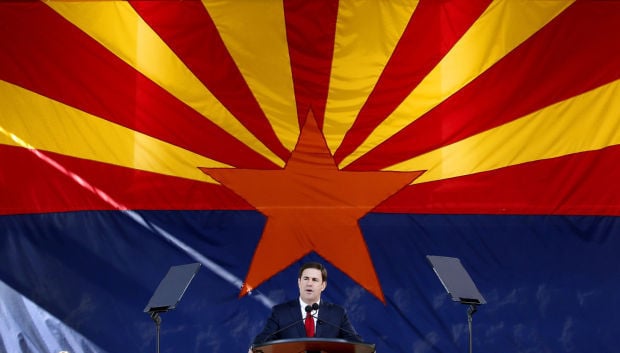
“It will be said that the state has already found all the savings that can be found, cut every line item that can be cut, and now, every option exhausted, it is for the people to pay for the shortfall with higher taxes,” he said in his prepared speech in front of the old state Capitol. “And I will reply: Not on our watch.”
Ducey said his four years as state treasurer have convinced him “a more efficient government is not only necessary, but sensible.”
“In the plainest terms, it’s not that the people are taxed too little,” he said. “It’s that their government is spending unwisely.”
Ducey did not spell out what spending he considers “unwise.” Those details will have to wait until at least this coming Monday, when he gives his State of the State address to the Legislature — and possibly until Jan. 16, when he unveils his budget.
But Ducey made it clear that he will not balance the budget with additional revenues.
“Raise taxes and you haven’t solved anything,” he said. “All that does is excuse the ineffective spending and invite more of it.”
And he warned of implications of higher taxes.
“Prosperity moves,” he said, going from one place to another. “And as taxes go up, it moves away,” Ducey continued, along with jobs, people “and companies that found a better welcome someplace else.”
Ducey’s promise of a balanced budget was applauded by both Senate President Andy Biggs, R-Gilbert, and Sierra Vista Republican David Gowan, who is in line to become speaker of the House. But Biggs acknowledged it’s one thing to talk about balancing the budget with spending cuts and quite something else lining up the votes to trim or eliminate a particular program.
Ducey made no mention Monday of his campaign promise to submit legislation each year to actually cut personal income tax rates as a method of stimulating the economy. But he did promise focused efforts he believes will lead to “new investment, more companies moving here, growing here, starting here, and many new jobs added these next four years.”
The new governor said, though, his spending plans “will not meet with general approval among special interests,” though he did not define exactly who he thinks fits in that category. Instead, he promised to focus on “opportunity for all.”
His speech did contain one specific promise: expansion of school choice.
“The right to a real education will not depend on family wealth or sheer luck,” Ducey said. He said he wants options available “to all parents, whatever their means, wherever they live, period.”
He did not say, though, whether that means expanding existing programs which provide parents with vouchers of state funds to send their children to private and parochial schools. Press aide Daniel Scarpinato said those details will have to wait until next week.
Ducey spoke to his audience, including the new crop of legislators who take office next week about what he called “simplicity” in the goals for government.
“Equal justice, public safety, aid to the helpless and the defense of the weak against the strong, take care of those duties and you have served well,” he said.
Here, too, there were few specifics. Instead, he listed the “fundamentals” of government, including guarding public health, protecting children, supporting higher education, “building roads where we develop and preserving natural lands where we don’t.”
Ducey extended an olive branch, of sorts, to the Democrats who remain in the minority in both the House and Senate.
“We can have legitimate differences and debate them openly and honestly,” he said. “We can acknowledge that all members of an elected body chosen by the people are worthy, and we can act accordingly.”
Shortly after taking office, Ducey enacted his first executive order: a moratorium on new regulatory rules by state agencies. Exceptions are provided for rules necessary to protect public health and safety, required to avoid violating a court order, fulfilling budget obligations or where they “create efficiencies.”
The action, however, likely has little practical impact: Jan Brewer, his predecessor, has had a similar moratorium in place for years.

