






When Martha McSally was still just a congressional candidate, she specified who she considered responsible for preventing epidemics in the United States: Congress and the president.
It was October 2014. The Ebola virus had suddenly gone from a distant concern in West Africa to a worry at home. A traveler had arrived infected in Texas, then two medical workers treating him were infected. Public concern spiked in mid-October, as ballots were mailed out ahead of the Nov. 4 midterm election.
In the last few weeks of the campaign, the Republican challenger McSally started hitting the Democratic incumbent, Rep. Ron Barber, on his response to the threat. I wrote a column on McSally raising Ebola as a campaign issue.
McSally’s written statement said: “It’s inexcusable that Congress and President Obama were unprepared for this threat considering we were aware of it months ago. Real leadership means taking action before there’s a crisis.”
That principle is as applicable today as it was in 2014. But now that McSally has served four years in the U.S. House and more than a year as an appointed U.S. senator, her clear vision of responsibility for epidemic prevention seems to have turned murky.
Asked by an Associated Press reporter April 10 about the federal government’s response to the novel coronavirus pandemic, McSally said “Nobody’s perfect.”
“No process is perfect, no government is perfect,” she went on. “But everybody is trying to do the best they can in order to save lives.”
McSally has gone from stern toward the federal government’s epidemic responses in 2014, when a Democrat was in the White House, to forgiving in 2020, with Republicans in charge. But she is eagerly finding fault for today’s COVID-19 epidemic. Rather than look to D.C. for responsibility, though, she is blaming China, as is President Trump and much of the GOP in a coordinated 2020 campaign.
She told the Fox Business Channel Feb. 18, “China is lying, lying to their own people, certainly lying to the international community. They are not providing access to scientists. We don’t know where this originated and how many people have been affected and how many people really died.”
Since then, her Blame-China campaign has accelerated. On April 7, she said, “China is to blame for this pandemic and the death of thousands of Americans.” McSally called for the banning of markets in China that sell live wildlife — a good idea — and she is sponsoring a bill, with Sen. Marsha Blackburn, that would allow Americans to sue China in U.S. court for damages from the epidemic — a bad idea.
This proposal might feel good, but China would ignore any damages awarded. Other countries could be tempted to remove sovereign immunity from the United States, opening U.S. military members, among others, to legal action.
Most importantly, though: It won’t help. The bill allows Americans to sue foreign states “in any case where such foreign state is alleged, whether intentionally or unintentionally, to have discharged a biological agent ... and such discharge results in the bodily injury, death, or damage to property of a national of the United States.”
This would create a disincentive to transparency. What country is going to be transparent if they might get sued even for an accident?
McSally and Trump are not wrong to blame China for covering up the coronavirus epidemic. China’s opacity did cost us time.
Still, we had time to act — “months,” as McSally said about Ebola. On Dec. 31, China reported to the World Health Organization that authorities were treating dozens of cases of a severe respiratory illness. On Jan. 21, the first U.S. case of the virus was confirmed. On Jan. 30, we had the first confirmed, person-to-person transmission in the United States.
But the initial effort by the Centers for Disease Control and Prevention to develop a test failed, and the Food and Drug Administration put up bureaucratic hurdles in front of other efforts.
Meanwhile, the president praised China for its handling of the epidemic throughout February, saying as late as Feb. 29, “China seems to be making tremendous progress … I think our relationship with China is very good.”
Over the same period, the federal government did little to improve the nation’s supply of personal protective equipment. Rather, we shipped a planeload of medical gear to China Feb. 7, and U.S. vendors sold $17.6 million in face masks and other personal protective equipment to China in January and February, the Washington Post reported.
Yes, this is all hindsight. But under the McSally Ebola Principle of 2014, the U.S. federal government, especially the president and Congress, ought to have had foresight. The fact that they didn’t is not China’s fault.
And about Ebola: It ended up infecting 11 people in the United States and killing two, total. As it turned out, the government was sufficiently prepared then. But the timing of Ebola’s arrival still allowed it to have political impact.
New research on the political impact of Ebola, published in March, shows that some 2014 Republican candidates, especially those in tight races, likely benefited from campaigning on the issue.
GOP candidates benefited either by combining talk of Ebola with discussion of immigration and border issues, or indirectly through an effect on turnout, said co-author Filipe Campante, a professor of international economics at Johns Hopkins University.
Heightened concern about Ebola, as measured through online searches and posts, was associated with lower Democratic voter turnout.
McSally won by 167 votes in 2014, thanks in part to poor Democratic turnout. The Ebola issue may have been decisive in launching her political career.
It would be nice if she returned to her political roots by holding the president and the Congress she’s now part of accountable for protecting Americans from epidemics by “taking action before there’s a crisis.”
As of now, at least 40,000 Americans have died of this one.
Photos for April 11: Tucson gets by during Coronavirus Pandemic
Tucson in photos, coronavirus pandemic
Updated
Susan Hillman chats with her mother Betty Hillman via telephone, April 9, 2020, Tucson, Ariz. Eighty-five year old Betty Hillman is in long term skilled care and Susan is unable to visit due to COVID-19 restrictions on nursing home facilities.
Tucson in photos, coronavirus pandemic
Updated
Susan Hillman chats with her mother Betty Hillman near a photo of Betty and her husband, Susan's dad, Bill, circa 2105, April 9, 2020, Tucson, Ariz. Eighty-five year old Betty Hillman is in long term skilled care and Susan is unable to visit due to COVID-19 restrictions on nursing home facilities.
Tucson in photos, coronavirus pandemic
Updated
Ben Forbes, left, owner of Forbes Meat Company, helps Jeronimo "Mo" Madril, right owner and executive chef of Geronimo's Revenge, wrap up tortilla's for to-go carnitas for Forbes Meat Company and Geronimo's Revenge's "Carnitas for the community" at Thunder Canyon Brewery, 220 E. Broadway Blvd., in Tucson, Ariz., on April 6, 2020. Forbes Meat Company and Geronimo's Revenge partnered to help the restaurant community by offering free carnitas to those affected by the Coronavirus Disease (COVID-19). They will be making to go carnitas every Monday in April starting at 2pm until all the to go packs, roughly 60, are all gone. Forbes wanted to find a way to help out the restaurant community. "They are struggling and my business is exploding," said Forbes.
Tucson in photos, coronavirus pandemic
Updated
David Clark, left, out of work bartender, and Jeronimo "Mo" Madril, owner and executive chef of Geronimo's Revenge, practice social distancing while waiting to give out carnitas for Forbes Meat Company and Geronimo's Revenge's "Carnitas for the community" at Thunder Canyon Brewery, 220 E. Broadway Blvd., in Tucson, Ariz., on April 6, 2020. Forbes Meat Company and Geronimo's Revenge partnered to help the restaurant community by offering free carnitas to those affected by the Coronavirus Disease (COVID-19). They will be making to go carnitas every Monday in April starting at 2pm until all the to go packs, roughly 60, are all gone.
Tucson in photos, coronavirus pandemic
Updated
Steve Tracy, Thunder Canyon Brewery co-owner and brewer, fills up 16oz bottles of locally made hand sanitizer at Thunder Canyon Brewery, 220 E. Broadway Blvd., in Tucson, Ariz., on April 6, 2020. Thunder Canyon Brewery, along with a few other local distilleries, are making United States Food and Drug Administration approved hand sanitizer for hospitals, first responders and the public in response to Coronavirus Disease (COVID-19). "Whatever I have, I am turning into hand sanitizer," said Tracy. "We are going to keep making it as much as we can."
Tucson in photos, coronavirus pandemic
Updated
Steve Tracy, Thunder Canyon Brewery co-owner and brewer, fills up 16oz bottles of locally made hand sanitizer at Thunder Canyon Brewery, 220 E. Broadway Blvd., in Tucson, Ariz., on April 6, 2020. Thunder Canyon Brewery, along with a few other local distilleries, are making United States Food and Drug Administration approved hand sanitizer for hospitals, first responders and the public in response to Coronavirus Disease (COVID-19). "Whatever I have, I am turning into hand sanitizer," said Tracy. "We are going to keep making it as much as we can."
Tucson in photos, coronavirus pandemic
Updated
David Sbarra, a psychology professor at the University of Arizona, points his webcam at his children Margot, 9, and Mateo, 12, as he begins his introduction of his office hours for a class he now conducts over Zoom in his living room while teaching from home, on April 7, 2020.
Tucson in photos, coronavirus pandemic
Updated
Ben Elias, manager at Westbound, center, helps Dustin Schaber with his pickup order on April 8, 2020. Due to the coronavirus disease (COVID-19) only two customers are allowed in the shop, located at the MSA Annex, at the same time and all orders are to-go.
Tucson in photos, coronavirus pandemic
Updated
Laura Tanzer, a local fashion designer, posted on Facebook that she will make masks for $5.00 each on April 5. Tanzer thought she would receive a couple of dozen orders, but, within 24 hours she heard from over 200 people. Tanzer is now working out of her shop in downtown Tucson making masks that also has a filter sowed into them. Tanzer is wearing one of her masks as she sows on April 8, 2020.
Tucson in photos, coronavirus pandemic
Updated
Oro Valley Hospital chief administration officer Erinn Oller talks with Fang, a local organizer with the Chinese-American COVID-19 Relief AZ group, which donated 6,000 masks, on April 9, 2020. Additional mask donations are planned as soon as shipments arrive.
Tucson in photos, coronavirus pandemic
Updated
Healthcare workers line up for their 2 free Sonoran hot dogs and a drink from BK Carne Asada & Hot Dogs in the parking lot of St. Mary's Hospital on April 10, 2020. The owner, Benny Galaz, is giving free food to healthcare workers at Tucson area hospitals for the next several weeks as a way to say thank you for their hard work during the coronavirus disease (COVID-19) outbreak.
Tucson in photos, coronavirus pandemic
Updated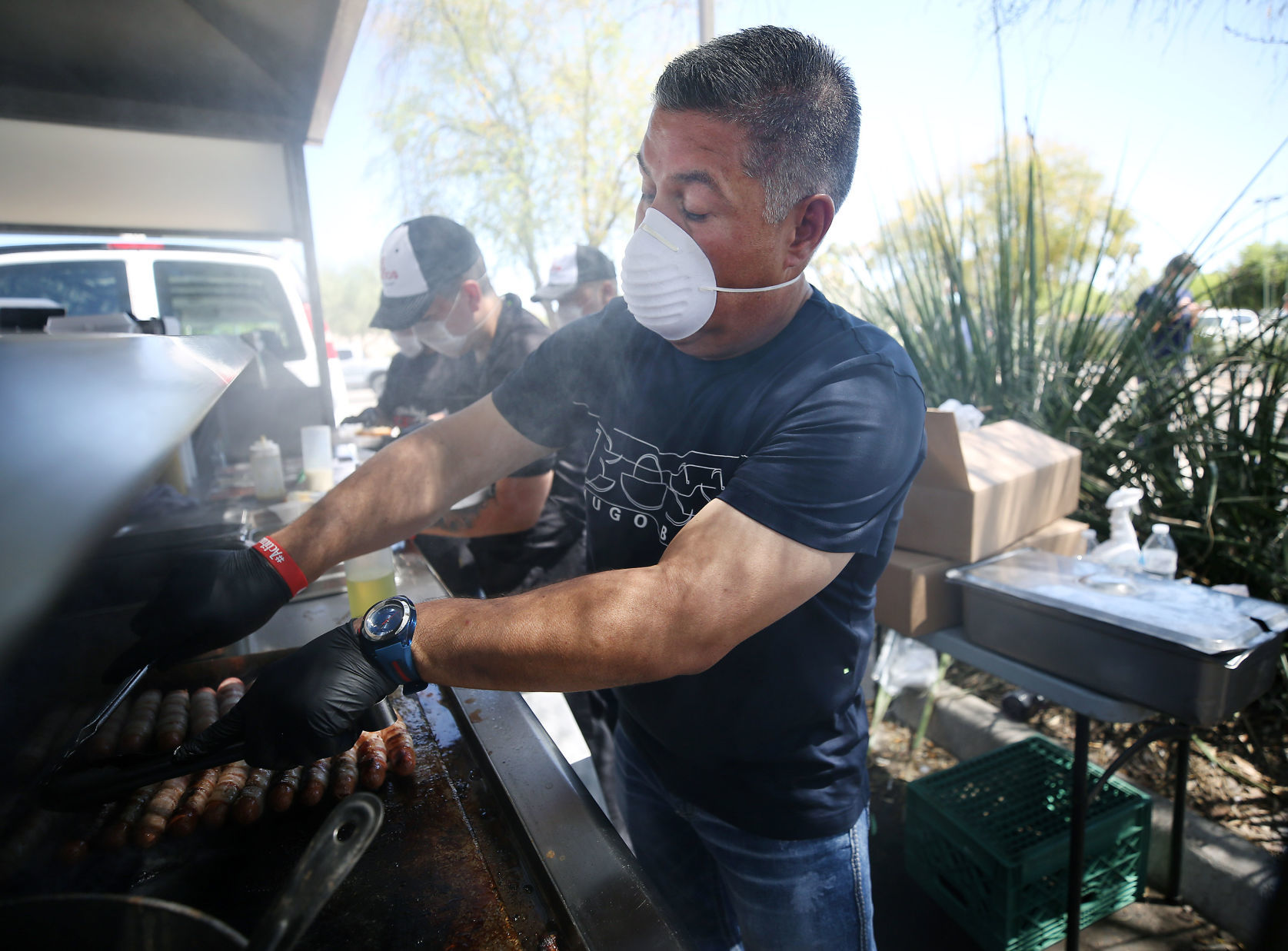
Benny Galaz, owner of BK Carne Asada & Hot Dogs, cooks up Sonoran hot dogs in the parking lot of St. Mary's Hospital on April 10, 2020. Galaz is giving free food to healthcare workers at Tucson area hospitals for the next several weeks as a way to say thank you for their hard work during the coronavirus disease (COVID-19) outbreak.
Tucson in photos, coronavirus pandemic
Updated
Healthcare workers line up for their 2 free Sonoran hot dogs and a drink from BK Carne Asada & Hot Dogs in the parking lot of St. Mary's Hospital on April 10, 2020. The owner, Benny Galaz, is giving free food to healthcare workers at Tucson area hospitals for the next several weeks as a way to say thank you for their hard work during the coronavirus disease (COVID-19) outbreak.
Tucson in photos, coronavirus pandemic
Updated
A man uses the taped off exercise station in Reid Park as an anchor for his band workout, April 8, 2020, Tucson, Ariz.
Tucson in photos, coronavirus pandemic
Updated
Alicia Roseanna, 9, fourth grader at Esperanza Elementary School, grabs a sheet of paper while listening to her teacher, Rachel Watson, and her classmates inside her home in Tucson, Ariz. during Watson's online class on April 7, 2020. Due to the Coronavirus Disease (COVID-19) closing down schools and universities, teachers and students have been forced to schedule and participate in classes online for the remainder of the school year.
Tucson in photos, coronavirus pandemic
Updated
COVID-19 survivor, Glen Reed, poses for a photo looking out from the room he's using for isolation from his family in his home, April 10, 2020, Tucson, Ariz. Reed spent nearly a month in the hospital including weeks in ICU on a ventilator.
Tucson in photos, coronavirus pandemic
Updated
ER and EMS workers run through a drill practicing how to process an incoming patient experiencing a respiratory emergency at the Tucson Medical Center's Emergency Room, on April 10, 2020.
Tucson in photos, coronavirus pandemic
Updated
Tucson Fire Paramedic personnel prepare to run a drill at the Tucson Medical Center's Emergency Room, on April 10, 2020.
Tucson in photos, coronavirus pandemic
Updated
The CDC recommends Americans wear a facial covering when out in public, part of an effort to reduce the spread of the virus that causes COVID-19. Above, shopping for spring blooms at Tucson’s Green Things Nursery.
Tucson in photos, coronavirus pandemic
Updated
Coronavirus disease (COVID-19) signs taped onto dorms at the Babcock Dorms. The rooms located at 1717 E Speedway Boulevard may be used to house hospital workers from Banner - University Medical Center if they need to be quarantined due to COVID-19.
Tucson in photos, coronavirus pandemic
Updated
Alex Swain, a member of Beloved in the Desert - Tucson's chapter of the Episcopal Service Corps, packs the trunk of his housemate's SUV in the parking lot of Fry's on 2480 N Swan Road after grocery shopping for an elderly man, on April 3, 2020. Swain and his housemates have volunteered to shop for elderly and at risk populations as people quarantine and stay at home during the Coronavirus (COVID-19) pandemic.
Tucson in photos, coronavirus pandemic
Updated
Julisa Montano, a bus driver with Sunnyside Unified School District, gathers up the last few meals to hand out to students outside of Gallego Primary School, on April 7, 2020. The school district is distributing meals and has wifi available for students to use for school.
Tucson in photos, coronavirus pandemic
Updated
A table is taped off at Fred Enke Golf Course, 8251 E. Irvington Rd., in Tucson, Ariz., on April 5, 2020 due to Coronavirus Disease (COVID-19). With a rise in the amount of people participating in golf, due to Coronavirus Disease (COVID-19), Tucson City Golf is taking extra measures to keep people safe such as sanitizing golf carts after each use and social distancing.
Tucson in photos, coronavirus pandemic
Updated
Rich DelVecchio, a Fred Enke Golf Course employee, sanitizes a golf cart. Course revenues at Tucson’s city-owned golf properties are up nearly 28% from the same period last year.
Tucson in photos, coronavirus pandemic
Updated
Golfers practice social distancing while on the driving range at Fred Enke Golf Course, 8251 E. Irvington Rd., in Tucson, Ariz., on April 5, 2020. With a rise in the amount of people participating in golf, due to Coronavirus Disease (COVID-19), Tucson City Golf is taking extra measures to keep people safe such as sanitizing golf carts after each use and social distancing.

