







Tim Steller is the Star’s metro columnist. A 20-plus year veteran of reporting and editing, he digs into issues and stories that matter in the Tucson area, reports the results and tells you his opinion on it all.
From certain angles, Tucson looks like a flaming progressive city.
Like from Lake Havasu City.
Or from the historic center of Tucson.
But from either of those angles, it’s a misperception, a distortion caused by the particular politics of that place. The results of the Tucson city election that ended Tuesday showed this.
Example A was the vote on the so-called sanctuary initiative, Proposition 205. For some months I’ve wondered aloud, including on social media, whether it isn’t the kind of idea popular in the part of town that considers itself the heart of Tucson, but not so popular in the vast acreage sprawling east, south and north from downtown.
This part of town is what I call the streetcar corridor — from the university, down North Fourth Avenue, through and around downtown over to the near west side. This is the area that is home to much of the artistic creativity that characterizes the city — the murals, the galleries, the writers, the musicians. The area is essential to what makes Tucson more than a long series of commercial strips. It’s an area that gets a lot of attention.
But it is also atypical of the city as a whole. The bulk of the Old Pueblo’s population lives in square mile after square mile of single-family homes, mobile home parks and apartment complexes stretching out in all directions. It’s a varied populace, much more Democratic than Republican, but surprisingly mainstream, especially if you’re looking at Tucson from a fortified bunker in Lake Havasu, expecting us to foment revolution.
From the streetcar corridor, the idea of giving the middle finger to the state Legislature and declaring Tucson a sanctuary city seemed like a natural choice. We should take risks to support the undocumented neighbors who need our help, supporters argued, even if it means facing the wrath of the Republican majority at the state Capitol. Besides, they said, the initiative was carefully written not to violate state law. (This was arguably true, though the Legislature would undoubtedly have changed state law to punish us.)
Tucson as a whole, though, didn’t find supporters persuasive. In fact, an analysis by my colleagues at the Arizona Daily Star shows the only area of the city that voted for the sanctuary initiative was precisely the streetcar corridor — the area including the university, downtown and adjacent neighborhoods. Even the south and west sides, the centers of Tucson’s Mexican-American community, voted “no.”
Supporters of the initiative have blamed the expensive anti-initiative campaign for using what they say are distortions or even outright lies by opponents, who included city officials. But I’m not sure if the vast margin of defeat — 71% to 29%in the counting so far — supports that conclusion. Would any initiative labeling Tucson a “sanctuary” have passed?
Residents of Tucson know we’re a poor city. We know we have long police-response times and mediocre roads. And by and large we were unwilling to risk making those problems worse as an unintended consequence of passing the initiative. If the worst-case scenarios played out, in fact, the city’s poor residents would have been the hardest hit. So the “no” vote was a risk-averse, pragmatic response.
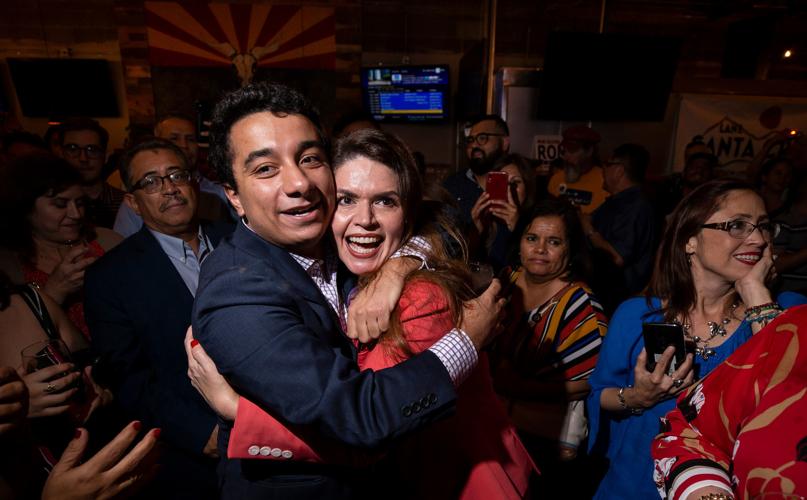
That also explains Example B, Regina Romero’s strong performance in winning around 56% to independent candidate Ed Ackerley’s 40% in the mayor’s race. Romero, who has in the past favored the concept of becoming a sanctuary city, rejected this particular initiative. She said she sympathized with the spirit of the ballot issue, but she had experienced making painful budget cuts after the recession reduced city revenue, and she did not want to risk putting Tucson in that position again.
Politically, it was a crucial move, putting her right where she needed to be to succeed with today’s Tucson’s electorate.
“Clearly the city was ready for, arguably a more progressive mayor than it’s maybe ever had,” Romero campaign manager Nate Sigal told me.
But she couldn’t be too progressive. Supporting the initiative might have helped Romero in the Democratic primary, but it would have hurt her in the general election.
“If she had endorsed it, I would have edged up closer to 50% ,” Ackerley estimated when we talked Thursday.
Alison Jones, who is chair of the Pima County Democratic Party, assessed Romero’s stand on 205 this way: “I don’t know what to say except, that’s politics, and it worked for her. Given the vote count on 205, I’d say she made the right call.”
Romero won the whole city west of Wilmot Road, the Star analysis found. East of there, Ackerley won.
Ackerley was pretty happy with his vote total of around 40% . It’s hard to launch and run a campaign without a party organization behind you, he noted. And the Democrats were formidable.
In past decades, though, Ackerley probably would have been a candidate with a party and interest groups behind him. Though he was a lifelong Democrat till this year, Ackerley’s policy positions follow the tradition of business-moderate Republican mayors such as Lew Murphy and Bob Walkup who have succeeded in Tucson politics.
The difference is, the Tucson we live in now no longer has a party home or even business support for such a candidate. The Tucson Metro Chamber of Commerce, which has been a reliable supporter of such candidates in the past, didn’t even make an endorsement in the general election. Ackerley and his ad agency are longtime members of the chamber.
Ackerley told me he suspects it was too risky for business groups to support him when, as an independent, he had little chance to win, and the result would simply be these groups starting off badly with the next mayor. On the other hand, running as a party member also would have doomed him.
“If I’d have run as a Republican, I’d have been trounced. Had I run as a Democrat, I never would have made it out of the Democratic primary,” he said.
The Pima County Republican Party, unable to find a strong mayoral candidate, cleared out of the way for Ackerley to make a run, chair David Eppihimer said.
“This is just a Democrat city,” Eppihimer said. “That’s just the way it is.”
But the results did put the Pima County Democratic Party in an awkward position. The executive committee voted by a 27-9 margin in March to endorse the sanctuary initiative, but their mayoral and council candidates were against it. And the rank and file of the party appear to have voted against it in large numbers.
“Obviously, there were a lot of Dems who did not vote for 205,” Jones said. “I think it was because the legal implications are really not clear to anybody.”
“There was a lot of uncertainty. When people are uncertain, they will stay with what they know.”
So this is the Tucson we live in now. It’s a city where business moderates will have a hard time becoming mayor, no matter their party. And it’s a city where you can be a pretty progressive Democrat and win the mayor’s race. But you can’t be too progressive.
Flaming progressive only works in the streetcar corridor.

