



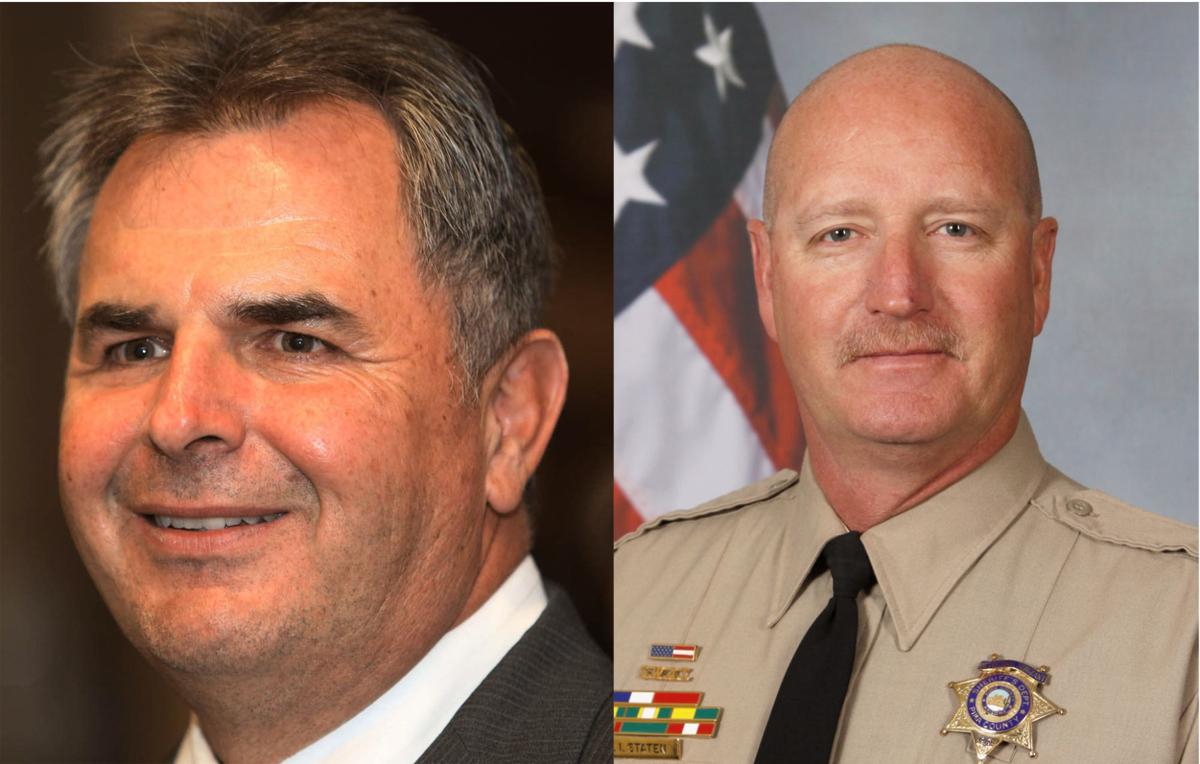
Two veteran law enforcement officers will be facing off in August’s Republican primary election for Pima County sheriff, bringing with them a combined 50 years of experience.
Mark Napier, 54, challenged then-Sheriff Clarence Dupnik in the 2012 election, coming up short with 46 percent of the vote to Dupnik’s 51.
Terry Staten, 51, is a sergeant with the sheriff’s department, but was placed on administrative leave in late May after county administrator Chuck Huckelberry said he violated a county policy related to campaigning.
The winner will face Sheriff Chris Nanos, a Democrat, in the November general election.
The Star spoke to both candidates about their positions. The primary election is Aug. 30.
Deputy pay issues
For the past year, the deputies union has been asking the Pima County Board of Supervisors to follow through on increases in salary, or “step increases,” that hundreds of employees were promised years ago.
Deputies, sergeants and corrections officers who were hired during the last nine years are being paid at the same rate as new hires.
Nanos has taken a different route, asking the board for “decompression” — a plan that would adjust deputies’ pay to bring them up to the proper level of the department’s pay scale.
Negotiations with the board ceased in late March, when County Administrator Chuck Huckelberry said he wouldn’t support salary increases for sheriff’s employees, as it excludes all other county employees.
Napier said having deputies who have been with the department for nearly a decade being paid the same as newly hired deputies doesn’t make sense. This leads to veteran deputies leaving the department for better paying jobs elsewhere.
“I would examine the current budget before going to the taxpayers or board of supervisors, to be sure we’ve done everything internally we can,” Napier said. “The organization might be a little on the top-heavy side, and there may be ways to save money there.”
Deputy and sergeant pay has been an issue for years, but Staten said it’s only discussed during elections.
“If I’m elected, it will be an ongoing effort, because it’s always about supporting the deputies in the field, corrections officers and the civilian staff,” Staten said. “If the upper-echelon, and I mean captains and above, were to just go away, the department would still run. If we don’t have any sergeants and deputies in the field, we can’t function. We have to be able to support them to even exist.”
Staffing levels
Both candidates have discussed the issue of “cronyism” during interviews with the media, saying some of the department’s high-ranking officials — including Nanos — exercise favoritism.
Last year, Chief Deputy Christopher Radtke retired, but was rehired and returned to work days later. Brad Gagnepain, former senior executive advisor, also retired from the department, but was brought back on last year by Nanos in a newly created chief of staff position.
“We need to end the policy of using unclassified positions to retain cronies,” Napier said. “For positions above sergeant, I’d implement a 360-degree review process, that would include input from peers, subordinates and command staff,” he said. “This would ensure that we’re promoting the appropriate people. It’s easy to do, and it adds a layer of transparency to the process.”
Staten said that he’d re-evaluate the entire structure of the department to find out which positions are needed.
“I question the chief-of-staff position. I don’t know where that came from. I thought the sheriff and chief deputy were supposed to be dealing with the staff issues,” he said. “That would be something I’d look at, since I don’t understand the reasoning behind it now. One of the things I did with the units I’ve had is, every six months, we’d sit down and evaluate what we’re doing and why we’re doing it. And if there was no real reason for doing something, we’d change it.”
Improving mental health response
In January, deputies shot a man who had been released from a local mental health provider after stabbing himself in the neck while fleeing from U.S. marshals the week before.
While he was at the facility, the department’s mental health support team served an order for him to appear in court for a mental health evaluation, but he failed to appear to the court date after he was released and days before he was shot and wounded by deputies. It’s unclear why he was released from the facility.
Napier suggested creating partnerships with the University of Arizona’s psychology department, seeking grant funding for mental health programs within the sheriff’s department, and creating internships for UA students studying criminal justice or mental health. A current UA employee, Napier said he has the connections to make these ideas a reality.
“My undergraduate degree is in psychology, so I understand mental health issues on an operational and academic level. I’d like to provide internal education for the deputies and more critical incident training on how to handle people with mental illness,” Napier said.
Staten said that while he was heading up the mental health support team, Pima Community College and Marana police were dedicating an officer to the team one day a week to help train other agencies on mental health issues.
“Before I left, we were also looking at co-locating with the city and one of the mental health providers in this town, and being housed in their office. We’d be able to walk across the hall to a recovery coach or a case manager, and we could use the resources if we needed it,” Staten said.
Crime-fighting ideas
Napier mentioned border issues as one of his priorities, saying that sheriffs in Maricopa and Pinal counties have been working with Gov. Doug Ducey on ways to improve law enforcement on or near the border. Last fall, Nanos called Ducey’s plan to create a border strike force “insulting,” which Napier said was just wrong.
“What I would also like to do is take the best elements from the best models — information-driven policing, problem-oriented policing and community policing — to develop a blended best-practices approach,” Napier said. “We’re looking toward long-term resolution to community problems by seeking the root causes.”
Staten wants to see an increase in support for deputies by members of the command staff, including going out into the field and making themselves more accessible to all members of the department.
“They’ve put themselves in positions where they don’t feel like the troops need to know who they are,” he said about top command staff.
Technology in the field
Agreeing with the position Nanos has taken, Napier said he’s not in a rush to bring body-worn cameras into the department.
“There are reasons to wait on body cameras and see how they pan out with other agencies, one of them being cost for storage,” he said.
Staten also agreed that the expense of body cameras is currently too great, but if the opportunity comes up to get body cameras at a low cost, Staten said he’d consider it.

