

Minnie Maddern first walked onto a stage when she was 3 years old and rarely left it until shortly before her death at age 66. She played in theaters across the country and even made a few early films. She spent only a few days in Arizona during her acting career, but her impact at the time was felt from one end of the territory to the other.
The name she was given at birth on Dec. 19, 1865, in New Orleans was Marie Augusta Davey, daughter of a theatrical agent and an actress. When she made her debut on stage in Little Rock, Arkansas, as a young Duke of York in the play “Richard III,” she was billed as Little Minnie Maddern.
Minnie often accompanied her father when he went on tour, and after her parents divorced, she and her mother toured together.
She was barely in her 20s when she traveled out West, arriving in Prescott in 1887.
“Grand Dramatic Event,” proclaimed Prescott’s Weekly Journal-Miner newspaper. Minnie was to perform shows on April 18 and 19 of the play “Caprice,” and a third show on the 20th of “Frou-Frou,” both light comedies at which she excelled.
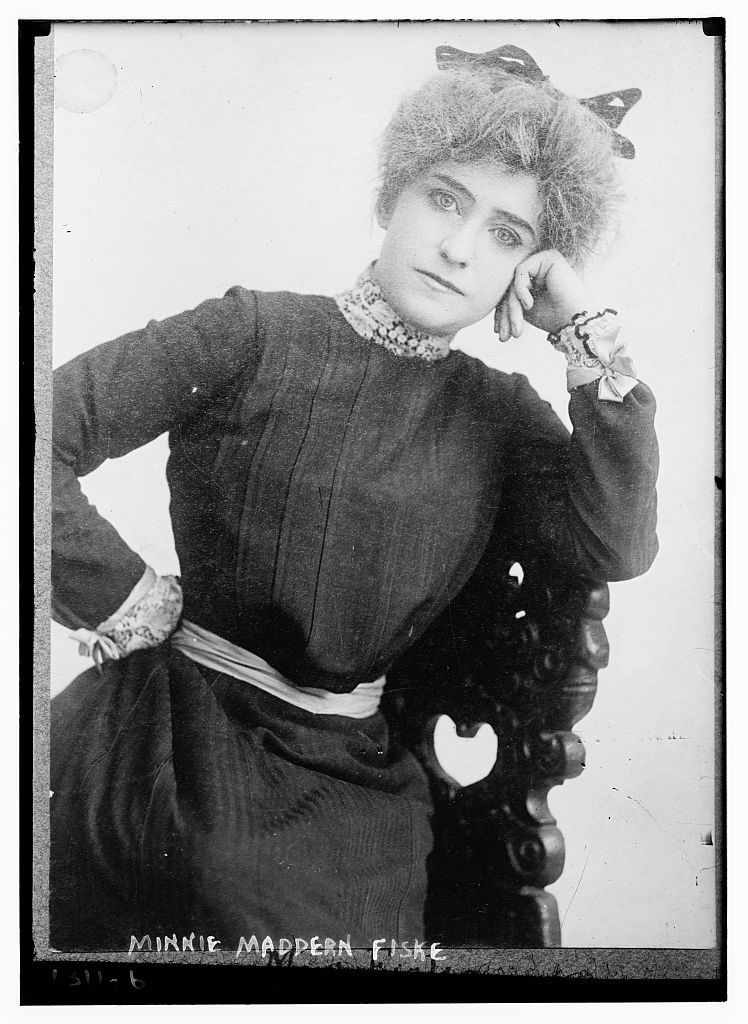
Minnie Maddern Fiske
Much was made of her $2,000 dresses during her performances at Howey’s Hall (Bashford’s Opera House), and the reviewers exclaimed, “There is so much for the true ring in Miss Maddern’s voice that it is no wonder she is such an expressive vocal as well as dramatic artist, as she proved by her rendition of a waltz melody in which she accompanied herself on the piano.”
It would be 20 years before Minnie returned to the Arizona stage.
Minnie had married as a teenager but shed her first husband in 1888. Two years later, she married Harrison Grey Fiske, a wealthy playwright, journalist and Broadway producer who owned the “New York Dramatic Mirror” theater publication. From that time, Minnie preferred to be billed as Mrs. Fiske on theater marques.
Initially, Minnie tried to be the dutiful wife. She left the stage but soon grew bored of domestic life and began writing plays. She returned to the stage in 1893.
Now a mature actress, Minnie went on tour in 1907, booking shows as she traveled the country. Her first stop in Arizona was on May 31 at the Dreamland Theater in Globe for a performance in “The New York Idea,” a light comedy about divorce. The theater, which served as a skating rink most of the year, was outfitted with a grand stage and seating for 2,500, the largest theater in the Southwest at the time.
“One Night Only,” ran the ad in Globe’s Daily Arizona Silver Belt newspaper. “Mrs. Fiske in ‘The New York Idea.’ Special Scenery! Magnificent Costumes! Perfect Cast! Reserve Seats Now.”
People came by train, buckboard and on horseback to see the famous New York actress.
Minnie and her troupe arrived by train after being delayed in Bowie, causing the performance to start several hours later than planned. Almost everyone stayed until the show ended at two o’clock in the morning.
“It was no ordinary audience and the company gave no ordinary performance,” claimed Minnie. “In the canyon theatre there was a warmth as well as a brilliance, and it was answered by the most overwhelming response which the play has ever produced.”
After the show, the troupe was transported back to Bowie by train to await a connection that would take them to Tucson for their next performance the following day at the Tucson Opera House.
Built in 1897 by businessman Anthony Vincent Grossetta, the Tucson Opera House held about 700 people. It boasted a balcony and had both gas and electricity throughout. The audience, while wilting in the summer heat, stayed mesmerized throughout the show.
According to one audience member, “It was well worth the sacrifice as ‘The New York Idea’ was the best ever presented in Tucson.”
From Tucson, Minnie headed for Los Angeles but returned to Arizona the following year to perform in Henrik Ibsen’s play “Rosmersholm,” a dark drama in stark contrast to the lively shows she had presented in the past.
On June 18, 1908, “Rosmersholm” opened at Bisbee’s Orpheum Theater to a sold-out audience of 1,000. One reviewer noted, “[T]he play was on a higher plane than any which had been presented in Bisbee,” and the audience raved that, “the wonderful voice of Mrs. Fiske, without any assistance was able to express without effort, every range of feeling from lightness to tragedy.”
The following evening, she was at the Tucson Opera House, where she received thunderous curtain calls, although one reporter admitted he had trouble following the play that he said was “of weird fascination, and it would be hard to explain.”
June 20 found Minnie in Phoenix, ready to perform at the Olympic Theater that could hold 900, but fewer than that showed up. Phoenicians did not like “Rosmersholm,” found it morbid and suggestive. But they did like the scenery.
“The scenic features were splendid even luxurious,” reported The Arizona Republic newspaper, “and admirably adapted to the play. The waits were too long between the acts and owing to Mrs. Fiske’s custom of having no music, the wits came dangerously near being wearisome.”
That was Minnie’s last live performance in Arizona. She was off to Los Angeles the next day and continued her successful career with one critic proclaiming, “She could star herself in a dramatization of the telephone book and I would praise her.”
She did return to Arizona theaters, however, in 1914 when the film “Tess of the D’Urbervilles” premiered. “It was almost a living, breathing Mrs. Fiske who greeted a ‘standing room only’ crowd,” gushed one reviewer.
Minnie died on Feb. 15, 1932, at her home in Hollis, Long Island. Ever the consummate actress, she never wilted on stage or in front of the camera. However, during one rehearsal, when someone noted the aging actress seemed to be tiring and suggested she take a much-needed rest, Minnie refused, remarking that, “this is just one of those occasions when the best-lifted faces fall.”

