


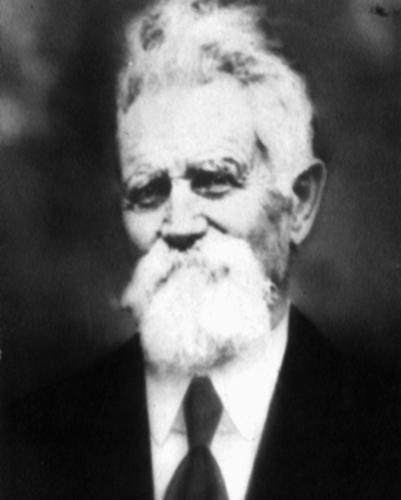
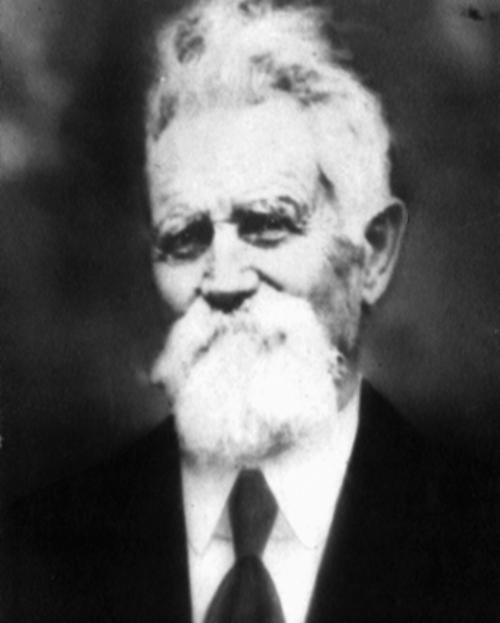
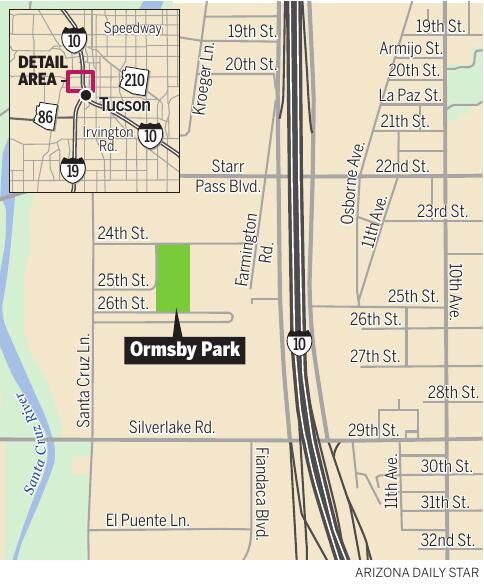
In 1972 — a century after his arrival in the Old Pueblo — the Tucson City Council named a park in honor of William Wallace Ormsby, a Civil War veteran who settled here.
Ormsby and his twin Levi Washington Ormsby were born Dec. 2, 1835, in Amherst, Ohio. Their father was William Ormsby, and their mother was likely Olive or Minerva Ormsby, and they also had a daughter.
By late 1843, it's believed the family, members of The Church of Jesus Christ of Latter-day Saints, or Mormons, had relocated to Kirtland, Ohio, which a few years earlier had been the center of this new religious movement and became the site of its first temple.
A couple years later, the family was in Nauvoo, Illinois, and likely witnessed the construction there of the second temple, as well as some of the mob violence against Mormons in that city, which eventually led to their departure.
By 1850, the family was at present-day Council Bluffs, Iowa, and in June of that year departed on a church wagon train, consisting of about 200 souls and approximately 50 wagons, known as the Milo Andrus Company. They passed many graves along the way, due in part to the cholera epidemic of the time, as they traveled along the Platte River through Nebraska and Wyoming before entering present-day Utah.
What happened after the Ormsby family's arrival in Utah was described in a letter a few years later by John Stoker, the bishop of Bountiful, Utah, to Abner Ormsby, who inquired about the location of "my brother William Ormsby, a man about 65 years of age":
"William Ormsby was a resident of the North Canyon Ward, Davis County, and he died in December 1851 or January 1852. He had a daughter named Olive Cynthia Ormsby who died March 1, 1851, age 17 years. He had two sons that were twins; their names were Levi & William Ormsby, who left the (Utah) Territory in the spring of 1853 for Lower California and were living near San Bernardino for a number of years — nothing further is known concerning them." (The fate of the children's mother is not known.)
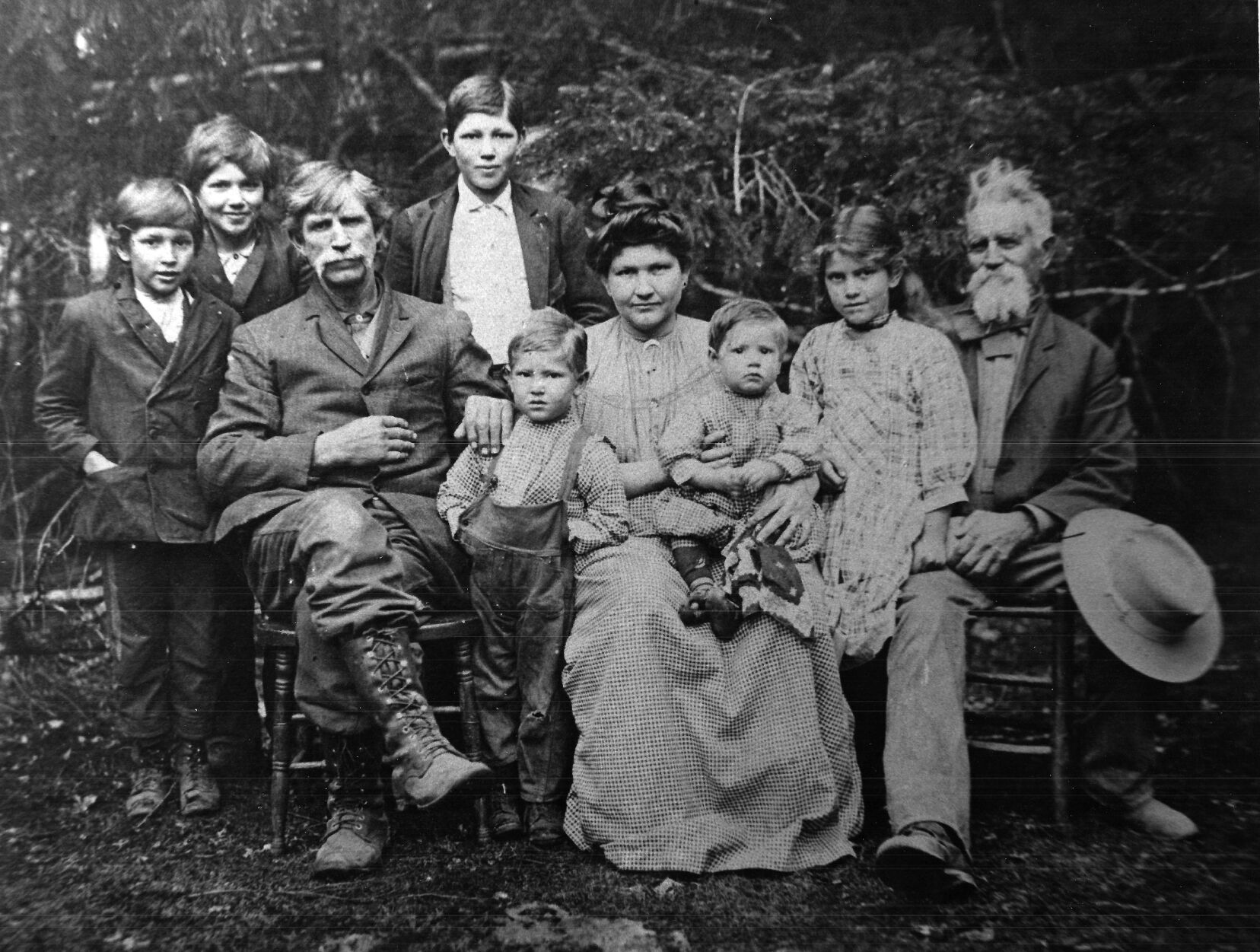
George Myers, Carmen Ormsby Myers and kids. W.W. Ormsby is at far right.
During the U.S. Civil War, Capt. Alexander Gibson organized what would be known as Company B., 7th California Infantry Regiment of the Union Army, at Marysville, California. The Ormsby brothers enlisted as privates, Levi on Oct. 10, 1864, and William Wallace on Oct. 27, 1864.
After the company was mustered into service on Nov. 1, 1864, it was dispatched to the Presidio of San Francisco, where it remained until May 1865, when it was ordered to Tucson, Arizona Territory.
The unit traveled by sea to San Pedro, California, marched from there to Fort Yuma, and thenceforth east along the Gila River and south along the Santa Cruz River to Tucson.
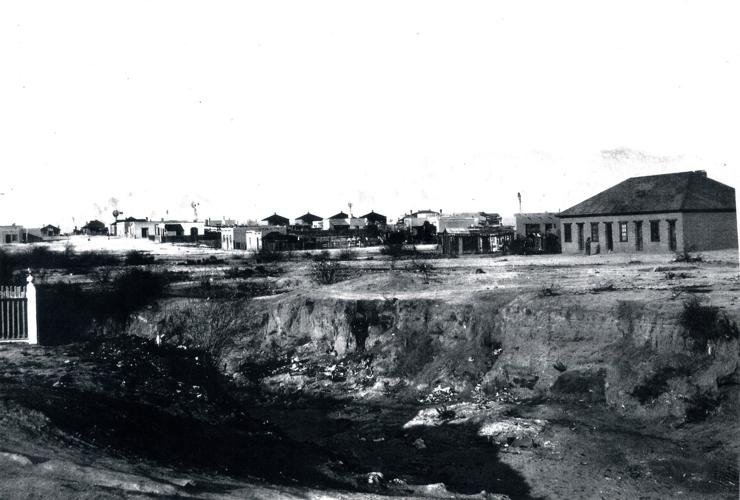
The Ormsby brothers spent a few months shy of a year in the Old Pueblo, a sunbaked adobe village that had begun as a Spanish presidio or fort and slowly grew outside the thick adobe walls.
While stationed here, it’s likely the brothers learned from the sparse Spanish-speaking population the names of the dirt streets they walked in town, which in many ways described the town itself.
For example, Calle del Arroyo (Wash Street) was where the arroyo or wash ran just south of the old fort wall into the nearby Santa Cruz River; Callejon Del Herrero (Blacksmith Alley) was where Louis Quesse, a Prussian-born blacksmith, plied his trade on one side of the alley and Pvt. Thomas Belknap, (Co. B., 1st California Regiment Cavalry) carried out the military blacksmith, farrier and wagon shop; and Calle de la Mesilla (Mesilla Street), a thin dirt path was where wagon trains carrying goods from Mesilla, New Mexico Territory traveled to La Plaza de la Mesilla (Mesilla Plaza) to be unloaded. The latter street name was soon changed to Mesilla Street and existed until about 1970. It was the last of the original Spanish street names.
It's unlikely either brother ever did any real fighting while stationed in Tucson, although it's possible one or both were part of Lt. Frank Upham's detachment to recover the bodies of a father, mother and child from Monterey, Mexico, who had been killed by Apaches about 27 miles southeast of Tucson near Cienega Creek. It's also likely the brothers spent many hours at the canvas-covered sentinel station on top of Sentinel Peak ("A" Mountain) watching for Apache raiding parties.
In early 1866, Company B. was ordered back to the Presidio of San Francisco where the brothers were mustered out on April 26, 1866.
The inseparable brothers relocated to San Rafael and then Santa Rosa, California, where William worked as a saddler and Levi as a miller, before becoming farmers in Carpenteria, California.
By late 1871, Ormsby had a letter waiting for him at the Tucson post office that had not yet been picked up, so he was likely on his way to Tucson at this point and likely arrived in early 1872.
By March 1873, Ormsby was involved with two partners in a small gold mining operation about 30 miles west of Tucson.

Windmills in Barrio Santa Cruz, ca. 1930s or 1940s that were installed by William B. Ormsby.
On Dec. 28, 1873, Judge W.J. Osborn (namesake of Tucson's misspelled Osborne Avenue) married William W. Ormsby to Refugia Buelna. Buelna is believed to have been born around 1850 in Sonora, Mexico, and to have immigrated to the U.S. around 1870.
The couple would have children William B. Ormsby in 1876, Carmen "Carrie" Ormsby in 1878, Rosa Ormsby around 1880 and possibly a fourth child, Rafael, around 1884.
In 1874, William W. Ormsby was part of a coroner's jury during an inquest into the killing of two suspected horse thieves near Desert Station, about 27 miles northwest of Tucson.
By late 1876, Ormsby was spending time near Florence, Arizona, likely searching for precious metals. Four years later he was involved in a mine named Phebe B. or Phoebe B. in the Santa Catalina Mountains.
In the mid-1890s, Carmen Ormsby married rancher George Myers; Rosa Ormsby wed Dececino Duarte; and William B. Ormsby took Francisca Argel to be his wife, all in Florence.
By 1901, William W. Ormsby was a widow or divorced. That year, he married Teodora Silvas in Florence, but this marriage lasted only six days before he abandoned his new wife and disappeared. A couple years later, after they were divorced, the likely reason came to the surface.
An area newspaper shared, "William Ormsby has located some very large quartz-filled veins, in the vicinity of Walnut Grove, 20 miles northeast of Florence. The quartz carries gold, copper and silver, on the surface, in fair percentage. He discovered these veins in the early days, when the Apaches were still lurking in the hills around Walnut Springs, and could not develop them at that time. He had not returned to them since those early days till last week and found some of his old tools just where he left them in the old works. The handles of the shovels and picks had rotted and fallen to pieces."
At the time he was working on his mine, he was receiving a six-dollar-per-month pension from the U.S. government, likely in connection with his Civil War service.
In 1910, Ormsby received his homestead patent for 40 acres for land northeast of Florence. He later lived in Dona Ana County, New Mexico, before he died in Tempe in 1922 at the age of 87.

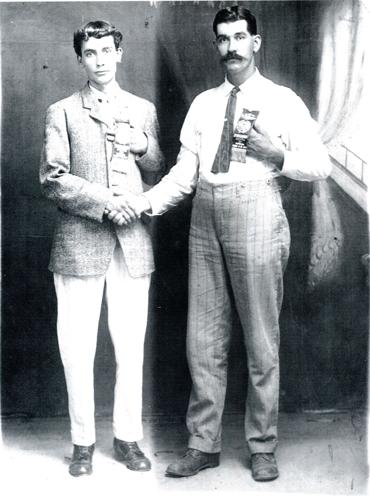
William Buelna Ormsby, right, son of William W. Ormsby.
By 1933, his son William B. Ormsby and his second wife, Carlota, were residing at "Santa Cruz Road, cor. Farms Co. ditch," in Tucson, an area now believed to be Santa Cruz Lane, somewhere between 24th Street and Silver Lake Road, in a neighborhood sometimes called Barrio Santa Cruz.
Other Ormsbys would soon follow, occupying homes in this area and to the north, in what is now called Barrio Kroeger Lane, for many generations to come.
Years later, in 1971, Tucson purchased a small parcel of land near West 24th Street and Santa Cruz Lane as part of the Model Cities mini-parks program.
Demesia Ormsby wrote a letter signed by numerous neighbors to Mayor Lew Murphy, successfully asking that the City Council name it Ormsby Park.

