

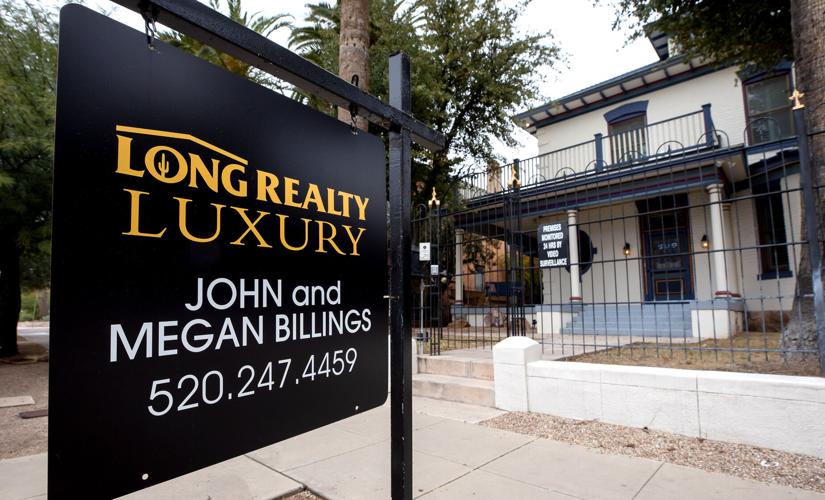
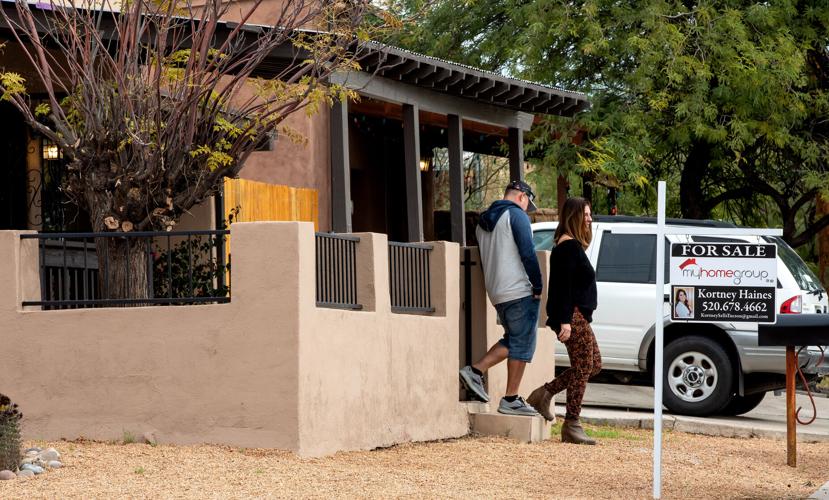

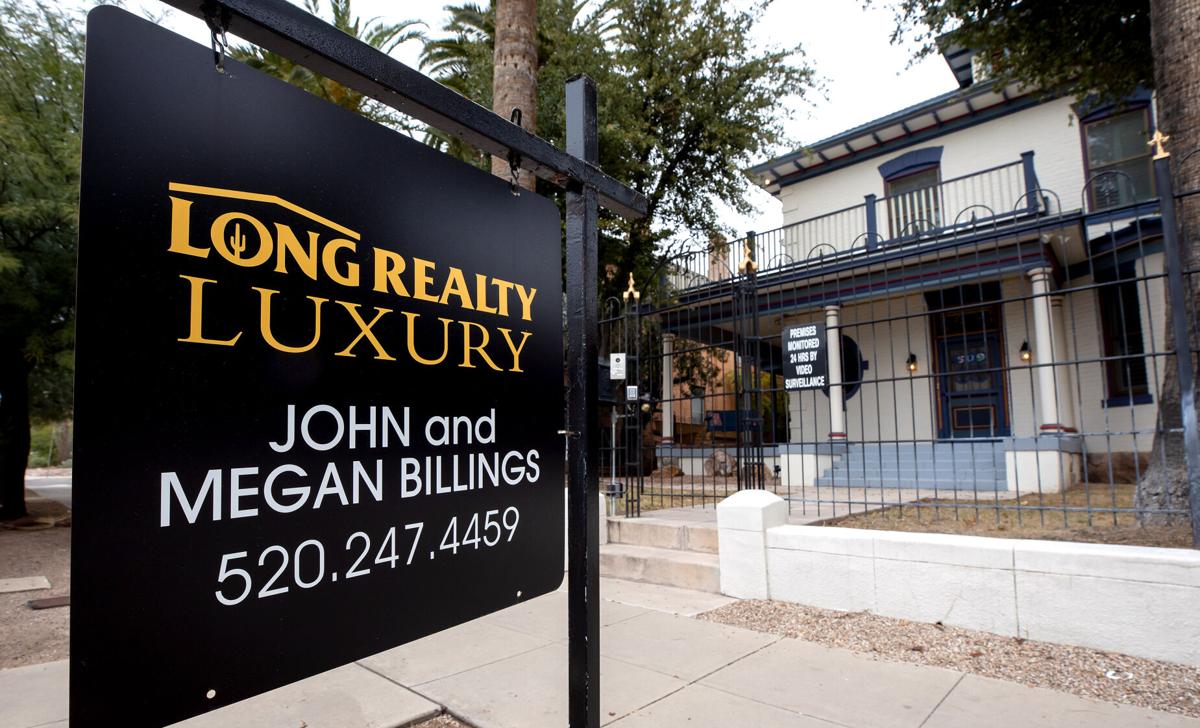
Prospective homebuyers will continue to face stiff competition for new homes in 2022 as Tucson’s surprisingly robust housing market of the past two years shows no signs of slowing down.
Predictions of whether the Federal Reserve will increase interest rates to calm the bidding frenzy vary widely.
Meanwhile the ongoing shortage of new homes and longer build times, due to supply-chain backlogs, is expected to keep prices inching up.
Already, the average new home price in the Tucson market is around $400,000, and the average resale home commanded $356,000 at the end of 2021.
Not since 2009 has the Tucson area been considered a “buyer’s market,” and 2022 is not expected to become one.
Investors still consider the Tucson area affordable when compared to markets on the West Coast, from where we’re seeing many transplant workers and retirees.
“We expect additional homebuilders to migrate their activities to the Tucson area attracted by the obvious economic and population growth trends and the availability of buildable land,” said local housing analyst Jim Daniel, with RL Brown Reports. “These builders can be expected to be aggressive and highly competitive as they attempt to capture market share.”
Lucrative market
Cash.
That is the blessing or the problem impacting the housing market, depending on one’s perspective.
“There’s quite a bit of cash coming in from people liquidating homes,” said Judy Lowe, vice president of operations for the Tucson Association of Realtors.
It’s a combination of workers relocating from more expensive markets, baby boomers retiring and cashing out Foothills properties and investors interested in snapping up single-family homes to be used as rentals.
“Affordability is a huge concern,” Lowe said. “We are still a lucrative market for investors because, in Arizona, Tucson ranks as one of the most affordable markets.”
Some believe an increase in interest rates is the solution.
A group of 20 top economic and housing experts brought together by the National Association of Realtors projects that median home prices will increase by 5.7% in 2022.
Analysts’ predictions for what the Federal Reserve will do about interest rates vary wildly with some saying there will be no increase in 2022 to others who believe interest rates could be hiked up to three times.

A two-bedroom, two-bath home for sale at 438 W. 18th St. is listed at $355,000. Housing has become less affordable in Tucson in part because of a limited supply as investors snap up single-family homes to be used as rentals.
The current mortgage rate is a little over 3% on a 30-year fixed mortgage.
The average prediction from leading economists is that it could rise to 3.8% in 2022, with some expecting rates to rise to more than 4%.
“Interest rates impact affordability even more,” Lowe said. “When interest rates creep up, it has an impact on the homebuyers, but also on sellers who decide not to sell.”
That, in turn, could affect the already tight supply of homes for sale.
Not letting up
The Tucson area is a beneficiary of all of these changes in the market as people are discovering the Old Pueblo, Lowe believes.
“I see us as a lure for potential buyers thinking about Arizona and really looking at Tucson,” she said. “In the past, people didn’t realize what Tucson had to offer.”
The National Association of Realtors, in fact, named Tucson one of its top 10 housing market “hidden gems” for 2022 during its recent real estate forecast summit.
“The housing sector performed spectacularly in 2021 in many markets with huge gains,” said Lawrence Yun, NAR chief economist and senior vice president of research. “Several markets did reasonably well in 2021, but not as strong as the underlying fundamentals suggested.
“Therefore, in 2022, these ‘hidden gem’ markets have more room for growth.”
Tucson is very affordable compared to Phoenix, the forecast says.
In the first quarter of 2021, the median property value was $261,046 which is equivalent to three times the median family income, compared to the median property value in Phoenix of $364,186 which is 4.3 times the median family income.
Among the top 10 undervalued markets, Tucson had the third largest net domestic migration in 2020, at 10,778 — next to Dallas and San Antonio.
“As anyone involved in the housing markets in Tucson already knows, there are a myriad of questions as to what to expect in the months ahead, and the opinions and projections from observers vary from one extreme to another,” analyst Daniel said. “Based upon the data that we track each day, relative to the metro Tucson marketplace, and our conversations with both long-term and a surge of recent new clients, we see little to suggest much of a change over the next year in the overall market velocity, and specifically in the new-home metro Tucson marketplace.”
The number of investors buying existing homes to be used as rentals and developers building housing communities exclusively for renters is also expected to increase as potential homebuyers are sidelined by rising home prices and choose to rent.
“The growth of investor interest in new and resale housing as rental investments has long been a factor in the metro Tucson housing market,” Daniel said, “but has the potential to become a much more potentially significant factor and bears careful watching.”
Then and now photos of Tucson (2020)
Garden Plaza, 1953
Updated
The Garden Plaza office building, 201 N. Stone Ave., Tucson, in December, 1953, shortly after it was completed. Joseph Weiss, a textile businessman from New York City, was "wintering" in Tucson when he decided to buy a used car lot at the site. It was one of the first buildings on Stone Ave. to be constructed after World War II.
Pima County
Updated
The county’s Development Services Department says it was looking for a “smarter way” to set building-permit fees.
All Saints Catholic Church, 1963
Updated
All Saints Catholic Church, 400 S. 6th Ave., Tucson, in 1963.
All Saints Catholic Church, 2020
Updated
Tucson Center for the Performing Arts, 400 S. 6th Ave., in Tucson, Ariz. on January 23, 2020. it was formerly All Saints Catholic Church.
Corbett's Lumber, 1955
Updated
Corbett's Lumber at 4545 E. Speedway in Tucson in 1955.
Corbett's Lumber, 2020
Updated
Tile With Style, 4545 E. Speedway Blvd., in Tucson, Ariz. on January 23, 2020. It was formerly Corbett's Lumber.
Coronado Hotel, 1987
Updated
The historic Coronado Hotel at 4th Ave. and 9th St. in Tucson, had seen better days by 1987. The 42-unit hotel, built in 1928, is listed on the National Register of Historic Places. A non-profit group saved the hotel from the wrecking ball in 1989.
Coronado Hotel, 2020
Updated
Coronado Apartments, formerly The Coronado Hotel, 402 E. 9th St., in Tucson, Ariz. on January 23, 2020.
Hi Corbett Field, 1963
Updated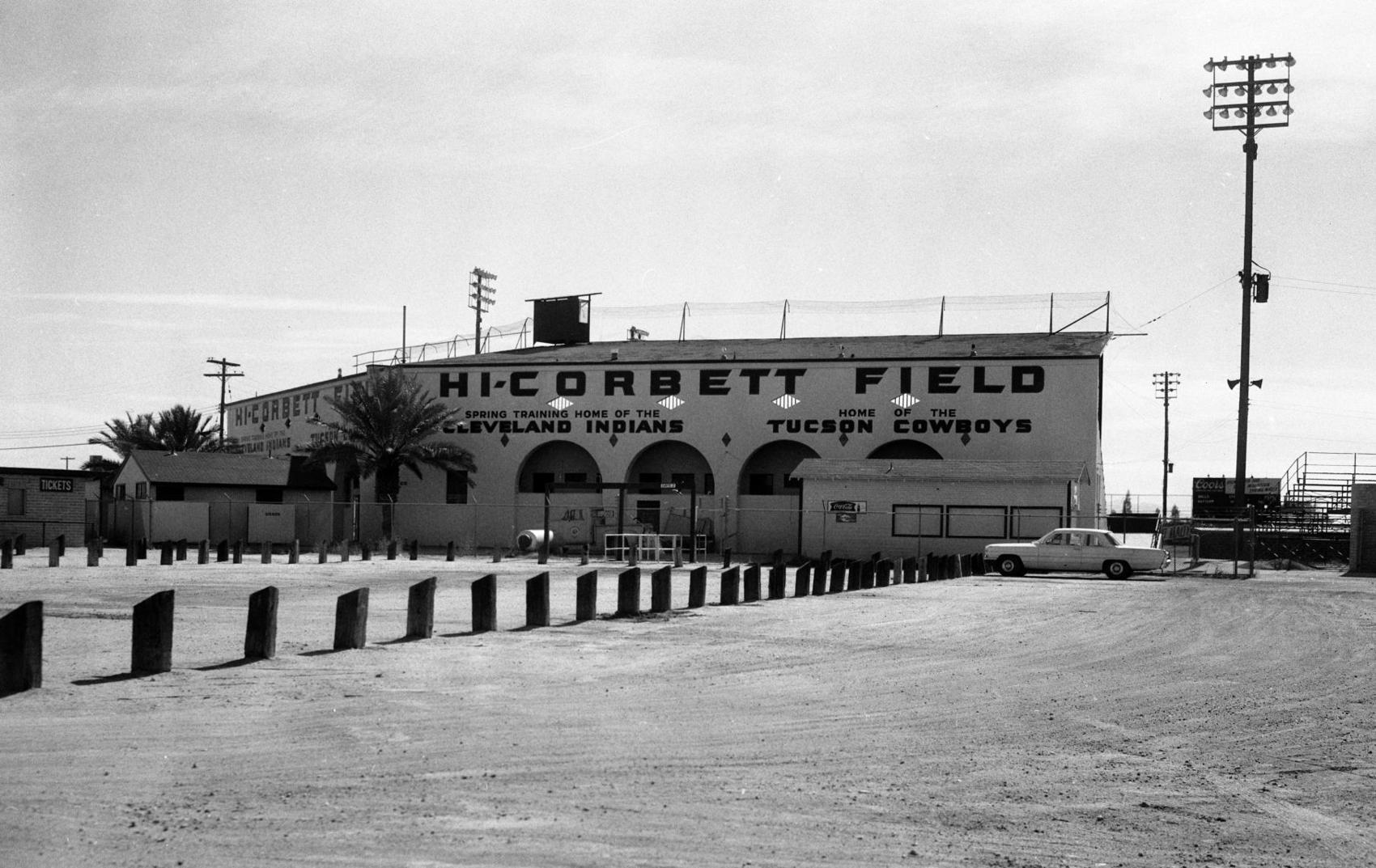
Hi Corbett Field at Gene C. Reid Park, Tucson, in 1963.
Hi Corbett Field, 2020
Updated
Hi Corbett Field, 700 S. Randolph Way., in Tucson, Ariz. on January 28, 2020.
Perkins Motors, 1955
Updated
Perkins Motors and Texaco gas station at Stone Avenue and Alameda Street, Tucson, in 1955. It was replaced by the Pima Savings building, which opened in 1956.
Perkins Motors, 2020
Updated
The Little One restaurant, 151 N. Stone Ave., in Tucson, Ariz. on January 23, 2020. It was formerly the site of Perkins Motors.
Roskruge Hotel, 1965
Updated
The Roskruge Hotel at 109 S. Scott, Tucson, in 1965. It was built in 1904 and demolished in 1984.
Roskruge Hotel, 2020
Updated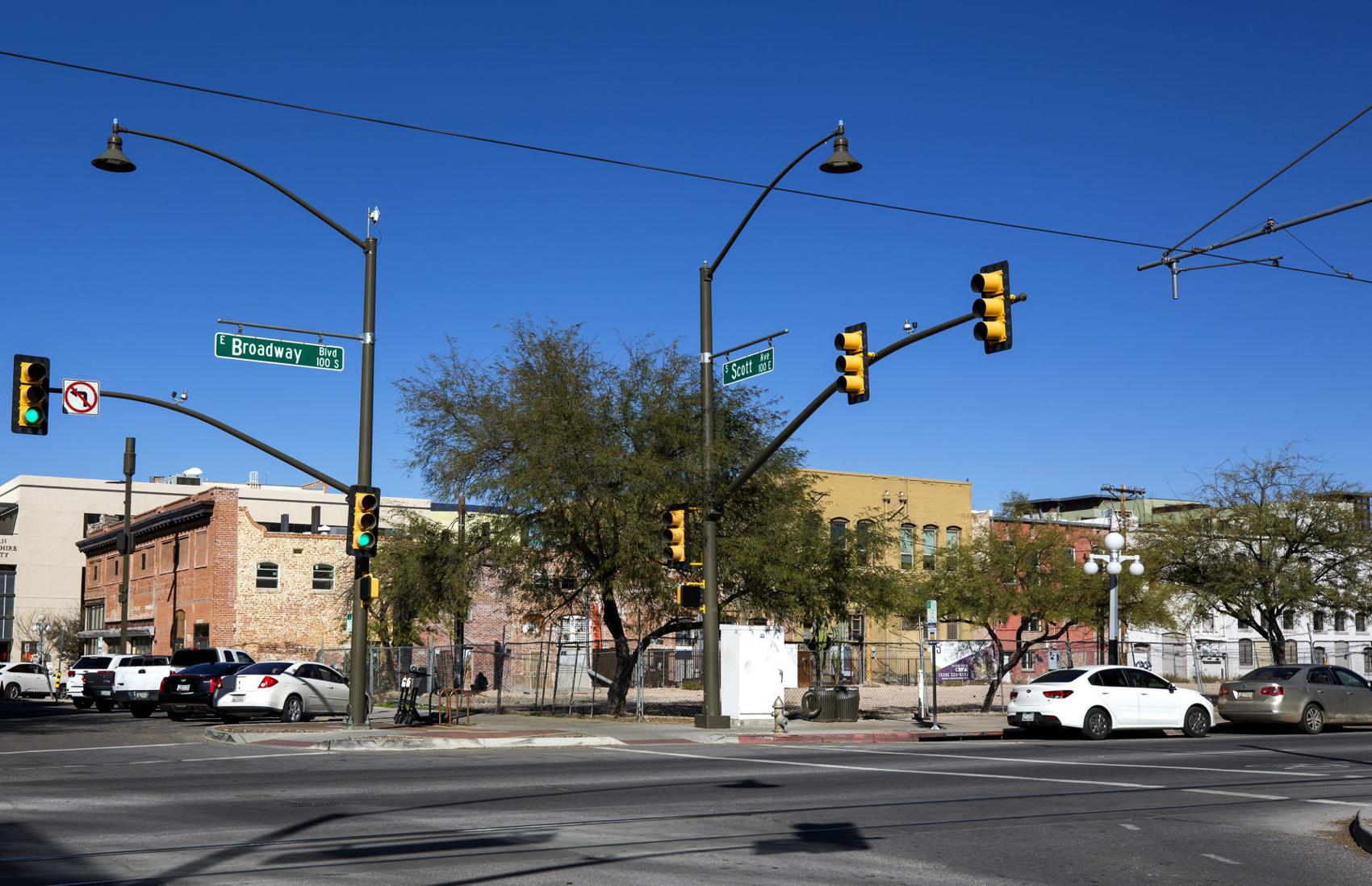
Empty lot on the north west corner of E Broadway Blvd. and S. Scott Ave., in Tucson, Ariz. on January 28, 2020. It was once the site of the Roskruge Hotel. A high-rise office/retail building is planned for the site.
Selby Motors Mercury, 1956
Updated
The new Selby Motors Mercury dealership at 2200 E. Broadway Road, Tucson, in 1956. The business moved from 820 S. 6th Ave.
Selby Motors Mercury, 2020
Updated
Chevron and Quick Mart on the southeast corner of E. Broadway Blvd. and S. Plumer Ave., in Tucson, Ariz. on January 23, 2020. It was formerly Selby Motors Mercury.
Temple of Music and Art, 1965
Updated
The Temple of Music and Art, 330 S. Scott Ave., Tucson, in September, 1965. It was built in 1926 and underwent an extensive renovation in 1990.
Temple of Music and Art, 2020
Updated
Temple of Music and Art, home of the Arizona Theatre Company, 330 S Scott Ave., in Tucson, Ariz. on January 23, 2020. The building underwent an extensive restoration in 1990.
Stravenue origin story is a trip down memory lane for one Tucson family
UpdatedWe have left turns from Michigan and potholes from the pits of hell, but one local traffic oddity is an Old Pueblo original.
What do you call a road that runs diagonally between an east-west street and a north-south avenue? Here — and nowhere else in America, apparently — that’s known as a stravenue.
Pima County is home to 40 of them, mostly in mid-century neighborhoods built around Tucson’s angled arteries — Aviation Parkway, Benson Highway, the Union Pacific Railroad tracks and Interstate 10 east of I-19.
The U.S. Postal Service even has an official abbreviation for the stravenue (that would be STRA), though mail carriers outside of Southern Arizona don’t need to concern themselves with it.
“Our records indicate the name is only found in Tucson, Arizona,” said Roy Betts, national spokesman for the Postal Service.
Tracing the origins of a made-up word
So who is responsible for coining the term?
Wikipedia gives credit for the stravenue to “Mr. Tucson” himself, Roy P. Drachman, who reportedly dreamed it up in 1948 as part of Del Webb’s Pueblo Gardens development near 22nd Street and present-day Kino Parkway.
But don’t believe everything you read on the internet. The apparent source for that historical nugget is a reader comment posted beneath an Arizona Daily Star story from 2008, which is pretty thin gravy, even for an online encyclopedia.
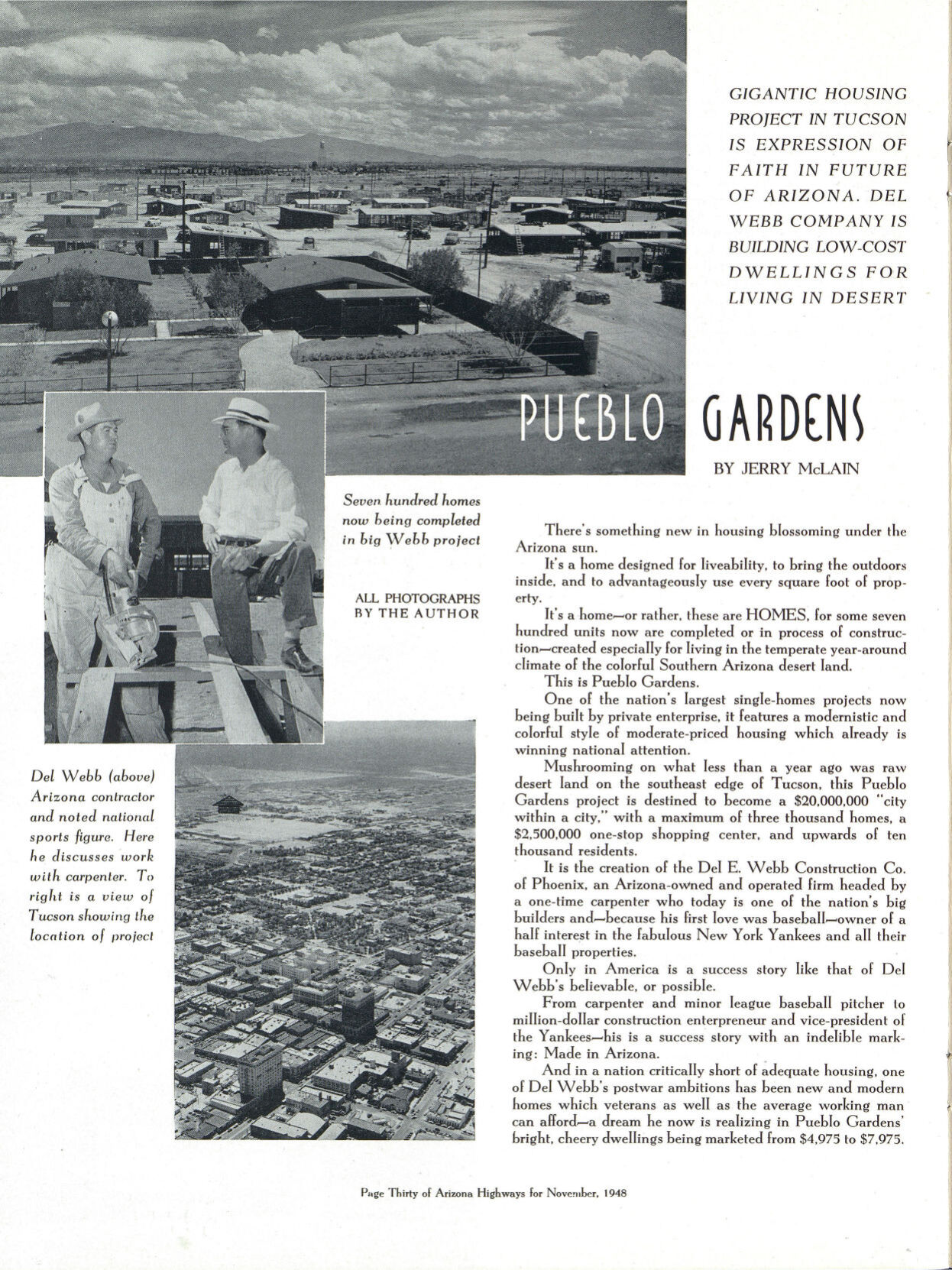
Arizona Highways magazine featured Del Webb’s Tucson development, Pueblo Gardens, in the November, 1948 edition.
Recent research by historian and preservationist Demion Clinco points to a more likely candidate: another prominent Tucsonan who played a large role in the city’s post-war development.
Clinco said the earliest appearance of a stravenue he can find is on the plat map for a subdivision called Country Club Park, a wedge-shaped neighborhood hemmed in by Aviation Road, Country Club and 29th Street.
It features six stravenues that were mapped out in February 1948, three months before the plat for Pueblo Gardens.
The same land surveyor produced both maps: Tony A. Blanton from the Tucson architectural firm of Blanton and Cole.
In December 1948, Blanton submitted another plat map, this time for North Campbell Estates at Campbell and Glenn, and again there were stravenues.
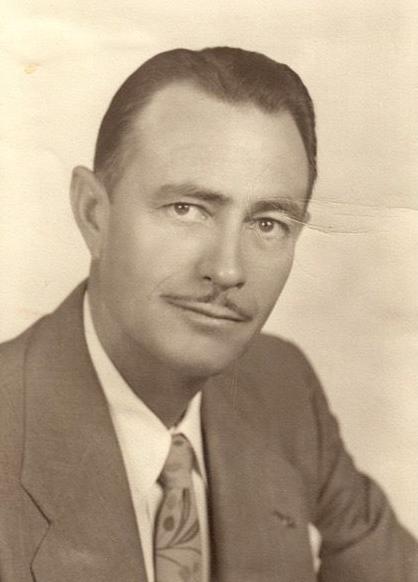
Planner and land surveyor Tony Blanton, ca. 1940s.
“Based on this, I think it would be fair to say Blanton brought us the stravenue,” Clinco said. “If he did not actually invent the term, he produced the first one and promoted their popularity in the late 1940s.”
Blanton helped put Tucson on the map
Longtime Tucson land surveyor Don Rockliffe said details like road names are often handled by the planner who is hired to draw up the subdivision map.
“Unless the developer had some pet names in mind, he left it up to the engineering firm to come up with the street names,” he said.
Of course, Rockliffe might be a little biased. Tony Blanton was his grandfather.
Rockliffe said his father, Donald Alan Rockliffe, married Blanton’s eldest daughter, Beverly, and worked as draftsman and design engineer for his father-in-law.
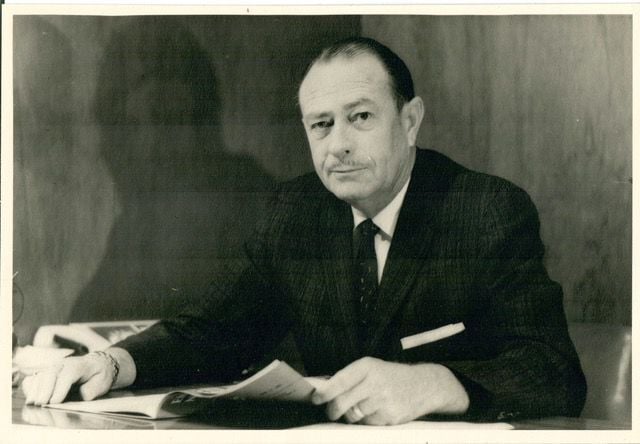
Tony Blanton, a prominent Tucson planner for decades, is a likely candidate for being the person who originated the term “stravenue.”
Blanton and Cole was one of Tucson’s first engineering and architectural companies, Rockliffe said, and it soon became the preeminent firm of its kind in the city.
By 1958, it had 42 employees and a newly built downtown office at Main Avenue and Pennington Street, though that building was lost to urban renewal about a decade later. “Now it’s buried beneath the county courthouse,” Rockliffe said.
Major local clients included the University of Arizona, several public school districts, Davis-Monthan Air Force Base and Hughes Aircraft Company. Blanton and Cole also worked on projects across Arizona and in eight other states.

Arizona Highways magazine featured Del Webb’s Tucson development, Pueblo Gardens, in the November 1948 edition. One “stravenue” origin story is that Roy P. Drachman reportedly dreamed it up in 1948 as part of Pueblo Gardens
.
From cowboy roots to the city’s “in-crowd”
Rockliffe said his grandfather was “part of the ‘in-crowd’ in Tucson, I guess you’d say, but he started out humble.”
He was born George Anthony Blanton in Calgary, Alberta, in 1910. His cowboy father was originally from Southern Arizona, and the family moved back here in 1911 — first to Willcox and then to Tucson in 1914.
After graduating from Tucson High School and studying at the UA, Blanton got his first engineering job with the Southern Pacific Railroad. He later worked for the U.S. Coast and Geodetic Survey, the U.S. Bureau of Public Roads, Pima County and the city of Tucson before launching a private practice with Frederick P. Cole, a former draftsman for the county.
Somewhere along the way, Blanton changed his legal signature to Tony A. Blanton — short (and somewhat redundant) for Tony Anthony Blanton.
Since learning of his family’s possible connection to Tucson road-naming lore, Rockliffe has done some research of his own that bolsters Clinco’s case.
He said there are 10 Tucson subdivisions that include stravenues, all of them mapped between 1948 and 1960. Blanton and Cole was the surveyor for six of them, including the five oldest.
Surveying streets runs in the family
The city planning and zoning commission added the made-up word to Tucson’s official street naming and numbering system in November 1948.
In May 1949, the Tucson Daily Citizen ran a piece explaining the new street type, which it described as “gobbledygood (sic) for diagonal.”
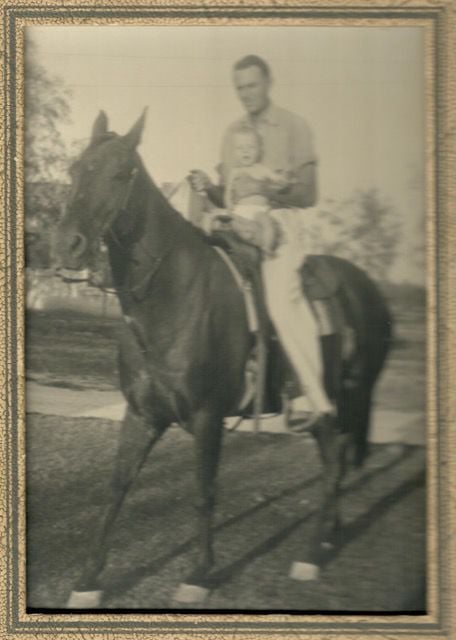
Tony Blanton rides a horse with his first child, Beverly, at his father’s ranch house on Hedrick Drive, near Campbell Avenue and Fort Lowell Road in 1936.
“I can remember seeing Cherrybell Stravenue as a child and thinking that was all so strange,” said Rockliffe, who retired in 2019 after 39 years as a land surveyor for Tucson Electric Power.
He never dreamed at the time that he might be related to the man who invented them — the man for whom Blanton Drive near Fort Lowell Road and Tucson Boulevard is now named.
Rockliffe said he used to visit his grandfather on Sundays and holidays. Occasionally, he would join him in his box seats at Hi Corbett Field for Cleveland Indians spring training games.
Blanton died in 1969 at the age of 59.
Rockliffe was about 11 at the time. Not long after, he began to learn the family business from his own father. He used to watch him work at his drafting table, and he later helped him draw a few subdivision plats before enrolling at the UA to become a registered professional land surveyor himself.
“He taught me surveying,” Rockliffe said of his dad, the likely son of the stravenue. “It felt like it was kind of in the blood.”

