



The first sections of the Trump administration’s steel-bollard border wall have been erected in the San Rafael Valley, where advocates say the planned barrier will seal off a critical wildlife corridor between the U.S. and Mexico, despite vanishingly few migrant crossings in the remote area.
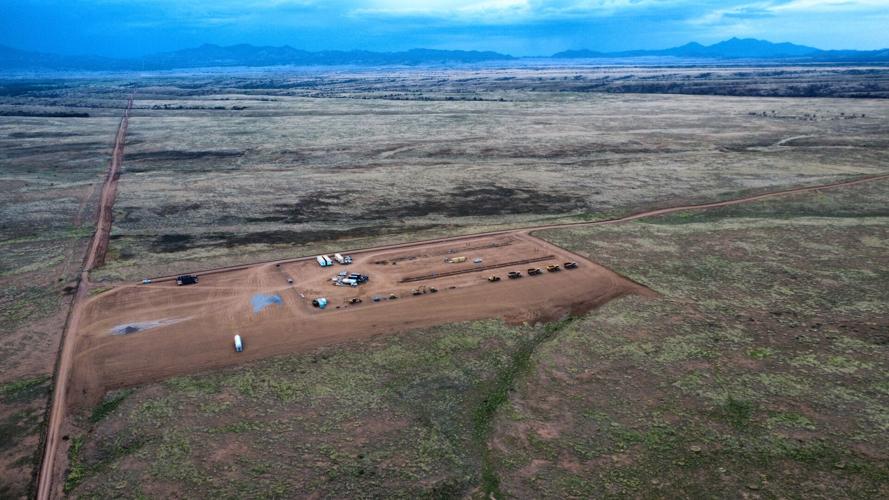
Conservationists described a “tragic” scene in the valley last week, between the Patagonia and Huachuca mountains, where workers have clear-cut the grasslands for two staging areas, including one that will be home to between 100 and 150 workers over the 900-day project period.
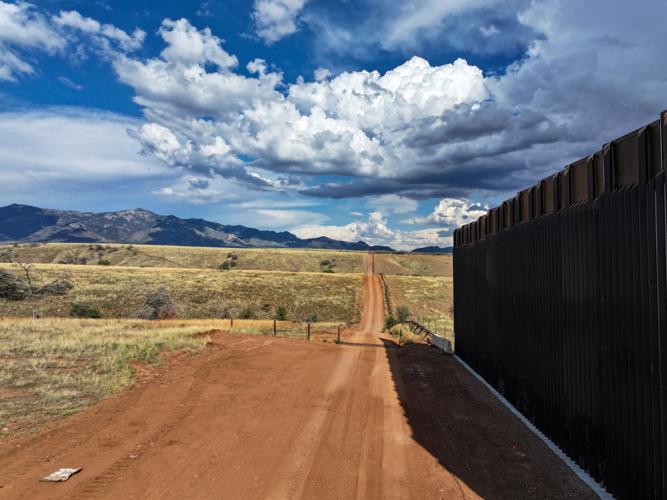
About 250 feet of the 30-foot-tall border wall had been raised last week, and construction crews were digging wells and grinding rock to produce concrete on site, said Russ McSpadden, Southwest conservation advocate at the Tucson-based nonprofit Center for Biological Diversity.

In the San Rafael Valley, near Lochiel, Arizona, a construction crew with Fisher Sand and Gravel uses heavy equipment to grind rocks in preparation for producing concrete on-site. The concrete will fill deep trenches into which workers will sink the steel bollards of the border wall, said Russ McSpadden of the Center for Biological Diversity.
“Operations have really gone into high gear. I was surprised how advanced the project had been on Monday,” said McSpadden, who visited the San Rafael Valley Sept. 15 to document the project’s progress.
Construction of the new border wall replaces the low-lying vehicle barriers and other fencing that still allowed for wildlife — including jaguars, ocelots, mountain lions, pronghorns, black bears and bobcats — to traverse the area in search of food, water, mates and safety.
“It’s tragic,” said Eamon Harrity, wildlife program manager for the Sky Island Alliance. “It really does hurt the soul. ... I’ve spent hundreds of hours down there, so to see it destroyed in this way is truly painful on a personal level.”
The nonprofit Sky Island Alliance has dozens of motion-activated cameras in the area, used to monitor wildlife, and has had to relocate those that would be in the path of the new wall construction, Harrity said.
The cameras have documented a negligible number of likely migrant crossings in the San Rafael Valley since 2020, Harrity said.
Over the last five years, Sky Island Alliance’s 60 cameras have captured an average of five pedestrians per month — half of whom appear to be hikers, hunters and border agents, Harrity said. That’s a rate of one human sighting every 10 months, per camera.
“Of all the places where a wall is unwarranted, this is one of the most unwarranted places,” he said.

Construction has begun on a new 27-mile stretch of steel-bollard border wall through the grasslands of the San Rafael Valley, blocking southeast Arizona’s last major open space for wildlife migration along the U.S.-Mexico border. The new 30-foot wall, photographed here on Sept. 15, replaces low-lying vehicle barriers and other fencing that was largely permeable for wildlife traveling between the U.S. and Mexico in this critical migratory corridor, conservationists say.
Border crossings have plummeted across the entire southern border over the last year, including in the Border Patrol’s Tucson sector, where the San Rafael Valley is located.
In August, border agents apprehended 1,068 migrants in the Tucson sector, which stretches 262 miles from the Yuma County line to the New Mexico state line, according to the latest data from U.S. Customs and Border Protection. That’s an increase from 671 in July, but a more than 90% drop from the year prior.
The agency doesn’t release migrant-arrest figures for specific areas within Border Patrol sectors, a CBP spokesman said in response to the Star’s query about unauthorized crossings in the San Rafael Valley.
The Tucson sector “is an area of high illegal-entry attempts and experiences large numbers of individuals and narcotics being smuggled into the country illegally,” CBP spokesman John Mennell said in a June emailed statement. CBP is complying with President Donald Trump’s executive orders “to ensure complete operational control of the southern border,” the statement said.
Mitigation possible, critics say
The valley is also the birthplace of the Santa Cruz River, which crosses the border twice in the construction zone. Crews will have to install floodgates in washes and at the river crossings and leave the gates open during monsoon season, when powerful flows could otherwise topple the wall, Harrity said.
Environmentalists unsuccessfully lobbied CBP’s environmental team for 5.5 inches, instead of 4 inches, between the border wall’s steel bollards, which would have allowed more animals to make it through, Harrity said.
But construction crews should be including small-animal wildlife crossings, measuring about 8-by-11 inches, at regular intervals in the new border wall, accommodating animals like javelina, coyote, bobcats and even female mountain lions, Harrity said. He added that in other areas of the border, the passages have been installed too infrequently to be very effective.
Still, Harrity said, “There’s been willingness to install these in the new wall project, so we’re really grateful for that. We hope they follow through and place small wildlife passages, because they make a big difference.”
Those passages won’t help larger animals like jaguars, who will be completely cut off from their migratory routes. The wall here is expected to reduce all wildlife crossings in the San Rafael Valley by 86%, according to a recent Sky Island Alliance study.
The east side of the valley was the site of former Arizona Gov. Doug Ducey’s unauthorized shipping-container border barrier, which ended up costing the state about $200 million.
McSpadden was among the conservationists whose advocacy halted construction of the shipping-container wall in 2022, and just two months after it was dismantled, a jaguar was spotted in the Huachuca Mountains.
“It was evidence that our efforts had mattered,” McSpadden said last week.
Three jaguars have been spotted in the valley since 2019, including multiple sightings this summer of a jaguar that was last seen in 2023, University of Arizona researchers said in August.
Impact on Patagonia
North Dakota-based Fisher Sand and Gravel was awarded the $309 million contract to build the new border wall in the San Rafael Valley.
In addition to the nearly 25 miles of wall stretching east from the Patagonia Mountains to the Coronado National Memorial, south of Sierra Vista, the project also includes a 0.2-mile segment to close a gap where the Santa Cruz River heads north into Arizona, and a 2.1-mile segment across the steep terrain of the Coronado National Memorial.
Residents in the Patagonia area worry about the impact of massive construction vehicles and heavy machinery traveling through the small town, and the potential for traffic accidents, Santa Cruz County Sheriff David Hathaway said Thursday.

A Sept. 1 drone photo shows one of the staging areas for construction crews building a 30-foot tall border wall in the San Rafael Valley, between the Patagonia Mountains and Huachuca Mountains. This staging area will become home to between 100 and 150 workers with Fisher Sand and Gravel, during the 900-day border-wall project period, said Erick Meza, borderlands coordinator for the Sierra Club.
In the early stages of border-wall construction, Patagonia will see between 15 and 30 large vehicles daily, transporting materials and heavy equipment like bulldozers to the border wall site, Hathaway said.
During an August conference call with U.S. Customs and Border Protection officials and representatives from Fisher Sand and Gravel, Hathaway asked if the company would reimburse the county for resulting damage to the roads. Fisher said they would try to remediate any road damage, but that commitment is not in writing, Hathaway said.
Hathaway, who said his family’s ranch is in the San Rafael Valley, is also concerned about having adequate resources to respond to traffic accidents, and any conflicts or injuries among the work crew.
With the nearby South32’s Hermosa mining project, also located in eastern Santa Cruz County, “We had already anticipated shortage of resources and deputies for that part of the county,” he said.
Hathaway said he’s hoping the mining company can offer supplementary funding to help the sheriff’s office get four more deputies.
Conservationists and valley residents are also worried about the wall construction’s effect on groundwater levels, especially combined with water pumping for the Hermosa mine.
During the first Trump administration, border-wall construction in the San Bernardino National Wildlife Refuge extracted 700,000 gallons of groundwater a day for mixing concrete on site, damaging an artisan spring system, McSpadden said.
That extraction depressurized the natural spring system that for thousands of years provided a critical water source for migratory birds and other species, he said.
“It’s not clear that system will ever recover naturally,” McSpadden said. It’s an example of the “lawless water pumping” enabled by the environmental waivers that enable rapid wall construction, he said.
“It’s likely we’ll see something like that in San Rafael Valley. Each valley is unique, but you can’t pump that much water without incredible impacts,” he said.
The San Rafael Valley border project is exempted from the normal environmental review process, due to waivers issued by U.S. Department of Homeland Security Secretary Kristi Noem, under the Illegal Immigration Reform and Immigrant Responsibility Act and the Real ID Act of 2005.
Those waivers allow the administration to ignore environmental safeguards — including the National Environmental Policy Act, the Endangered Species Act, Clean Water Act and Clean Air Act — and have paved the way for the rapid expansion of the border wall across multiple presidential administrations, advocates say.
A July lawsuit from the Center for Biological Diversity and Conservation CATalyst challenges both the use of the waiver in the San Rafael Valley, as well as the waiver authority itself that can bypass regulations established by Congress.
The use of the waiver authority “violates the foundational principle of the separation of powers rooted in the U.S. Constitution,” Jean Su, attorney for the Center for Biological Diversity, wrote in the July complaint.
“The Arizona Border Wall Project would essentially be the death knell for jaguars in the United States, eliminating over 53 years-worth of jaguar conservation efforts ... leaving an irreplaceable void in the landscape that would be continuously felt by the communities who have lived beside them,” Su wrote.
Harrity said the border barrier in the San Rafael Valley is not only unnecessary, but ineffective.
In other parts of the borderlands, smugglers routinely cut through the wall’s steel bollards with hand tools, and migrant crossings are more frequent in areas that already have a barrier, compared with the remote San Rafael Valley, far from major roads in both the U.S. and Mexico.
The border wall is “supposed to send this message of strength, but I think it sends a message of weakness and fear more than anything,” Harrity said. “It doesn’t solve any problems, and really damages the landscape and forever ruins the connectivity for wildlife.”
The Pentagon is expanding National Defense Areas along the southern border in western Arizona and South Texas.

