


The University of Arizona is focusing on mining as one of its strengths and initiatives, and expects increased federal funding for it as the Trump administration emphasizes interest in critical minerals, including copper and rare earth minerals.
The UA recently built a coalition with mining companies, including Freeport-McMoRan, South32 Hermosa and Resolution Copper, a joint venture owned by Rio Tinto and BHP; and with suppliers including Komatsu and Caterpillar, which have significant operations in Southern Arizona, David Hahn, dean of UA’s School of Engineering, told the Arizona Daily Star.
South32 is an Australia-based mining giant building a roughly $2.5 billion underground zinc and manganese mine on private land in the Patagonia Mountains south of Tucson. British-Australian mining firm Resolution Copper plans to build a copper mine at Oak Flat east of Phoenix that Apache leaders say is sacred to Indigenous people; the U.S. Supreme Court declined recently for the second time to hear a bid by tribal opponents to halt a federal land exchange for the project.
“These relationships (with UA) support student learning outcomes, faculty research, and workforce development through industry informed research questions, capstone design projects, and technical collaboration, which are required practices for an engineering program accredited by the Accreditation Board for Engineering and Technology and fully consistent with the university’s land grant mission to serve the state,” Hahn said.
In the newest development, a mineral processing facility will be added to the UA’s San Xavier Underground Mining Laboratory near Sahuarita after a bipartisan federal spending bill was signed into law, which gives $3 million to the university.
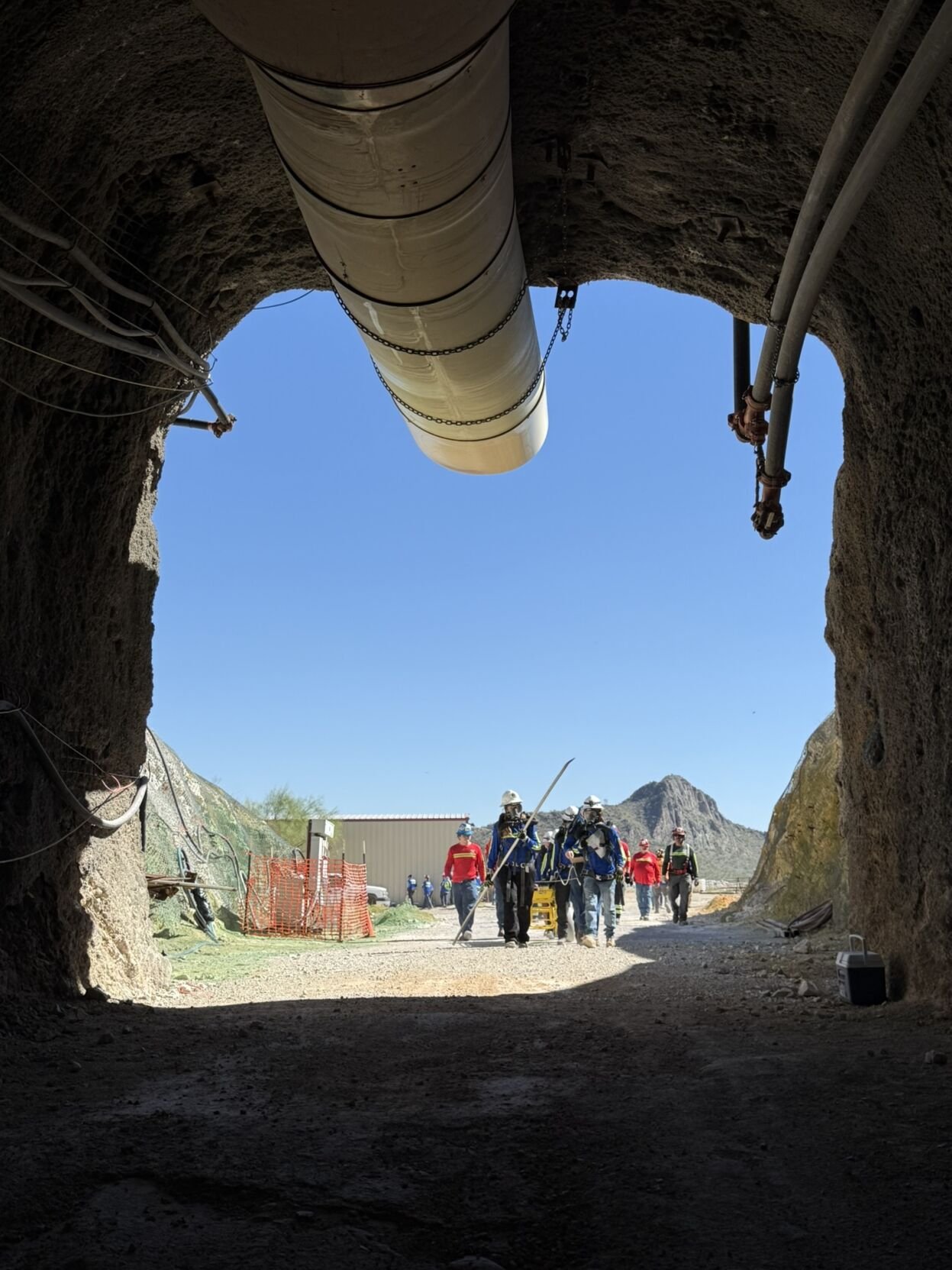
The University of Arizona will seek a $25 million grant from the U.S. Energy Department to be used in part to expand the UA’s San Xavier Underground Mining Laboratory, shown here. The underground lab, 20 minutes south of the Tucson campus, would be expanded to more than 2,000 acres of “an innovation and workforce training ground to serve all of the nation.”
The facility will be “designed to strengthen the state’s mining workforce while fortifying mineral processing resources that are critical for national security,” the UA said in a news release Thursday.
The UA is also working on a proposal for a $25 million grant from the U.S. Department of Energy for developing and testing new mining technologies, Hahn said in a January interview with the Star.
One aim is to develop technology to more effectively recover federally designated critical minerals in U.S. operations via automation and power efficiency improvements, in partnership with industry, said UA spokesperson Mitch Zak.
The University of Arizona will seek a $25 million grant from the U.S. Energy Department to be used in part to expand the UA’s San Xavier Underground Mining Laboratory, shown here. The underground lab, 20 minutes south of the Tucson campus, would be expanded to more than 2,000 acres of “an innovation and workforce training ground to serve all of the nation.”
The grant money would also be used to expand the San Xavier Underground Mining Laboratory to more than 2,000 acres of “an innovation and workforce training ground to serve all of the nation.”
Focus on critical minerals
Listing the critical minerals the UA actively focuses on, Hahn pointed to copper, which was added to the U.S. critical minerals list just last year, and said Arizona produces about 74% of the copper in the U.S. He also listed zinc and manganese, which the South32 Hermosa mine near Patagonia plans to produce.
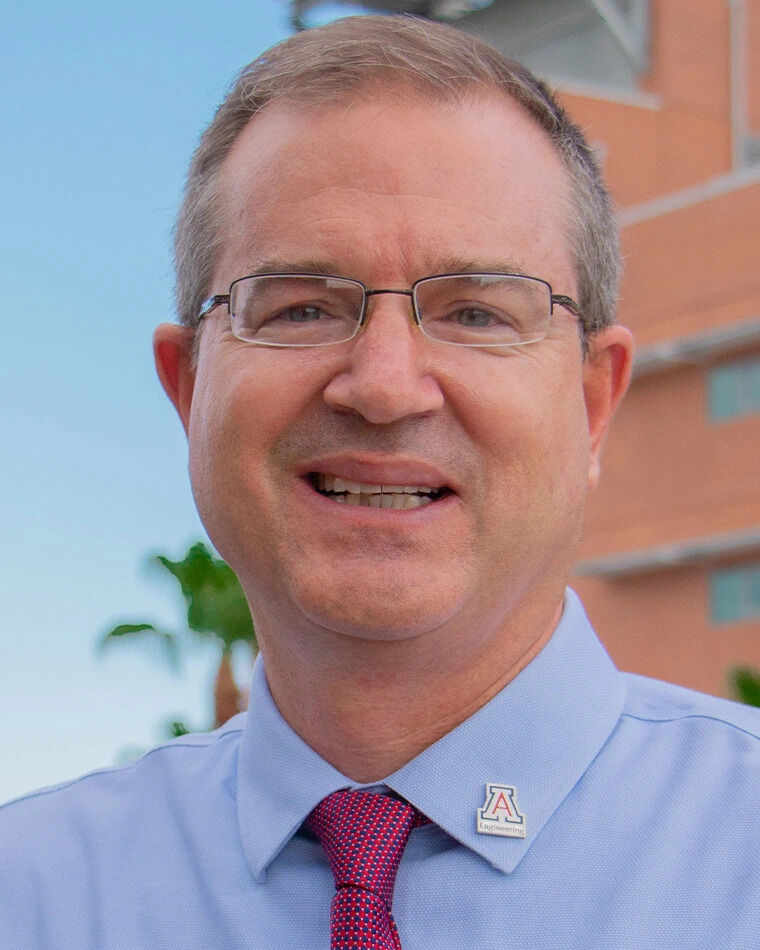
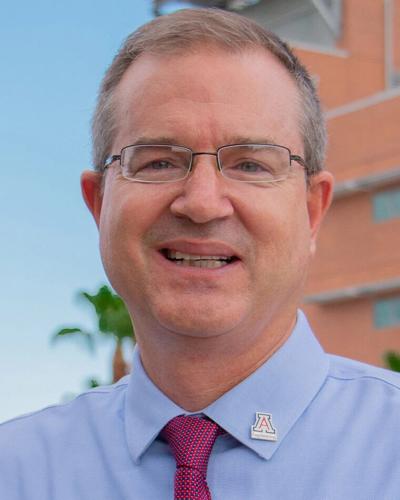
David Hahn, Craig M. Berge Dean of the University of Arizona's College of Engineering, and a professor of aerospace and mechanical engineering. UA’s engineering college is one of the leaders in the nation and world in mining, he says.
Critical minerals are defined by the U.S. Geological Survey as essential to the national economy and security and as having “supply chains that are vulnerable to disruption.” The federally designated list has 60 minerals, including 10 new to the list as of 2025 and 15 “rare earth elements.”
Hahn said there has always been an overlap between critical minerals and rare earth minerals, and that copper being designated a critical mineral opens up additional avenues for federal investment and fast-tracks the process of getting such investment. The UA also anticipates additional federal funding specifically to develop advanced processing technologies, he said.
President Donald Trump signed an executive order in February 2025 that calls for boosting the domestic copper industry by “investigating the national security implications of imports and weighing tariffs as a response,” the Associated Press reported. “His interest in domestic copper could eventually be a boost to two delayed Arizona mining projects: Copper World near Tucson and the Resolution Copper project at Oak Flat near Superior,” the AP reported at the time. Copper is needed for products including cellphones, LED lights and flat-screen TVs.
David Hahn, Craig M. Berge Dean of the University of Arizona's College of Engineering, and a professor of aerospace and mechanical engineering. UA’s engineering college is one of the leaders in the nation and world in mining, he says.
Trump has also emphasized an interest in rare earth minerals, including those in Greenland as he targets the Danish territory for U.S. control. Rare earth minerals, including neodymium, cerium and yttrium, are “crucial for modern tech like EVs, wind turbines, smartphones, and defense systems,” but are difficult to extract economically, CNN has reported. “China dominates the market, making supply chain security a major concern, prompting efforts to develop new sources and processing in other nations including the U.S.,” CNN has noted.
UA’s Hahn said the U.S. has now come to the realization it has outsourced the production of a lot of critical and rare earth minerals and become dependent on foreign sources to buy the refined minerals. The U.S. has also outsourced a lot of the process, meaning that even if the ore is extracted here, it is shipped out of the country to foreign countries to be processed into refined materials, he said.
This makes the U.S. vulnerable to economic and national security liabilities, Hahn said, so it has pivoted to more domestic production and domestic processing, which he said is exciting because it opens up new areas for innovation.
“What’s important to understand is that (critical minerals) tend to be lower volume but higher cost, and in mining, that can make the economics very tricky,” said Hahn. “What is a really good avenue for this is what we call ‘co-production.’ So, we have a copper mine, but guess what, there’s a little bit of neodymium in that copper ore. Right now, that’s largely just thrown away. So, we can help develop cost-effective technologies while they’re extracting copper — suddenly the economics get a lot better because you’re already a profitable operation selling copper.”
UA cites leadership role
UA’s engineering college is one of the leaders in the nation and world in mining, Hahn said. The university’s commitment to mining differentiates it, he said, and also aligns with the interests of Arizona legislative leaders. That commitment preceded the current federal administration’s interest in increasing funding for critical minerals, UA officials say.
The UA’s commitment to mining is “good for the state of Arizona as a land-grant institution,” Hahn said, referring to UA’s role as Arizona’s only land-grant university, designated in the 1800s to provide practical education in science, engineering, agriculture and other fields. In fact, the first UA building to be constructed after its founding in 1885, now known as Old Main, was originally the School of Mines, Hahn said, so “mining is at the very, very origin of the University of Arizona.”
“But it’s also great for the nation, and the jobs are fantastic,” he said. “A student that graduates in mining can move into a six-figure income; they can work right here in Arizona, Southern Arizona or all over the world. So, it just provides so much opportunity and upward economic mobility.”
“When you talk to people about careers in mining, they don’t even understand sometimes the robotics, electrification and the sustainability aspects and all of these exciting things that, as a young engineer, scientist or businessperson, can come in here and really make an impact,” Hahn said.

With $3 million in new federal funding for its San Xavier Underground Mining Laboratory near Sahuarita, the University of Arizona's School of Mining Engineering and Mineral Resources plans Phase 1 of a major plan to boost the state's mining education-to-workforce pipeline, UA officials say.
While the university focuses on research and mining operations, Hahn said workforce development is an important part. UA trains people to get their bachelor’s, master’s and PhDs in mining engineering, economic geology and peripheries that support the mining industry, including business, accounting, mineral law, environmental science or engineering and electrical engineering.
“We train because we’re cognitive of the workforce needs, we train people to assess all aspects of the workforce in mining,” said Hahn. “We also do continued education — so if you’re a mining company and you’re now going to move from a manual piece of equipment to an automated piece of equipment, we might bring those people in and train them.”
The mines of the future are far from the mines of the past, he said — future mines will have automation, electrification, “a much longer cycle view of sustainability” and improved management of tailings, the leftover finely ground rock and residual chemicals from mining operations after valuable minerals are extracted. Future mines might also be able to conduct extraction with the least amount of disturbance to the environment of the material, Hahn said.
With the federal government making mining a priority and stating its intent to invest more money in it, Hahn said schools that have never been in mining are trying to dive in. He said that’s good, since the nation can always use more mining schools, but that the UA is one of the originals and has stuck to mining even in times when there wasn’t a lot of attention given to it.
“We have always been in mining; we have expertise, faculty, and a history of doing amazingly innovative things, and a lot of our graduates have become CEOs and leaders of mining companies,” Hahn said. “We’ve been here forever and we’re going to be here forever.”
Critics of the partnership
Russ McSpadden, the Southwest conservation advocate at the Tucson-based Center for Biological Diversity, said critics have two core concerns about UA’s expanding collaboration with major mining companies, including Rio Tinto, Freeport-McMoRan, and others.
First, he said, environmental and community impacts are treated as ”secondary to industry priorities,” and second, partnerships with companies pursuing highly contentious projects carry serious ethical implications, McSpadden said.
“UA-hosted mining conferences and industry-facing programming have repeatedly sidelined or excluded tribes, local residents in impacted areas, and environmental organizations. These groups are simply not invited to speak,” McSpadden told the Star in an email. Additionally, he said, “Rio Tinto (through its subsidiary Resolution Copper) continues to pursue the Oak Flat mine, an Apache sacred site where mining would permanently destroy irreplaceable cultural and ecological values.”
While the UA’s partnership with mining isn’t new or “inherently bad,” there are concerns it creates a bias within the university, said Anna Darian, executive director of Patagonia Area Resource Alliance, or PARA, an organization fighting the Patagonia mine projects.
“Such that researchers — who might otherwise be really strong allies for organizations like us, who are looking for science-based information to help us protect our communities and the environment — now are in a position where it’s controversial to be working with an organization like ours, because they are now compromising their position within the university, who has put their stake in the ground that their allegiance is to industry and specifically for the mining industry,” Darian told the Star.
Darian said the process of naming critical minerals is a political decision, and the stated intention is to increase their production to reduce reliance on foreign countries such as China.
“The reality is that these are foreign companies that are mining in the United States with extremely loose resolutions, particularly here in Arizona,” she said. “These minerals are being sent all over the world to be processed and there isn’t a one-to-one relationship to the U.S. being supplied with these minerals. And so, to take these projects and position them as increasing our supply of critical minerals from a domestic perspective, is just not the truth, so the conversation is frankly frustrating.”
Darian said PARA nonetheless sees the UA, and entities within it, specifically including the mining school, as partners that have invited it to guest lecture in courses.
“What we’re fighting for is for mining to be the most responsible it can be to the environment, to the communities that are affected by the mines,” she said, saying some mines historically left “toxic waste dumps” that polluted land and water. “The idea of mining education is not inherently a bad thing and we wouldn’t want people to not have the opportunity to be educated. I think what’s concerning to us is where the research focus goes.”
UA’s Hahn said mining research today intersects with engineering, environmental science, public health, geoscience and law, and brings experts together to address sustainability, environmental protection and human health.
“Conducting this work in the United States, where environmental, labor, and public health standards are among the world’s most rigorous, supports better outcomes for communities, the global environment and humankind. This work is guided by academic expertise, peer reviewed research, and public interest considerations,” he said.
Darian said it seems obvious that the UA’s decision to more closely align itself with the mining industry, and critical minerals in particular, correlates with the Trump administration’s position and the prospects of federal funding.
“The university has (also) historically prioritized sustainability and environmental research,” she said, “and so, with this announcement that mining is a pillar of research focus, we are scared of what that’s going to mean in terms of funding that could go towards better water studies or air quality research.”
Zak, the UA spokesperson, declined to specifically address McSpadden and Darian’s comments, instead issuing a written statement that the College of Engineering “engages with a wide range of industries and government to ensure its teaching and research remain relevant to Arizona’s workforce needs and national priorities. ... Mining and mineral resources represent one component of a broad, faculty driven research portfolio.”
Get your morning recap of today's local news and read the full stories here: tucne.ws/morning

