


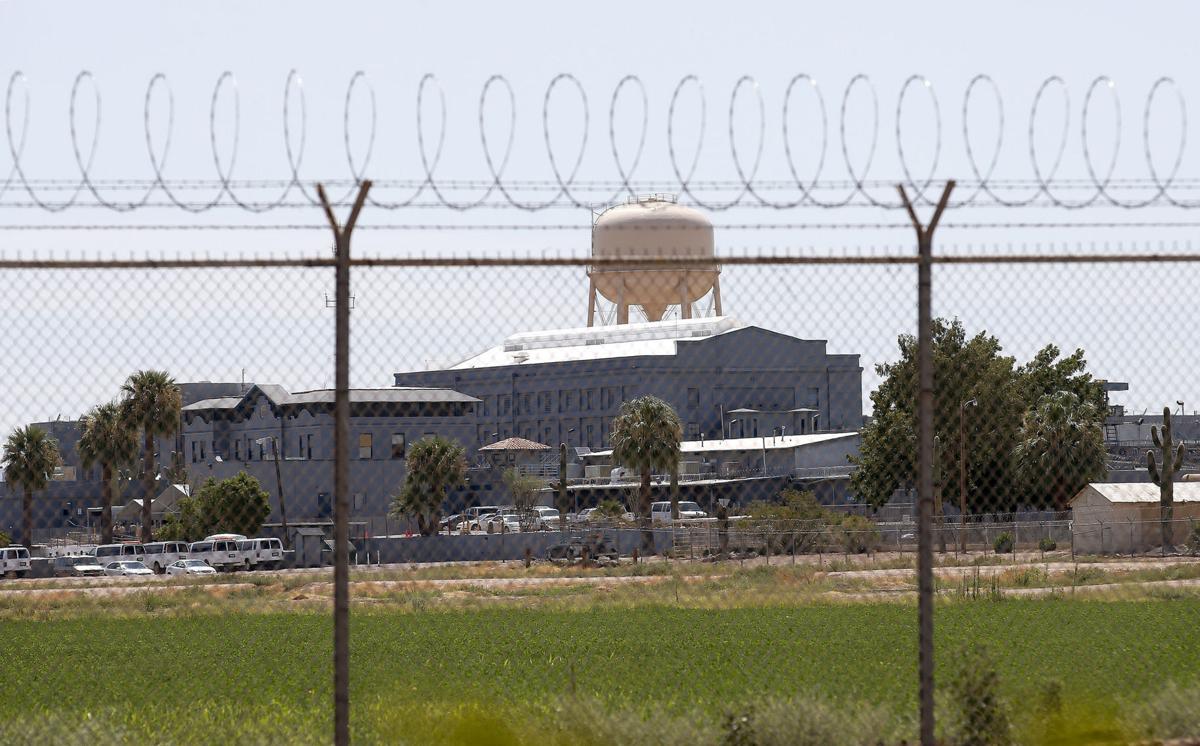
PHOENIX — Gov. Katie Hobbs formed a special commission Wednesday to review operations of the state prison system, saying problems there have been ignored for years.
The panel is charged with looking at everything from security and staffing levels to the ability of inmates to speak with family members and access basic necessities like nutrition, medicines and sanitary products. A preliminary report is due Nov. 15.
But the Democratic governor made it clear she’s not going to wait that long to address one particular issue on the commission’s agenda: Accessibility and quality of medical care and mental health programs.
That requires more immediate attention, Hobbs said, at least partly because the state is under federal court order to fix the system.
In a ruling last year, U.S. District Court Judge Roslyn Silver declared the care provided by state prisons is “plainly grossly inadequate’’ and state officials are acting “with deliberate indifference’’ to the substantial risk of harm to inmates.
Silver said top prison officials were aware of conditions that resulted in serious, and unnecessary, physical injury and death to inmates and actively ignored the problems.
Years-long litigation
The lawsuit was filed in 2012 on behalf of inmates. The state agreed to a settlement signed in 2015, Republican Gov. Doug Ducey’s first year in office, promising to do better. And the state was fined $1.4 million in 2018 for failing to live up to the performance measures to which it had agreed, with Silver imposing another $1.1 million penalty in 2021.
David Shinn, who was Ducey’s director of the Department of Corrections, Rehabilitation and Reentry, is gone, having been replaced by Hobbs with Ryan Thornell, former deputy corrections director in Maine.
“Our office is actively engaging with this case to make sure that we are addressing the issues that have been brought up, which really have largely been ignored until now,’’ Hobbs said.
“We intend to focus on what needs to be done and turn this around and provide humane treatment to folks in our care,’’ she said. “We’re under, now, judge’s orders. And they’ve been ignored.’’
Less clear, Hobbs said, is whether there has been a cover-up of the deficiencies in the prison system.
“That’s part of what we need to find out,’’ she said.
Silver, in her 200-page order last year, definitely had some thoughts on the issue. She said prison officials had purposely ignored unconstitutional conditions in the system that is responsible for nearly 34,000 inmates.
“Despite years of knowledge, driven by this litigation and defendants’ monitoring of private healthcare contractors’ performance, defendants have in fact made no significant attempts to substantively change the health care system and compel sufficient staffing,’’ Silver wrote.
“Thus, defendants are acting with deliberate indifference to plaintiffs’ serious medical and mental health care needs,’’ she continued. The judge said testimony from Shinn and others during the trial “provides compelling evidence of knowledge of the failures but a refusal to take meaningful measures to correct systemic flaws.’’
Silver accused Shinn of being more interested in protecting himself from criticism than protecting inmates.
Hobbs: Urgency has been lacking
Hobbs agreed with Silver’s overall assessment.
“I don’t think there is any disagreement in here that there has been a lack of transparency into these really serious corrections issues, and a lack of, really, any urgency to deal with them and change the way that we’re treating folks that are in our custody in the state,’’ the new governor said. She said there’s a “myriad of problems that have continued to exist.’’
“That’s why we’re bringing in a director who’s focused on reform,’’ Hobbs said.
The governor said Thornell is “absolutely aware of the issues he’s walking into with this department.’’
For the moment, though, he is simply Hobbs’ nominee. She has to get him confirmed by the Republican-controlled Senate, though he can serve up to a year without confirmation.
Hobbs said her office is “in the process’’ of sending his nomination to the Senate, along with those of others she has tapped to head state agencies. She said she is counting on lawmakers approving her choices.
“We believe they are focused on their role as public servants,’’ she said. “I am hopeful they will give my nominees a fair hearing.’’
One question already is being raised is that Thornell has not dealt with anything the size of Arizona’s system. At last report, Maine had fewer than 2,200 inmates.
“It’s surprising they’re saying this without the nomination paperwork in front of them,’’ Hobbs said.
But the Governor’s Office hasn’t provided much more in details about his background other than his position in Maine.
In a news release when he was named, Hobbs said Thornell “has led significant initiatives that re-envision traditional policies and approaches to incarceration, reforming a wide variety of adult corrections areas, challenging the status quo, and implementing 21st century, normalized corrections practices.’’
The commission Hobbs is forming includes two members of the House and two members of the Senate, from different political parties, and a representative of an “inmate advocacy organization’’ that the governor will select. Others include a physician, a mental health professional, a representative of an organization of corrections officers, as well as previously incarcerated men and women and a close relative of someone who served at least three years behind bars.
Not ‘isolated occurrences,’ judge said
Whether replacing Shinn is enough may be an open question.
After Silver issued her order last year, Walt Blackman, then a Republican state representative from Snowflake, told Capitol Media Services that Shinn was clearly ignoring obvious problems. But he said firings shouldn’t stop with Shinn and that the state needs to “clean house’’ of deputy directors and wardens who have been there for years and are running their facilities as if they are independent operations.
“So instead of taking their directions from the director ... they are doing their own thing,’’ Blackman said. “And that’s a problem.’’
In fighting the lawsuit under Ducey, attorneys for the state did not dispute the multiple examples Silver cited of inmates who died or were harmed due to lack of medical care. Instead, they argued these were “simply isolated occurrences’’ that do not show a pattern or practice of providing deficient health care.
The judge wasn’t buying it.
“The overwhelming evidence shows these cases indicate the opposite,’’ Silver wrote, pointing out the number of encounters each of these inmates had with the prison medical system, including many different personnel.
“It is impossible to conclude their treatment represented isolated occurrences,’’ she said. “Rather, these outcomes show that if a prisoner develops as serious health condition while in ADCRR custody, he or she is at substantial risk of grievous harm or death due to medical personnel’s inability to accurately assess and diagnose such conditions.’’
Federal correctional officers staged a protest in response to an Associated Press investigation that exposed how the Bureau of Prisons repeatedly promoted an official who was accused of beating several Black inmates. The officers gathered in front of the Bureau of Prisons' regional office in Stockton, California. The picket comes as members of Congress, including the chairman of the Senate Judiciary Committee, are demanding answers from the agency's director after AP's reporting on deputy regional director Thomas Ray Hinkle. Hinkle was repeatedly promoted, most recently to one of the highest posts in the agency. And this has happened despite his being accused of beating multiple Black inmates in the 1990s. Since then, people who know Hinkle say he has repeatedly boasted about the beatings and being part of a violent, racist group of officers that called themselves "The Cowboys." An Associated Press investigation has found the Bureau of Prisons has continued to promote Hinkle despite numerous red flags.
Then and now photos of Tucson (2020)
Garden Plaza, 1953
Updated
The Garden Plaza office building, 201 N. Stone Ave., Tucson, in December, 1953, shortly after it was completed. Joseph Weiss, a textile businessman from New York City, was "wintering" in Tucson when he decided to buy a used car lot at the site. It was one of the first buildings on Stone Ave. to be constructed after World War II.
Pima County
Updated
The county’s Development Services Department says it was looking for a “smarter way” to set building-permit fees.
All Saints Catholic Church, 1963
Updated
All Saints Catholic Church, 400 S. 6th Ave., Tucson, in 1963.
All Saints Catholic Church, 2020
Updated
Tucson Center for the Performing Arts, 400 S. 6th Ave., in Tucson, Ariz. on January 23, 2020. it was formerly All Saints Catholic Church.
Corbett's Lumber, 1955
Updated
Corbett's Lumber at 4545 E. Speedway in Tucson in 1955.
Corbett's Lumber, 2020
Updated
Tile With Style, 4545 E. Speedway Blvd., in Tucson, Ariz. on January 23, 2020. It was formerly Corbett's Lumber.
Coronado Hotel, 1987
Updated
The historic Coronado Hotel at 4th Ave. and 9th St. in Tucson, had seen better days by 1987. The 42-unit hotel, built in 1928, is listed on the National Register of Historic Places. A non-profit group saved the hotel from the wrecking ball in 1989.
Coronado Hotel, 2020
Updated
Coronado Apartments, formerly The Coronado Hotel, 402 E. 9th St., in Tucson, Ariz. on January 23, 2020.
Hi Corbett Field, 1963
Updated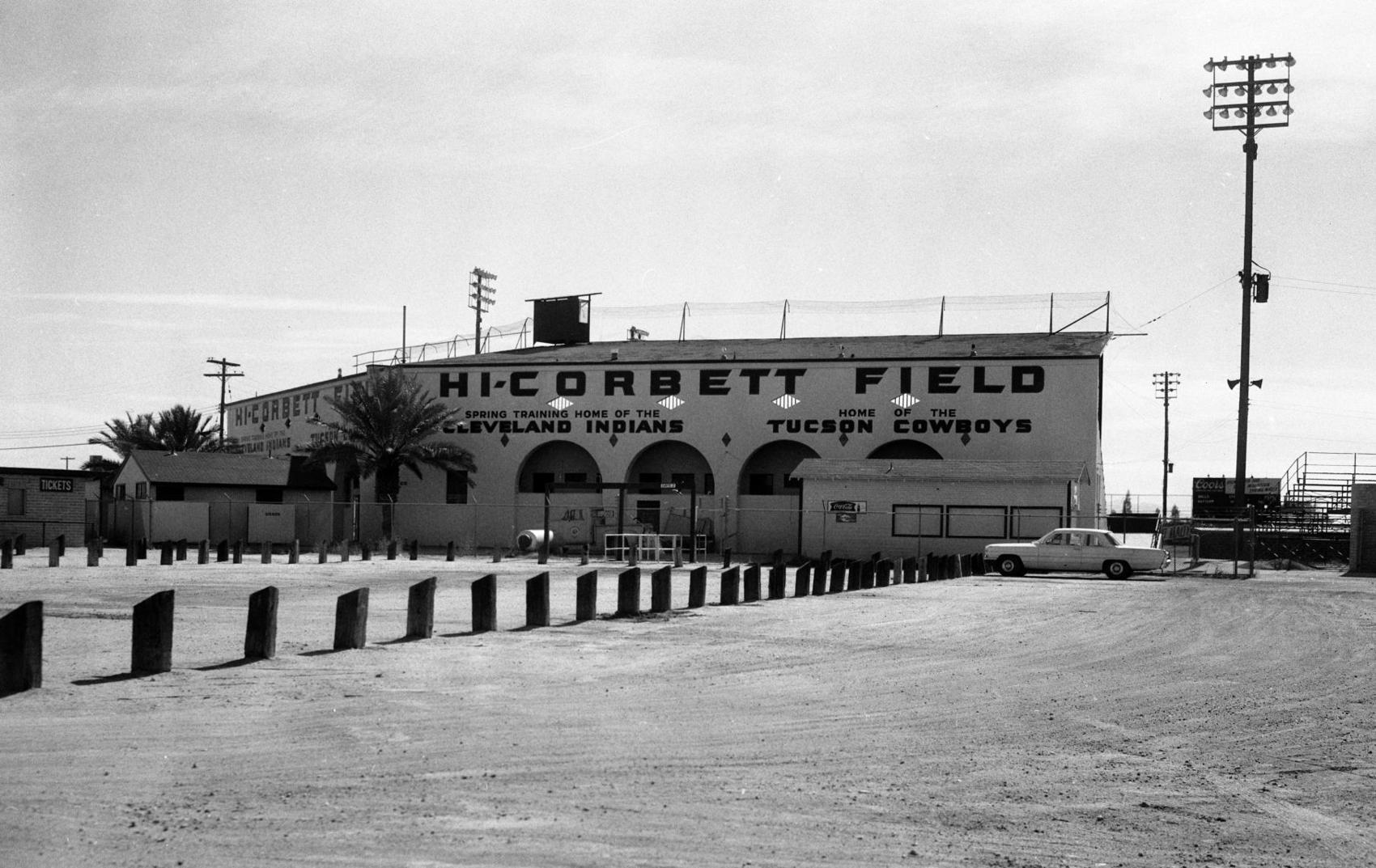
Hi Corbett Field at Gene C. Reid Park, Tucson, in 1963.
Hi Corbett Field, 2020
Updated
Hi Corbett Field, 700 S. Randolph Way., in Tucson, Ariz. on January 28, 2020.
Perkins Motors, 1955
Updated
Perkins Motors and Texaco gas station at Stone Avenue and Alameda Street, Tucson, in 1955. It was replaced by the Pima Savings building, which opened in 1956.
Perkins Motors, 2020
Updated
The Little One restaurant, 151 N. Stone Ave., in Tucson, Ariz. on January 23, 2020. It was formerly the site of Perkins Motors.
Roskruge Hotel, 1965
Updated
The Roskruge Hotel at 109 S. Scott, Tucson, in 1965. It was built in 1904 and demolished in 1984.
Roskruge Hotel, 2020
Updated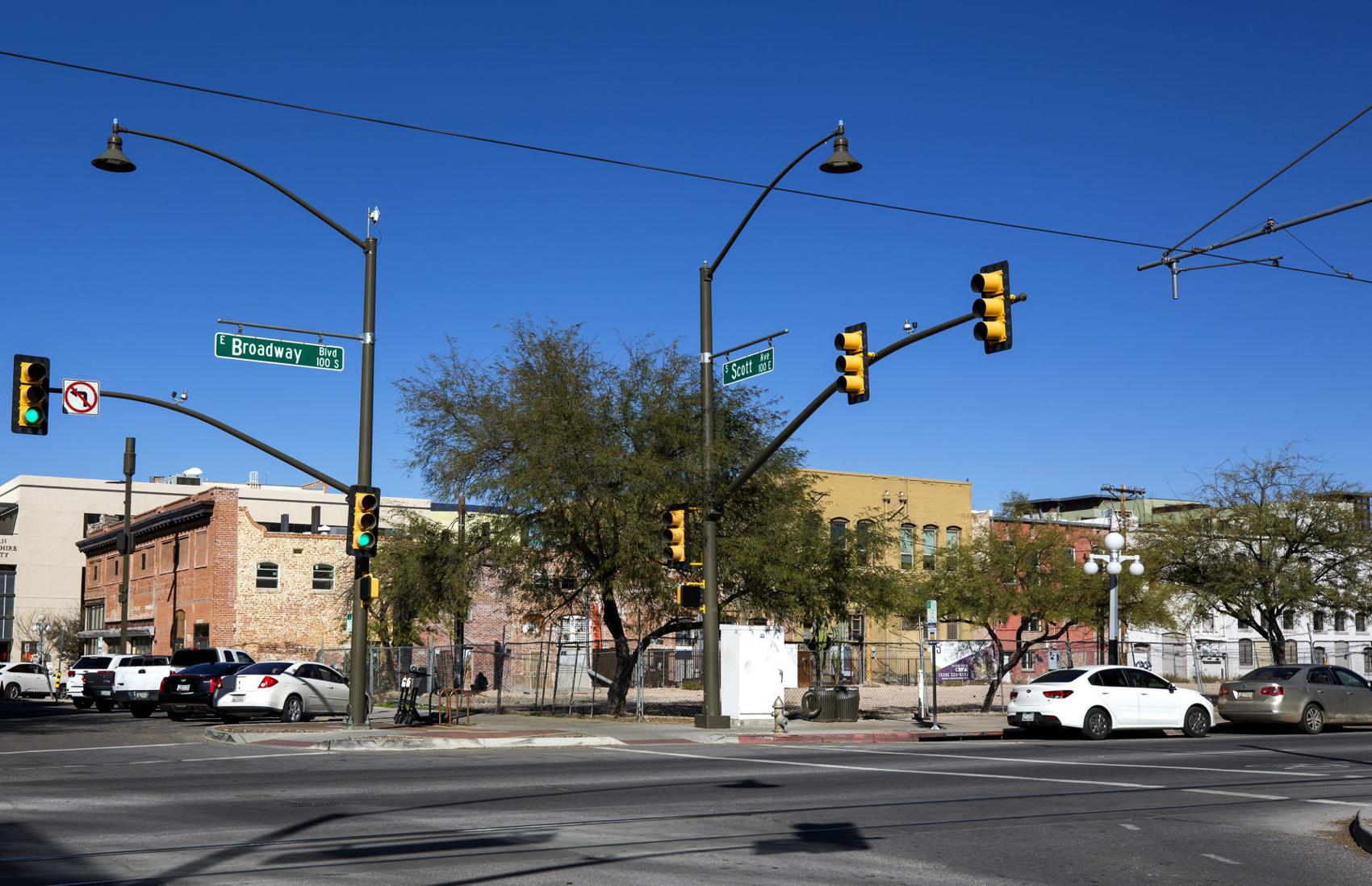
Empty lot on the north west corner of E Broadway Blvd. and S. Scott Ave., in Tucson, Ariz. on January 28, 2020. It was once the site of the Roskruge Hotel. A high-rise office/retail building is planned for the site.
Selby Motors Mercury, 1956
Updated
The new Selby Motors Mercury dealership at 2200 E. Broadway Road, Tucson, in 1956. The business moved from 820 S. 6th Ave.
Selby Motors Mercury, 2020
Updated
Chevron and Quick Mart on the southeast corner of E. Broadway Blvd. and S. Plumer Ave., in Tucson, Ariz. on January 23, 2020. It was formerly Selby Motors Mercury.
Temple of Music and Art, 1965
Updated
The Temple of Music and Art, 330 S. Scott Ave., Tucson, in September, 1965. It was built in 1926 and underwent an extensive renovation in 1990.
Temple of Music and Art, 2020
Updated
Temple of Music and Art, home of the Arizona Theatre Company, 330 S Scott Ave., in Tucson, Ariz. on January 23, 2020. The building underwent an extensive restoration in 1990.
Stravenue origin story is a trip down memory lane for one Tucson family
UpdatedWe have left turns from Michigan and potholes from the pits of hell, but one local traffic oddity is an Old Pueblo original.
What do you call a road that runs diagonally between an east-west street and a north-south avenue? Here — and nowhere else in America, apparently — that’s known as a stravenue.
Pima County is home to 40 of them, mostly in mid-century neighborhoods built around Tucson’s angled arteries — Aviation Parkway, Benson Highway, the Union Pacific Railroad tracks and Interstate 10 east of I-19.
The U.S. Postal Service even has an official abbreviation for the stravenue (that would be STRA), though mail carriers outside of Southern Arizona don’t need to concern themselves with it.
“Our records indicate the name is only found in Tucson, Arizona,” said Roy Betts, national spokesman for the Postal Service.
Tracing the origins of a made-up word
So who is responsible for coining the term?
Wikipedia gives credit for the stravenue to “Mr. Tucson” himself, Roy P. Drachman, who reportedly dreamed it up in 1948 as part of Del Webb’s Pueblo Gardens development near 22nd Street and present-day Kino Parkway.
But don’t believe everything you read on the internet. The apparent source for that historical nugget is a reader comment posted beneath an Arizona Daily Star story from 2008, which is pretty thin gravy, even for an online encyclopedia.

Arizona Highways magazine featured Del Webb’s Tucson development, Pueblo Gardens, in the November, 1948 edition.
Recent research by historian and preservationist Demion Clinco points to a more likely candidate: another prominent Tucsonan who played a large role in the city’s post-war development.
Clinco said the earliest appearance of a stravenue he can find is on the plat map for a subdivision called Country Club Park, a wedge-shaped neighborhood hemmed in by Aviation Road, Country Club and 29th Street.
It features six stravenues that were mapped out in February 1948, three months before the plat for Pueblo Gardens.
The same land surveyor produced both maps: Tony A. Blanton from the Tucson architectural firm of Blanton and Cole.
In December 1948, Blanton submitted another plat map, this time for North Campbell Estates at Campbell and Glenn, and again there were stravenues.
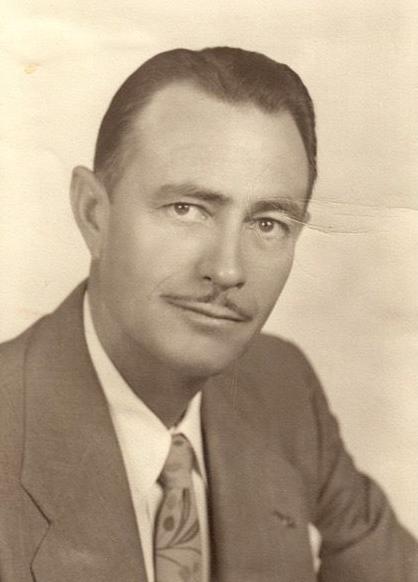
Planner and land surveyor Tony Blanton, ca. 1940s.
“Based on this, I think it would be fair to say Blanton brought us the stravenue,” Clinco said. “If he did not actually invent the term, he produced the first one and promoted their popularity in the late 1940s.”
Blanton helped put Tucson on the map
Longtime Tucson land surveyor Don Rockliffe said details like road names are often handled by the planner who is hired to draw up the subdivision map.
“Unless the developer had some pet names in mind, he left it up to the engineering firm to come up with the street names,” he said.
Of course, Rockliffe might be a little biased. Tony Blanton was his grandfather.
Rockliffe said his father, Donald Alan Rockliffe, married Blanton’s eldest daughter, Beverly, and worked as draftsman and design engineer for his father-in-law.
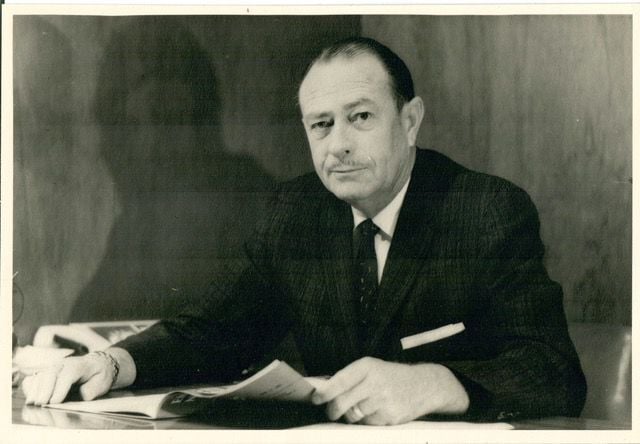
Tony Blanton, a prominent Tucson planner for decades, is a likely candidate for being the person who originated the term “stravenue.”
Blanton and Cole was one of Tucson’s first engineering and architectural companies, Rockliffe said, and it soon became the preeminent firm of its kind in the city.
By 1958, it had 42 employees and a newly built downtown office at Main Avenue and Pennington Street, though that building was lost to urban renewal about a decade later. “Now it’s buried beneath the county courthouse,” Rockliffe said.
Major local clients included the University of Arizona, several public school districts, Davis-Monthan Air Force Base and Hughes Aircraft Company. Blanton and Cole also worked on projects across Arizona and in eight other states.

Arizona Highways magazine featured Del Webb’s Tucson development, Pueblo Gardens, in the November 1948 edition. One “stravenue” origin story is that Roy P. Drachman reportedly dreamed it up in 1948 as part of Pueblo Gardens
.
From cowboy roots to the city’s “in-crowd”
Rockliffe said his grandfather was “part of the ‘in-crowd’ in Tucson, I guess you’d say, but he started out humble.”
He was born George Anthony Blanton in Calgary, Alberta, in 1910. His cowboy father was originally from Southern Arizona, and the family moved back here in 1911 — first to Willcox and then to Tucson in 1914.
After graduating from Tucson High School and studying at the UA, Blanton got his first engineering job with the Southern Pacific Railroad. He later worked for the U.S. Coast and Geodetic Survey, the U.S. Bureau of Public Roads, Pima County and the city of Tucson before launching a private practice with Frederick P. Cole, a former draftsman for the county.
Somewhere along the way, Blanton changed his legal signature to Tony A. Blanton — short (and somewhat redundant) for Tony Anthony Blanton.
Since learning of his family’s possible connection to Tucson road-naming lore, Rockliffe has done some research of his own that bolsters Clinco’s case.
He said there are 10 Tucson subdivisions that include stravenues, all of them mapped between 1948 and 1960. Blanton and Cole was the surveyor for six of them, including the five oldest.
Surveying streets runs in the family
The city planning and zoning commission added the made-up word to Tucson’s official street naming and numbering system in November 1948.
In May 1949, the Tucson Daily Citizen ran a piece explaining the new street type, which it described as “gobbledygood (sic) for diagonal.”
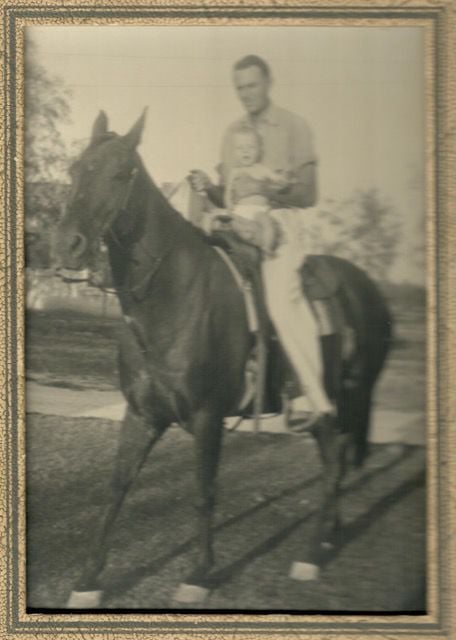
Tony Blanton rides a horse with his first child, Beverly, at his father’s ranch house on Hedrick Drive, near Campbell Avenue and Fort Lowell Road in 1936.
“I can remember seeing Cherrybell Stravenue as a child and thinking that was all so strange,” said Rockliffe, who retired in 2019 after 39 years as a land surveyor for Tucson Electric Power.
He never dreamed at the time that he might be related to the man who invented them — the man for whom Blanton Drive near Fort Lowell Road and Tucson Boulevard is now named.
Rockliffe said he used to visit his grandfather on Sundays and holidays. Occasionally, he would join him in his box seats at Hi Corbett Field for Cleveland Indians spring training games.
Blanton died in 1969 at the age of 59.
Rockliffe was about 11 at the time. Not long after, he began to learn the family business from his own father. He used to watch him work at his drafting table, and he later helped him draw a few subdivision plats before enrolling at the UA to become a registered professional land surveyor himself.
“He taught me surveying,” Rockliffe said of his dad, the likely son of the stravenue. “It felt like it was kind of in the blood.”

