


Tucson Water is offering to leave "significant volumes" of its annual Central Arizona Project water supply in the Colorado River for the next three years in return for financial compensation from the federal government.
But its letter to the U.S. Bureau of Reclamation making that offer didn't propose a specific cut to the city's annual CAP allocation. Supplying 144,191 acre-feet a year to Tucson Water, CAP provides virtually all of the drinking water served to more than 730,000 utility customers. Tucson has enough left over from that supply after serving those customers to recharge nearly one-third of the water into the ground to store for future use. An acre-foot will supply up to four Tucson families with water for a year.
"We are letting the (bureau) know we are interested in discussions over a potentially significant contribution over the next several years," Tucson Water spokeswoman Natalie DeRoock said in an emailed response to a question from the Star about why the utility isn't disclosing a specific amount of water it's offering to leave.
Since Tucson has one of the larger CAP contracts in the state, "we are offering an undetermined amount at this time because we may have the most flexibility" in supporting a statewide conservation program, added Tucson Water Director John Kmiec.
The uncertainty of Tucson Water's proposal is similar in some respects to how some other Arizona responded to the bureau's requests to leave water in the Colorado River starting next year. The bureau seeks this water as part of what it calls a "system conservation" program.
This request is one portion of the bureau's multi-pronged strategy for bolstering the river's imperiled reservoirs, Lakes Mead and Powell. The bureau wants to cut Colorado River water use by 2 million to 4 million acre-feet a year total across the seven river basin states.
The bureau asked cities, farms and tribes in the river's basin states to offer to leave some water in the river in return for compensation, ranging from $330 an acre-foot for water left for a year to $400 an-acre foot for water left for three years. Arizona, California and Nevada are in the Lower Basin.
Hesitation, uncertainty
Officials of several other Arizona-based CAP users, including Oro Valley, told the Star they are hesitant to make specific commitments at this time to leave water. That's because of a very real possibility that next year, the bureau will decide to cut its annual release from Powell to Mead in 2023 from a planned 7 million acre-feet to as little as 5.5 million acre-feet.
Such a reduction would dramatically lower Mead's water level, and ultimately lead to still more drastic cuts in water deliveries to the Central Arizona Project and to other Lower Basin water users.
While Oro Valley declined to offer to leave any of its CAP supply in the river, officials in cities including Phoenix and Peoria along with Tucson have put conditions on their offers, to try to avoid losing what they think would be too much water should additional cuts prove necessary.
The bureau has made no decision about next year's release, although it has held out the possibility of reducing it to keep Lake Powell's water level from falling too low. It is considering cutbacks for next year as it works on an environmental review of its options for river management. A draft environmental report is due next spring, with a final report and decision likely by summer 2023.
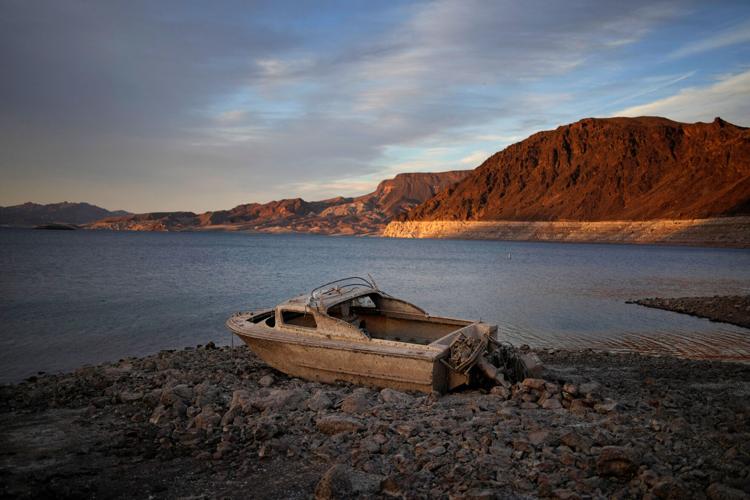
But an analysis released this month by Arizona water officials concluded that a 5.5 million acre-foot release in 2023, followed by a 6.5 million acre-foot release in 2024, could drop Lake Mead's level to barely 960 feet by fall 2024 — down from 1,043 feet this week.
When the lake falls below 950 feet, Hoover Dam's turbines would no longer generate electricity for its eight million customers around the Southwest. Lake Mead also would then sit only 55 feet above "dead pool," at which no water could be extracted to be sent downstream to water users in Arizona, California and Mexico.
Lake Powell appears to face an equally dire if not a greater threat. The farther it drops below its minimum power production level of 3,490 feet, the harder it will be for water in the lake to pass through the dam and be delivered to Lake Mead and the Lower Basin.
'On the razor's edge'
The Phoenix Water Department has offered to leave 30,000 acre-feet in the river for 2023. But it will leave it in separate "chunks" over the course of a year rather than at once, said Cynthia Campbell, the city's water resource planning manager.
The Gila River Indian Community, holder of Arizona's largest CAP allocation of 311,000 acre-feet, has declined to say how much water it will leave behind. The Tohono O'odham Nation has offered to leave some of its CAP supply of 74,000 acre-feet in the river but declined to publicly disclose how much.
Oro Valley opted to take all of its CAP allocation of about 10,300 acre-feet, in part because of the uncertainty of how much water will be released to Lake Mead next year.
"If I was guaranteed that what we did would benefit the Lower Basin states, I might be inclined to do it," said Peter Abraham, Oro Valley's water utility director. "Without that guarantee, any amount of savings we might do for Lake Mead might not be realized."
The Gila River community also sees "a lack of clarity" about how the bureau's environmental report might affect it, said tribal attorney Jason Hauter.
"It’s difficult to provide a number until further discussions are had with Reclamation," Hauter said.
These users are "on the razor's edge" of being able to meet their obligations to deliver water to customers with the reservoirs so low, said Kathryn Sorensen, a research fellow at Arizona State University's Kyl Center for Water Policy.
"The uncertainty is intolerable at this point. The cities can’t be in a position where they pledge water and then in three months, the bureau comes back and cuts a lot more," Sorensen said.
In his letter to the bureau last week, however, Tucson Water's Kmiec didn't mention concerns Reclamation could later cut more water deliveries as a reason for not offering a specific amount of water. In fact, city officials are interested in discussing with the bureau opportunities for additional CAP conservation, to be carried out under different parts of of the bureau's water conservation program, he said.
"We appreciate (the bureau's) efforts in this area, and we welcome constructive dialogue, to address the drought crisis with prompt and responsive actions and investments to ensure the entire Colorado River Basin can function and support all who rely on it," Kmiec wrote.

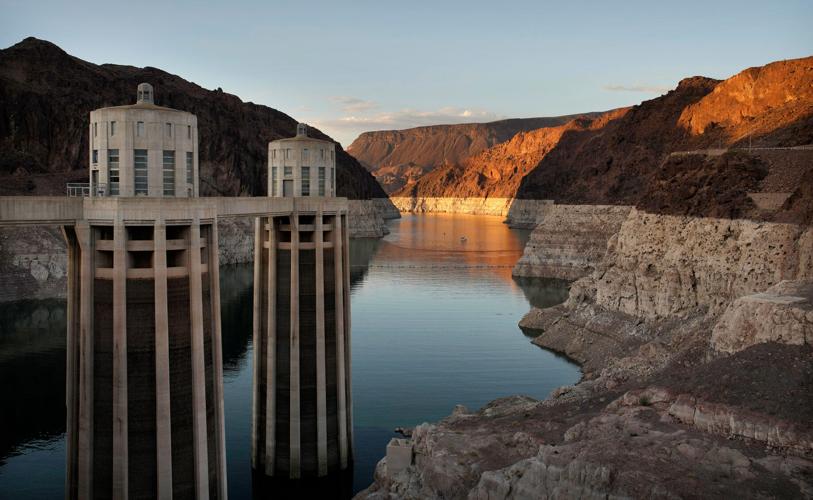
A bathtub ring of light minerals shows the high water line of Lake Mead near water intakes on the Arizona side of Hoover Dam at the Lake Mead National Recreation Area in June near Boulder City, Nevada. Dire consequences could result if states, cities and farms cannot agree on how to cut the amount of water they draw from the Colorado River.
Tucson seeks federal commitment
Kmiec did condition Tucson's willingness to leave water in Lake Mead upon getting a federal commitment that whatever conservation the city does now will be given credit if the bureau hasto make more cuts.
"Our intention is to avoid paying a water resources penalty" for participating in the bureau’s voluntary program, Kmiec said.
It appears the bureau will want more cuts beyond what the states have already agreed to in the 2019 drought contingency plan, "and it does not appear likely that voluntary participation in the bureau’s programs will completely forestall the need for the bureau to make difficult decisions in allocating available water," Kmiec said.
The prospect of as little as 5.5 million acre-feet coming down the Colorado from Lake Powell next year was first publicly raised by Arizona Department of Water Resources and Central Arizona Project officials at a Nov. 4 meeting of a committee of water officials and experts. The committee was formed to advise Arizona on how to prepare for renegotiaton of an earlier set of federal guidelines to operate the river's reservoirs.
"We didn’t come up with 5.5 million acre-feet out of thin air," ADWR Director Tom Buschatzke said at the meeting. "This is something Reclamation has discussed with us."
Such a cut will happen if "we got to bad enough hydrology on the river this winter," he said.
Bureau officials have said that if runoff into Lake Powell is less than 50% of normal next winter and spring, "they will need to stabilize the system, and we should expect less than seven million acre-feet," Buschatzke said.
Bureau officials can't speculate now on the possibility of a less-than-normal release from Powell to Mead, said spokesman Doug Hendrix. But Interior Department officials will hold a public webinar to go into more depth about where it stands, Hendrix said.
Scottsdale Water has submitted a conditional proposal to leave water in the river "so that we can be a part of continued talks and part of the solution," said utility spokeswoman Valerie Schneider. Scottsdale has rights to 52,000 acre-feet — more than any Arizona city besides Tucson and Phoenix.
She did not specify how much water the utility proposes to leave, adding: "Ultimately, contribution numbers would be based on a number of factors — something we are not comfortable sharing at this time since the proposal is just the first step in the process."
But in the Tucson area, Marana and the private Vail Water Co. have opted to take their full CAP allocations next year. They have much smaller CAP supplies than Oro Valley — 2,236 acre-feet a year for Marana and 1,857 acre-feet for Vail.
Since Marana uses its entire CAP supply in its water system every year, "we will have to order the full allocation," Marana Water Director Jing Luo said. "Meanwhile, staff are working diligently on drought awareness and water conservation to improve long-term water efficiency and sustainability for our community and the region."
While Vail Water might leave water in the river in the future, "right now we want to see how it plays out," said Kip Volpe, the company's vice president. "We don't have a lot to leave on the river."
The company uses "quite a bit" of its CAP supply, and, "I don’t want to get caught short," Volpe said.
The Central Arizona Project is a 336-mile canal in Arizona that supplies Colorado River water for the Phoenix and Tucson area, agriculture and several Native-American tribes. Construction began in 1973 and was substantially complete by 1994. This portion is located near Sandario Road and Mile Wide Road west of Tucson on March 17, 2021. Video by: Mamta Popat / Arizona Daily Star
Photos: Construction of Hoover Dam on the Colorado River in the 1930s

This general view of Black Canyon on the Colorado River, looking upstream toward the site of Hoover Dam, shows a temporary steel suspension bridge in the foreground and portals of the 56-inch diversion tunnel bores which will carry the river water while the dam is under construction, March 12, 1932. The dam will be in Black Canyon, despite the fact that it is generally known as the Boulder Canyon Project. (AP Photo)

This photograph was made from the Nevada side of the river, and shows some of the blasting operations in progress, Aug. 24, 1932 in Nevada. Some idea of the difficulties of the operations may be gained from this view of the rock cliffs. (AP Photo)

This view shows the interior of one of the tunnels through which the Colorado River will be diverted around the Hoover Dam site in Boulder City, Nev., April 18, 1932. The project is in the early stages of construction. (AP Photo)

Looking down on Hoover Dam site, the parapet is directly over the power plant site, and also part of the Nevada-Arizona highway which will traverse the dam, shown Aug. 24, 1932. Beyond this will be the greatest lake ever created by man. (AP Photo)

A lake covering 227 miles will form the 30,500,000 acre foot reservoir from Hoover Dam when completed. Elmer L. Chapman, junior reclamation service engineer, points to the hills which will be submerged after the completion of the project in Nevada, Aug. 24, 1932. The flat top lone mountain in the center of the photograph will be an island 14 feet above water. (AP Photo)

This is a downstream view of the Hoover Dam showing the immense concrete blocks rising from the bedrock of Black Canyon's floor, which will be the core of the dam, near Boulder City, Nev., Aug. 12, 1933. Concrete is being poured into the forms at the rate of about 6,000 cubic yards daily. (AP Photo)

Construction continues Jan. 9, 1932 as workers construct the retaining wall that gives support to the road leading over the top of Hoover Dam. Labor troubles were experienced during the huge engineering project on the Colorado River near Las Vegas, Nevada. (AP Photo)
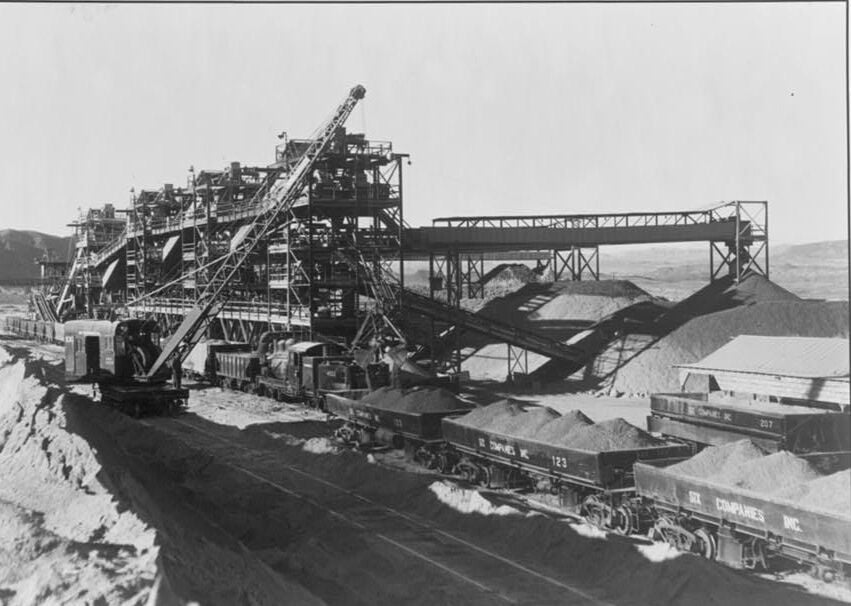
Gravel screening and washing plant in 1934. Glaha, Ben D., 1899-1970, photographer
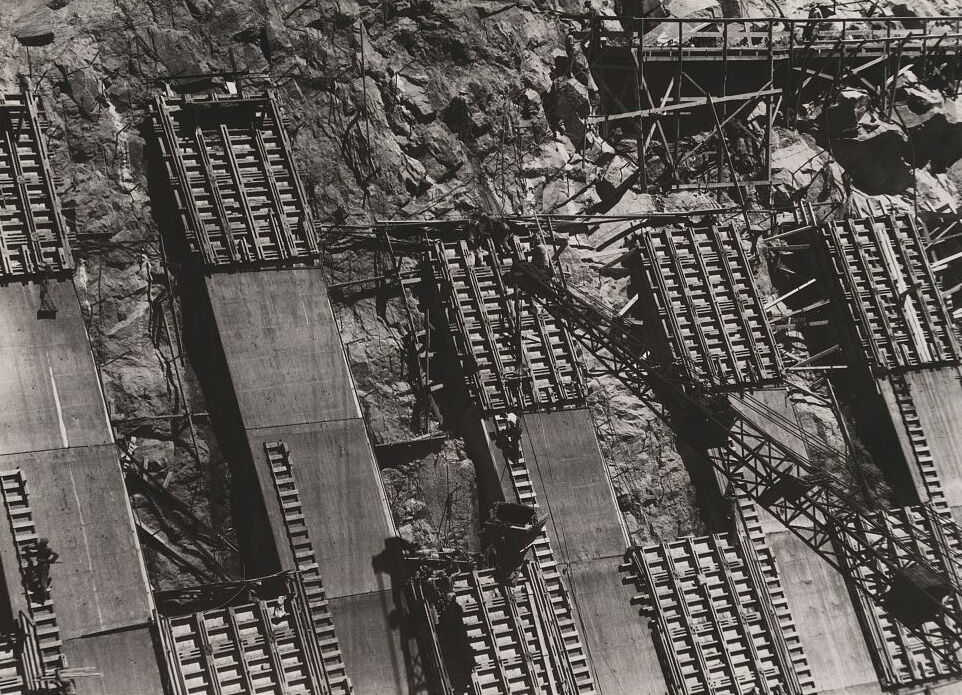
Boulder Dam, (i.e. Hoover Dam) between Arizona and Nevada in 1933. Placing concrete in the sidewall of the Nevada spillway. A 2 cubic yard bottom-dump bucket is being handled by crane. Note the manner in which the panels are staggered
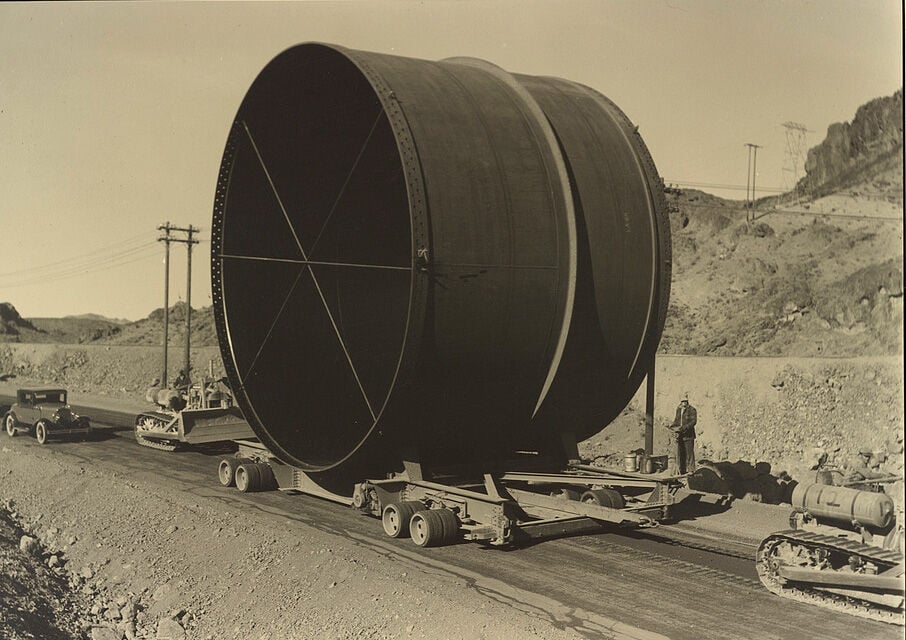
Penstock on trailer, 1934. Glaha, Ben D., 1899-1970, photographer
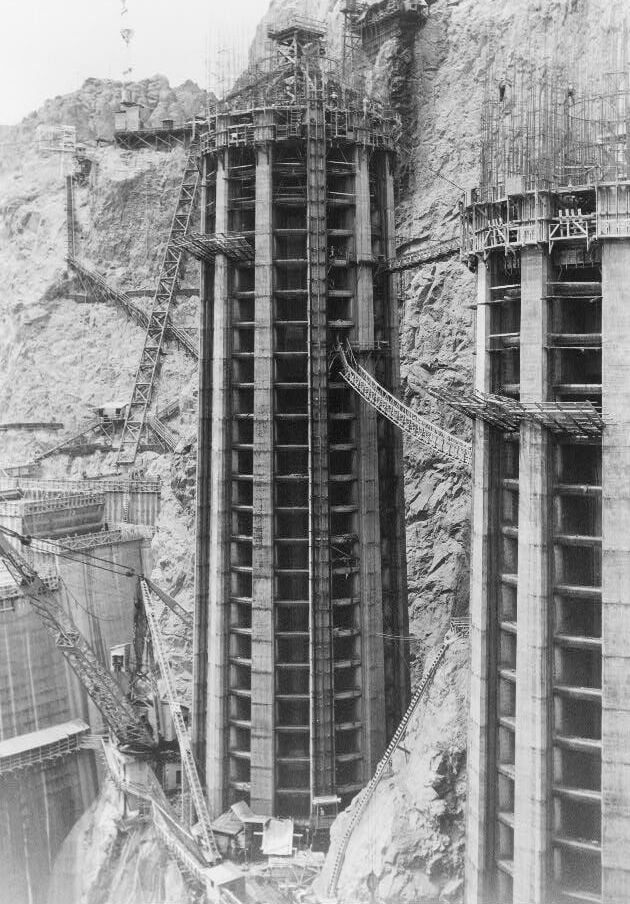
The Nevada intake towers at Boulder Dam in 1934. Glaha, Ben D., 1899-1970, photographer
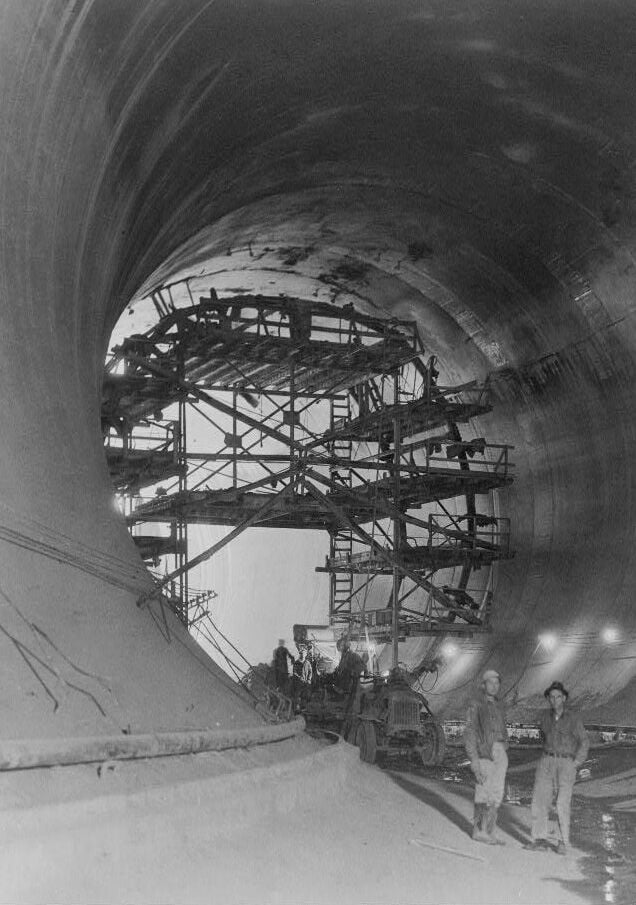
Grouting concrete lining in 50' diameter diversion tunnel in 1934. Glaha, Ben D., 1899-1970, photographer

Construction of the Hoover Dam continues, a constant stream of large trucks dumping fifty tons of soil a minute, built an earth fill dam across the Colorado River, forcing its turbulent waters into two fifty-foot diversion tunnels on the Arizona canyon wall on Nov. 15, 1932. (AP Photo)

Inside of diversion tunnel no. 3, on the boulder dam project, showing concreting operations, July 9, 1934. The intersection of the inclined tunnel from the intake tower (above) with the present diversion which is being plugged. These tunnels will carry the 30-foot diameter steel penstocks for the power system. Photo by bureau of reclamation. (AP Photo)

This is an aerial view of one of the four intake towers of the Hoover Dam, Aug. 9, 1934. The towers, two on each side of the canyon upstream from the dam, will measure at 380 feet high. (AP Photo)

The Boulder Dam, Black Canyon of Colorado River, is nearing completion, this view showing 500 of its projected 730 feet above the canyon floor, Aug. 28, 1934. The federal reclamation service, directing the construction, says the dam, now 80 per center completed will be finished next April, a full year ahead of schedule. (AP Photo)

A view of the huge Boulder Dam operation from a high point on the Nevada rim of the Black Canyon, shown Sept. 11, 1934. The immensity of the project can be seen from this picture. (AP Photo)

Hoover Dam takes shape from the concrete columns in which it was poured (shot from cableway control tower downstream on Nevada rim, so looking upstream) in 1934.

The rarely-seen upstream face of Hoover Dam, May 1935

This is a view of the Hoover Dam from upstream as construction continues near Boulder City, Nev., Feb. 1, 1935. The crack in the upper center of the dam is a space left open for cooling and settling of the concrete and will be filled as work progresses. (AP Photo)

This aerial view shows a crest of the Hoover Dam, aka Boulder Dam, showing the highway leading across it on July 16, 1935. The road, soon to be opened to the public, will provide an easy route between Las Vegas, Nev., and Kingman, Arizona. The intake towers jut up on the other side of the dam in Boulder City, Nevada. (AP Photo)

Night view of Boulder Dam and Mead Lake taken from a plane United airlines-western air express shows the roadway over the dam top illuminated and the candles atop the intake towers casting their reflections on the water, Sept.22, 1936 in Boulder City, Nevada. (AP Photo)

Behind boulder dam, in the black canyon of the Colorado River, is the largest man-made lake in the world shown, June 11, 1938. Pressing against the barrier of concrete and steel are 20,000,000 acre-feet of water which, translated into gallons, is enough to provide 51,100 gallons for every person in the United States. This water is to be used to meet the needs of the power house at the toe of the dam, and to irrigate the thousands of acres of reclaimed desert downstream in Arizona and California. (AP Photo)

Meet the Champs. These six 82,500 kva generators in the Nevada wing of the power house at Boulder Dam are the biggest in the word, Feb.7, 1939 . Power produced at the dam by these generators and one in the Arizona wing, amounts to 130,000,000 kilowatt hours of energy each month which sells for ?290,000. The Bureau of Reclamation which built and operates the dam, received $3,297,289 in two years. Production at this time is approximately one-third of the ultimate capacity. (AP Photo)

Aerial view of Hoover (Boulder) Dam on the Colorado River, Dec. 11, 1948. (AP Photo)

This is Main Street in Boulder City, Nevada, Aug. 24, 1932, the model construction housing center for the workers on the huge Hoover Dam project. This city was constructed at a cost of $2,000,000. (AP Photo)

A three million pound gate of tunnel no. 4, shown above at left, was ready to close, Feb. 1, 1935, stopping flow of the Colorado River at the Boulder Dam, thus starting filling of a huge reservoir. The above photo taken just before the gate stated closing shows a coffer dam built across the entrance of tunnel no. 3, which has been diverting the river through the canyon walls and around the dam on the Arizona side. (AP Photo)

Spectators watch from bridge over spillway as Boulder Dam overflows for first time, August 6, 1941, and pours 15,000 cubic feet per minute from record level of Lake Mead into Colorado River behind the dam. Spillway leads into tunnel 50 feet in diameter and then 2200 feet to river level below where water bursts out in great jet. At Dam, Lake Mead had reached level of 590 feet and contained more than 10,000,000,000,000 of water. (AP Photo)

The mighty man-made falls of the Colorado River with the six outlets wide open in a night display. Since the start of generation of power here the dam has been a night-time Mecca for tourists in Los Angeles, Sept. 22, 1936. The transmission of power to Los Angeles will be started on October 9. (AP Photo)

The 115,000-vollite generator in the world?s biggest power plant, here at Boulder City, Sept. 29, 1936, where all is in readiness to start electricity over the world?s longest power transmission line ? 365 miles to Los Angeles. (AP Photo)

This magnificent man-made scenic favorite is Hoover Dam by night, May 11, 1953, one of this century?s outstanding triumphs of engineering and construction. At its foot is Lake Mead, the world?s largest man-made body of water on Popular with anglers and fans of boating, Lake Mead is fast becoming a favorite vacation playground. Gateway to the Hoover Dam ? Lake Mead recreational area is fabulous Las Vegas, Nevada on the main line of Union Pacific Railroad. AP Photo)

The mighty Hoover Dam impresses a young Swiss couple making their first tour of United States on their scooter, April 9, 1954 in Nevada. Natives of Zurich, Fred and Beatrice Troller were veteran scooter travelers in Europe before coming here. (AP Photo)

Boulder Dam?s mighty water intake towers, rising 395 feet into the air, are in picture of the gigantic power project shown, April 14, 1938. Through these towers flows the water which operates the huge generators in the powerhouse below the 727-foot dam. On the shores of the 110-mile long lake impounded, the government has established the boulder dam recreational area. Luxurious accommodations are available at Boulder City. New a regular airline stop. (AP Photo)

English: Tourists gather around one of the generators in the Nevada wing of the powerhouse of Boulder Dam (later Hoover Dam) to hear its operation explained.

Hoover Dam at Dusk, Sept. 20, 1950. (AP Photo)

This July 18, 2014 photo shows generators inside the Hoover Dam, located on the Colorado River, on the border between Arizona and Nevada. It's considered one of America's great civil engineering wonders. Located about a half-hour from Las Vegas, it's a top destination for visitors to the region. (AP Photo/John Marshall)

In this July 28, 2014 photo, lightning strikes over Lake Mead near Hoover Dam at the Lake Mead National Recreation Area in Arizona. On the left are the Arizona intake towers of Hoover Dam. The bathtub ring of light minerals shows the high water mark of the reservoir which has shrunk to its lowest point since it was first filled in the 1930s. (AP Photo/John Locher)

Low water levels in the Lake Mead reservoir and at the Hoover Dam show a "bath tub ring" on October 14, 2015. Water in the lake has continued to drop. (Irfan Khan/Los Angeles Times/TNS)

A boater gets an up-close view the "bathtub ring" that is visible at low water levels and is the result of the deposition of minerals on previously submerged surfaces while touring the front of Hoover Dam, which sits on the border of Nevada and Arizona, at Lake Mead, Nevada, June 28, 2021.

The intake towers that feed Hoover Dam’s power generators are almost fully exposed as the Lake Mead water level continues to decline in June, 2022.

