



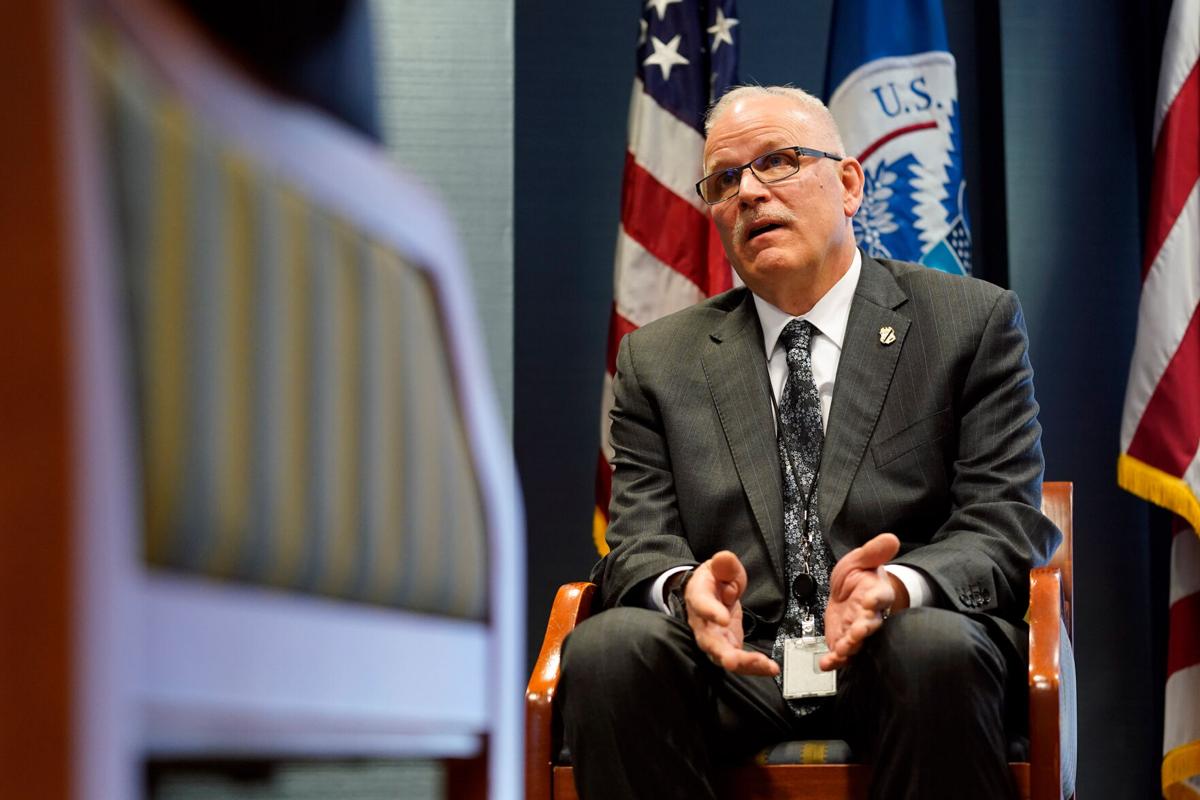
Former Tucson police chief Chris Magnus says he resigned as head of Customs and Border Protection because he wasn’t aligned with its leadership, but he hopes the agency will continue the progress he was making.
“I was asked to resign, and I didn’t want to resign because I was so committed to working on a lot of the issues that were important to me, and I had a lot of people that I felt were relying on me to do that,” he told the Arizona Daily Star on Monday. “At the same time, I ultimately came to realize that trying to continue in this role just wouldn’t make sense for DHS or for me.”
Many of Magnus’ priorities were about reforms within CBP, while there has been much criticism leveled at the agency and the Department of Homeland Security as the number of migrants apprehended at the border has reached record highs.
“There are immense challenges with addressing irregular immigration, and clearly that’s not just happening here,” Magnus said. “It’s happening throughout the world. So these are real problems. I think there are members of Congress who continue to use immigration and border security as wedge issues in ways, I think, to generate fear and bolster their brand of politics. I think we saw a lot of that in the most recent election. It really makes me sad because these are complex issues that don’t lend themselves to simple partisan solutions.”
Magnus resigned Saturday, Nov. 12, after his boss, Secretary of the Department of Homeland Security Alejandro Mayorkas, told him to do so a day earlier, as first reported by the Los Angeles Times.
The White House put out a statement Saturday saying President Joe Biden appreciates Magnus’ four decades of service to law enforcement and the contributions he has made to police reform. Mayorkas has not said publicly why he told Magnus to resign.
Magnus would not specify why he was asked to quit. He did say that part of his role as CBP commissioner was to “do a lot of asking why things are done a certain way and to turn over rocks.”
“I think that’s tough with law enforcement agencies across the board,” he said. “They get pretty entrenched in doing things in certain ways. And I think law enforcement culture can sometimes be very resistant to change. I think the bigger the organization, the more challenging that is. And I’m not sure that some of that approach was aligned with some of what the folks I was working for placed as their highest priority.”
Before becoming Tucson police chief in 2016, Magnus was chief in Richmond, California, and in Fargo, North Dakota.
The Tucson Police Department underwent a myriad of changes under Magnus, including changes to the use-of-force policy, multiple programs that provide alternatives to arrest, enhanced pay and wellness benefits for officers, and a nationally recognized review process for major incidents.
During his tenure in Tucson and in previous positions, he was in alignment with city leadership, Magnus said, which was important to him. He said he also felt committed to the administration’s priorities in Washington, D.C., when Biden appointed him last year and the Senate confirmed him for the post in December.
“I wanted that alignment to exist, but ultimately, I realized that needed alignment, it just didn’t exist,” Magnus said. “I’ve often told high-ranking folks in police departments who want to be police chiefs that they need to make sure that their vision, philosophy and priorities are aligned with the people that they’re working for. It’s a little like a marriage and that alignment has to exist or the marriage is going to fail.”
As head of CBP, Magnus was vocal about issues such as Title 42, a public health policy that allows the government to immediately expel migrants from the country, saying it “comes at a heavy cost to many asylum seekers,” the L.A. Times reported. He also tried to change the culture of Customs and Border Protection and clamped down on social media activity.
Magnus says he was part of internal decisions and also had multiple visits with Mexican government officials related to border issues, visited several dozen border sectors and port locations to work on identifying their needs, and was active on trade issues. He represented the U.S. at the World Customs Organization meeting in Brussels in June. And last month, he was in Ottawa, Canada, trying to resolve some problems with a Canada-U.S. program for pre-screened travelers, he said.
Magnus came under fire in October after reporting by Politico cited five anonymous administration officials who said he didn’t always attend White House meetings concerning the border, that he bad-mouthed other agencies to colleagues and superiors, that he didn’t build relationships within the agency, was unengaged in his job and was primarily focused on reforming the culture of the Border Patrol by addressing a long list of allegations of racism and violence.
“I want to push back significantly on this narrative that was being spun that somehow I was disengaged, especially being described in that way by anonymous sources,” Magnus said. “It was patently false, and people may not agree with what I was trying to do, but disengaged? No.”
Border Patrol Union President Brandon Judd said Magnus butted heads with people across many agencies under the Customs and Border Protection umbrella.
“He’s known as an activist,” Judd said. “Anytime a police chief in uniform is out holding up signs on Black Lives Matter — regardless of whether you agree with the organization or you don’t agree with the organization — if you’re a police chief in uniform and you’re holding up signs supporting that organization, which is an activist organization, all you’re doing is politicizing a law enforcement entity.”
“So he was known to be an activist. He was known to be very, very far left leaning and in law enforcement that’s not going to go over well because law enforcement, we want to do a job. We want to protect the American public,” Judd said.
Magnus held a Black Lives Matter sign during a rally against police brutality in 2014 while chief in Richmond.
Some of the issues Magnus had identified as priorities in CBP included: expanding mental-health resources and suicide prevention for officers and agents, improving the agency’s social media policy, increasing public access to data and policies, retaining and increasing the number of women in Border Patrol and throughout the agency, and updating Border Patrol’s pursuit policy.
“This was a very serious issue in the Border Patrol,” Magnus said about the latter policy. “There are way too many pursuits that end badly with injuries and death. We did a lot of work on that policy, and I hope it will be released soon. That’s something that I thought delayed too long, and I hope that stays on track.”
Deadly pursuits and crashes involving Border Patrol have increased over the last few years. There have been at least 17 deaths so far this year, nationwide, in crashes where Border Patrol had been in pursuit, four of which were in Arizona.
Judd took issue with numerous policies Magnus was working on, including the pursuit policy.
“It was going to encourage more criminal activity because he was going to greatly, greatly restrict pursuit, and anytime that you telegraph to criminals that all they have to do is act in a dangerous fashion, they’re going to act in that fashion,” Judd said. “So it does encourage criminals to act more dangerously, and that was coming down the pipe and hopefully that will be stopped now that he’s gone.”
The Department of Homeland Security opened complaints earlier this year alleging that CBP personnel unnecessarily engaged in vehicle pursuits at high rates of speeds that were unwarranted given the alleged crime, and that they deployed vehicle immobilization devices or used pursuit techniques that potentially led to serious injury or death. The department’s Office for Civil Rights and Civil Liberties said it is pursuing an investigation.
Magnus also committed to eliminating Critical Incident Teams, Border Patrol teams that investigated fellow agents in extreme use-of-force cases and were considered controversial by many because of conflict-of-interest concerns. Those investigations will now be handled by a third party.
Homeland Security Chief Mayorkas told CBP staffers that deputy commissioner Troy Miller, who temporarily held the role before Magnus, would take over as head of the agency in an acting role, the L.A. Times reported.
Customs and Border Protection is the largest law enforcement agency in the country and one of the largest in the world, with more than 60,000 employees. The agency focuses on more than border security and immigration issues. It also enforces trade and customs laws and has national security responsibilities.
The Associated Press reported that Magnus being asked to resign was part of a larger shakeup expected at Homeland Security, which oversees CBP, due to the large number of migrants showing up at the U.S.-Mexico border.
Mayorkas is testifying before lawmakers on Nov. 15, in a Homeland Security Committee hearing on security threats, and will likely be asked about Magnus’ resignation and the nearly 2.4 million apprehensions this year at the U.S.-Mexico border, according to Reuters.
Magnus says he still cares about and is committed to community-engaged policing, accountability, transparency, implementation of best practices, good use of data in terms of making decisions both internal and external, and procedural justice in engaging with the public and employees. But he hasn’t decided what he’ll do next.
“I’m not in a rush to run out there, and I’m not sure what those contributions exactly will look like,” he said. “I’ve been doing this for as long as 43 years, and there are arguably those who would say, maybe it’s time to hang it up. But I think I still have a lot of commitment and ideas and enthusiasm about partnering with the right people in the right places. And I think it’s just a matter of finding that right alignment.”

