



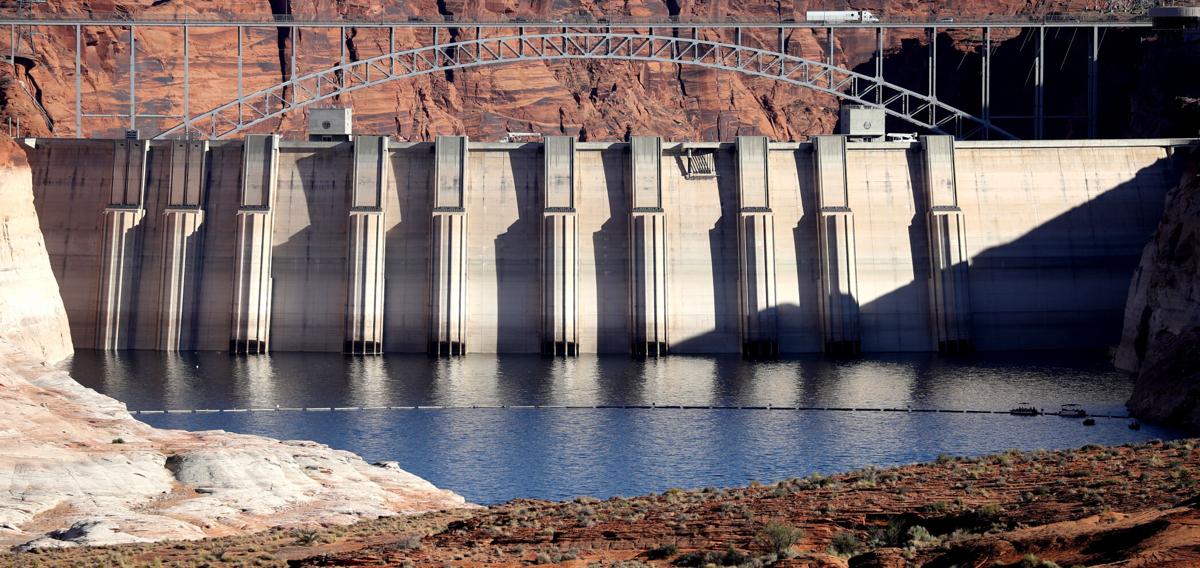
The Bureau of Reclamation is for the first time legally signaling its intent to make major cutbacks in water deliveries from Lake Powell to Lake Mead and the Lower River Basin to protect the reservoirs that are on the edge of collapse.
In online presentations last week, the bureau said it’s working through a formal process that could lead to cutting deliveries from Powell by 2 million to 3 million acre-feet annually and possibly more. That could happen if states in the Lower River Basin — Arizona, California and Nevada — can’t reach agreement by Jan. 31 on how to slice their take from the river, the agency said. The bureau didn’t specify when cuts would begin or how they would be divided among states, saying those questions will be answered later.
But “it means that we’re looking at unprecedented reductions in supplies. There’s just no way you can slice and dice this any other way than that, especially if you’re using water from the CAP (Central Arizona Project),” said Cynthia Campbell, Phoenix’s water resources management advisor.
The CAP, which serves drinking water to Tucson and Phoenix, sits at the bottom of the list of who in the Lower Basin has priorities for river water when cutbacks happen. But if “they don’t go strictly by priority and zero us out, it’s still going to be a big cut,” Campbell said.
As they have said before, bureau officials said last week cuts of this scale are needed to prevent Mead and Powell from falling to catastrophically low levels that would jeopardize their ability to deliver water to cities and farms and to generate electricity from their respective dams. They serve power to 8.5 million people in the Lower Basin states and 5 million in the Upper Basin states. Colorado, New Mexico, Utah and Wyoming comprise the Upper Basin.
Forecasts getting worse
This time, however, the bureau warned the reservoirs could reach such low levels sooner than it said before — if no cuts are made and the weather stays dry and hot.
It’s possible Lake Powell could fall below 3,490 feet, at which Glen Canyon Dam can’t deliver electricity, by next June or July, officials said. Under several bleak scenarios analyzed by the agency, Powell would stay below 3,490 through the end of 2026.
After more than a decade of construction, Glen Canyon Dam was officially dedicated by First Lady Ladybird Johnson on Sept. 22, 1966.
Under the new forecasts, Mead could hit “dead pool” at 895 feet — at which no water could be extracted — by early 2025, and stay there for much of the rest of that year. It could fall below 950 feet, at which Hoover Dam can’t generate electricity, by mid-2024.
The reason the scenarios turn dire so quickly now is that for the first time, the bureau analyzed impacts to river flows and reservoir levels if we repeat the very dry period of the early 2000s. By 2005, Powell dropped 100 feet in elevation, and lost half its total stored water from 2000 levels.
Scientists have long warned that a rerun of those years could be disastrous, because Powell is far lower now than it was in the early 2000s. On Friday, a bureau official raised the possibility the next few years could be even drier.
The latest projections still don’t reflect the full range of possible low hydrologic conditions, said Dan Bunk, operations chief for Reclamation’s Boulder City, Nevada office. Because of that, “a drier future than what happened historically is possible,” Bunk said.
"The Colorado Riverf system is in very dire conditions," said Bunk, noting that the last five years brought the river one of its driest periods on record.
Cuts of the scale envisioned by Reclamation would shave 28% to 42% off deliveries from Powell to Mead compared to this year’s 7 million acre-feet. It would represent a smaller share — from 22% to 33% — of the 8.9 million that the Lower Basin states and Mexico actually took from the river last year. By comparison, CAP is scheduled to deliver about 1 million acre-feet this year to cities, farms and tribes in Central and Southern Arizona.
That the states and Mexico are taking more out of Mead than what’s sent there each year is at the root of the Colorado’s problems. The river has been running a supply-demand deficit for many years.
‘Right to the edge of the cliff’
“Reclamation is significantly advancing the discussion by showing with real numbers and real modeling how bad it can get,” if the basin states don’t significantly reduce water use, said Jack Schmidt, a Utah State University scientist who has overseen major studies of the river.
“We’re going right to the edge of the cliff ... We don’t have anything comparable to what we need in proposed cuts. If we don’t make the cuts, we go off the cliff. Reclamation showed what does it mean to go off the cliff,” said Schmidt, who is director of the university’s Center for Colorado River Studies.
Bureau officials aren’t saying they expect a particular kind of climate impact — “They are saying a particularly bad hydrology is clearly possible, and we need to have a plan for what we will do if that hydrology happens,” said John Fleck, an author and University of New Mexico water researcher.
“One of the things they are saying is that under climate change, we don’t know what the most probable future is. We know that with climate change, the future will be different from the past,” Fleck said.
Reclamation officials have said since June that cuts on the scale they talked about in detail last week are necessary.
Now, however, bureau officials plan to make cuts, if necessary, through formal procedures governed by the National Environmental Policy Act. Agency officials say they’ll propose a range of alternatives for managing the reservoirs by next spring, and make final decisions by late summer 2023. In draft and final environmental statements, the bureau will analyze three alternatives.
One would be to take no action to cut water deliveries. A second would be for the states and the federal government to reach consensus on a plan for reductions. A third alternative would be for the bureau to act unilaterally if consensus proves unattainable.
“What Reclamation did was challenge everyone to come up with a way we don’t go off the cliff,” Utah State’s Schmidt said.
The bureau declined to respond to questions from the Star about how these cuts would play out among the states and Mexico, and who would decide that. Reclamation is in the early stages of environmental reviews and is accepting public comments until Dec, 20 on what subjects the environmental impact statement should cover, said Michelle Helms, a bureau spokeswoman.
“That’s the kind of stuff Reclamation desperately doesn’t want to have to make decisions on,” Schmidt said. “We are in such completely uncharted territory, I do think people are desperately trying to come up with something. In some ways, the most thoughtful innovative stuff is still talked about behind closed doors.”
‘It will hurt everyone’
One reason the bureau was reluctant to take steps this dramatic in the past is that its officials feared a lawsuit, said environmentalist John Weisheit. If such a court action went as high as the U.S. Supreme Court, it could drag on more than a decade as did the dispute between Arizona and California in the 1950s and ‘60s, said Weisheit, director of the Utah-based Living Rivers.
“But I think at this point the federal government doesn’t have any other choice but to save the system and leave the states in the dust because they haven’t been helpful,” Weisheit said.
Bureau officials know that whatever they do, they’ll be challenged, because the results of what they have to do will be so big it’s going to hurt, said Phoenix’s Campbell.
“It’s not going to hurt a small group of people. It’s not going to hurt just CAP. It will hurt everyone. They could take us out in Arizona and they’re not halfway there in reaching their goal,” Campbell said.
Arizona Department of Water Resources Director Tom Buschatzke was out of town on business and unavailable for comment. Southern Nevada Water Authority officials didn’t respond to a request for comment.
California officials have offered in a letter to federal officials to cut 400,000 acre-feet a year, or just under 10% of the states’ total supplies. Arizona officials say that offer is inadequate. But “there’s multiple proposals submitted to the feds” to save additional water that haven’t been made public, said Bill Hasencamp of Southern California’s Metropolitan Water District.
“I anticipate it will be more than 400,000 between the two states that’s offered, maybe significantly more,” he said. Adding those cuts to those already already approved under earlier drought plans, “I think we have a potential for a pretty good sized conservation plan,” he said.
But “if it’s really dry, record dry, our conservation is not going to be enough. There will be have to be mandatory cuts in 2024. If we get years like 2002 through 2005 stacked up, voluntary actions are probably not going to be enough. That’s just the reality.”

