



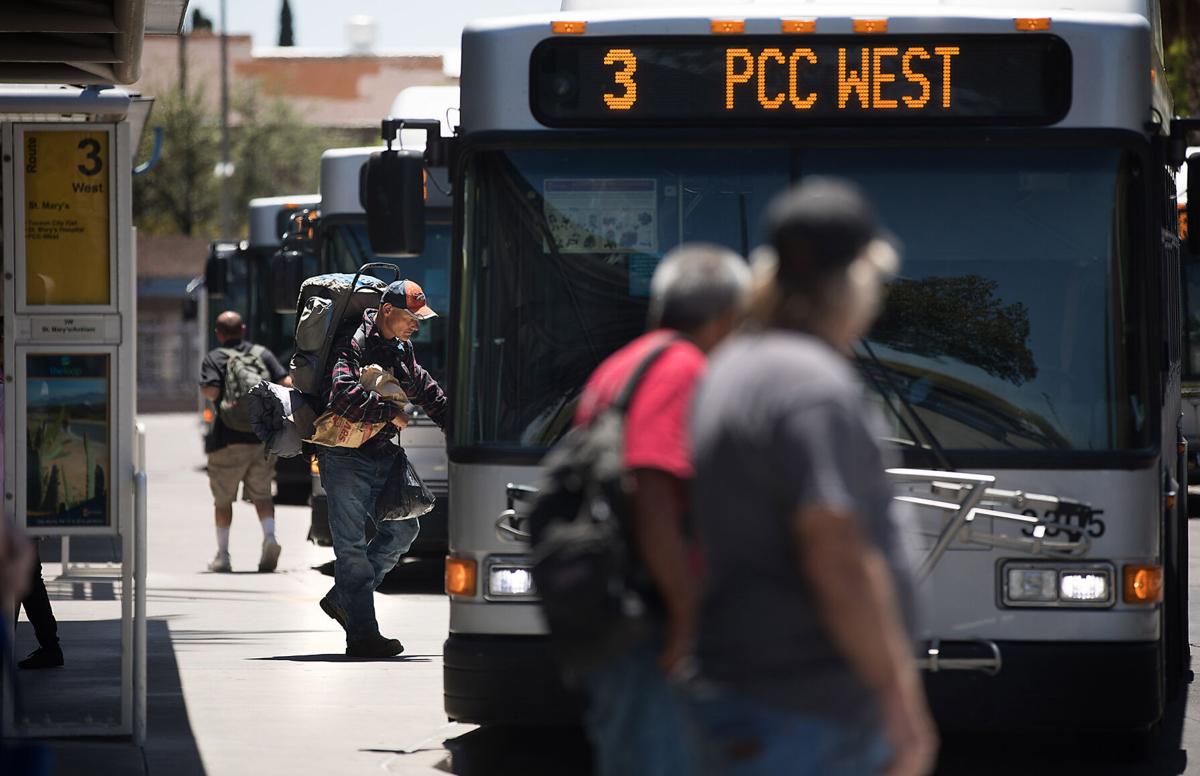
Take a Sun Tran bus these days and you’re likely to notice a difference from the pre-pandemic days.
I’m not talking about the free fares — a great change.
I’m not talking about the occasional whacked-out riders — a bad change.
I’m talking purely about people, passengers. There are more of them.
As the Tucson City Council looks ahead to a June 30 deadline for the free-fare program that has existed since the beginning of the pandemic in 2020, a basic fact shows the program’s success: More people are taking the bus.
In the fiscal year that ended June 30 2022, ridership was up by about 20 percent from the pandemic-affected year before. Since then, ridership is up another 12 percent. That amounts to an additional 1 million bus rides taken over the eight months through February this year.
For occasional riders like me, who haven’t been on the bus every day as ridership increased, the change can seem dramatic and refreshing. An empty bus just feels like a waste.
And a full bus means fewer cars on the road, less harmful vehicle emissions and reduced need for space dedicated to parking, among other good things. I also like the short walks to and from the bus stop.
But of course there is a hitch, or hitches. And the main one is money.
A relatively small portion of the money to support Sun Tran comes from fares. This year, it would be $9.1 million out of a total cost of $105 million, but the city is covering that on a one-time basis.
About half of the $105 million annual cost is covered by $53 million from the city’s general fund, and major additional contributions from federal grants and the Regional Transportation Authority. The state of Arizona contributes nothing.
The city has been reaching out to “partners” — institutions like the University of Arizona and Pima Community College — to convince them to contribute to filling the $9 million to $10 million hole for next year.
The last time Mayor Regina Romero reported to the council on these efforts, in December, it wasn’t going so well.
One argument she said she used with Pres. Robert Robbins: “Wouldn’t it be nice not to have to build more parking garages in very valuable land at the University of Arizona?”
But there wasn’t any movement, she reported: “The UA is not really seeing the benefit of being a big investor in public transit.”
‘Nothing bad on the bus, hardly’
That’s a shame, because University of Arizona students and employees are big riders of our public transit, the Sun Link streetcar as well as Sun Tran buses.
I’ve taken the No. 3 bus west down East Fifth Street several times lately. The exodus at the University is notable.
Most Sun Tran passengers say they like the free fares that have been in existence since 2020, but some say it lets too many troublemakers on the buses.
And when I took a variety of buses Friday morning, interviewing passengers, I found it wasn’t just the No.3, or the No. 4 on Speedway that they ride. On the No. 18 line going along South Sixth Avenue, I met Juan Pablo Morales, who told me he is originally from Caborca, Sonora and goes to the university.
He told me he really appreciates the free service and takes it almost every day to the university.
Most of the dozen or so people I interviewed Friday are regular riders. Most told me they like the free service because of the money it saves and because of the convenience.
Riding a quiet No. 12 bus up South 12th Avenue, I spoke with Kathy Molina and Miguel Rodriguez, passengers who weren’t together but were sitting in the far back corners of the bus.
Molina told me that since the free fares started, riding the bus is “the same but with more people on it.”
The free fares, she said, “saves me a lot to where I can at least buy my daughter some things.”
Miguel Rodriguez told me he’s been riding the bus since he was a kid. Now he rides two of them to get to work. He estimated the free fares save him $20 per week, though there were cheaper monthly bus passes before the free fares came in.
As with everyone I interviewed, I asked Rodriguez about any bad experiences with other passengers, especially since the free fares began.
“I haven’t seen nothing bad on the bus hardly,” he said. “There’s some weird people, but other than that it’s been cool.”
Different lines, different experiences
This concern, I think, is what holds a lot of Tucsonans back from taking the bus: The drug-addicted or mentally ill people who sometimes ride and are disruptive, especially since the free fares eliminated that one small barrier to entry — a couple of bucks for a ride, or a bus pass.
It’s not an illegitimate concern. I’ve spoken with more than one rider who wants the city to re-impose fares to keep more of the troublemakers off the bus. One man I interviewed at Ronstadt Transit Center told me he’s actually fought with apparent street people who harassed his wife and then ran off. He said he wants the fares imposed again
But much more common is the perspective of people like Darrell Maxwell, who likes saving the money but doesn’t like the people that brings in.
“You get a lot more people who are high or who are irritating,” Maxwell told me, riding the No. 8 east along Broadway. If the city charged again, “I wouldn’t have to deal with as much riff-raff.”
Maxwell was to my left; to my right, Rebecca Bender chimed in that she doesn’t like it, either, when people get on with 3 or 4 bags and fill up seats with them. But being a low income person, she said, she wants the bus to remain free anyway. Maxwell was fine with it either way.
The truth is, not every bus is the same. For example, there’s more trouble on the No. 18 along South Sixth Avenue and the No. 16 along North Oracle Road at night, as passengers and drivers told me.
“The 18 is a whole ‘nother world,” Maxwell said.
Overall, free fares are working
The drivers’ union, the Teamsters Local 104, raised concerns about increased assaults on drivers and misbehavior by some passengers that surged after the free fares began. The principal officer of the union, Karla Schumann, told me Friday the union has no position on free fares but just wants the drivers, passengers and public to be safe.
The city responded to the safety concerns by putting guards on certain routes and in transit centers to try to stop troublemakers. They’ve also put up new fencing at Laos Transit Center, added police at the centers, improved surveillance cameras and otherwise beefed up efforts to stop bad behavior.
Most riders I’ve spoken with say — and my own experience is — truly bad behavior is pretty rare. And for me, the inconvenience of the occasional weirdo is more than offset by the incredible convenience of being able to hop on a bus anytime without thinking about fares.
Sunnyside High School student Cleofas Ludlow told me he’s been riding two buses per day, there and back, every day for more than a year, including on the notorious No. 18 line.
“I’ve only had like four bad experiences,” he said as he waited to transfer at the Laos center. “For over a year, that’s not bad.”
Those experiences were: In one case, people fighting with each other, and in the other cases, bad verbal arguments or disruption. None of it directed at him specifically.
Maria Felix, who has been riding the bus for 13 years, spoke to me in Spanish and put her experiences this way: “Over all, very good. Once in a while some problems. Maybe a passenger sits next to me and is in a bad state, but overall, very good.”
The upshot is, the free-fare program is working, taking cars off the road, reducing air pollution, filling buses that used to be emptier.
It would be a shame for the city’s big institutions — the UA, PCC, RTA, Pima County, the city itself — to let the program disappear over a relatively piddling $10 million cost.

