

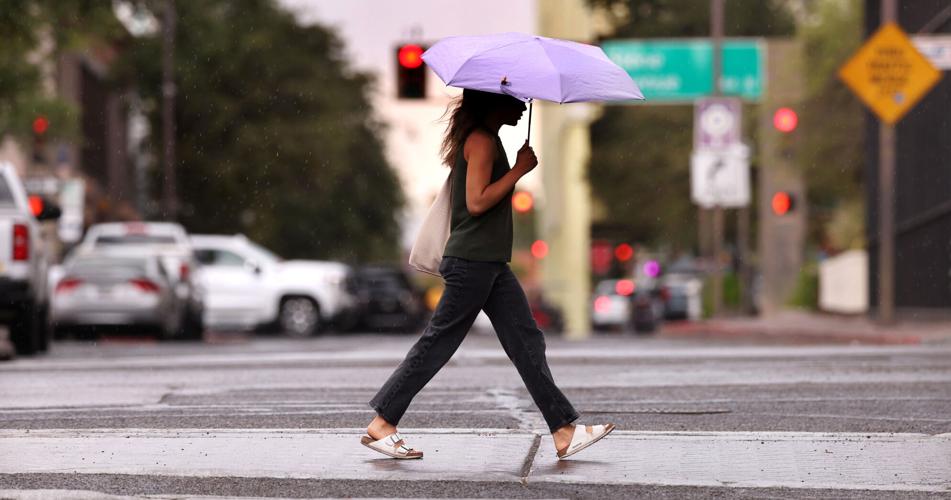



Well, Tucson, we did it. A final, rainy push at the end of monsoon season knocked 2025 off the list as being one of the driest on record — but not by much.
A mere .03 inches kept this year’s monsoon from ranking as the 10th driest season, beaten narrowly by 1918’s 2.79 inches of total rainfall.
It was, however, a slow and dusty start.
Totals reported by the National Weather Service taken at the airport, where official weather records are kept, show that although a very small amount of rain was reported having fallen June 1, not another drop was recorded the rest of the month.
Luck would soon change. The month that followed was the season’s wettest.

July rains dropped hard on Tucson, making up 1.88 inches of the entire season’s 2.82 inch total, the weather service says.
July rains dropped hard on Tucson, making up 1.88 inches of the entire season’s 2.82-inch total, the weather service says.
There were 12 measurable rain events during July. But one storm that toggled July 15 and 16 dropped 1.35 inches of the month’s total rainfall. It marked the wettest 24-hour period of the 2025 season.
August rainfall (of which there were four measurable days) totaled .11 inches of precipitation. And September crept in with 10 days of rain totaling .83 inches, sufficient to knock 2025 off the driest season record list. The wettest day of the month was logged on Sept. 18, when .5 inches was recorded, the weather service says.
And while Tucson was just barely bumped off driest list by 2004’s 2.42 inches — ranking at 12th — there are other record-holding years that have kept their titles for decades, and even a century.
Photos: Monsoon 2025 in Tucson

An monsoon storm cell throws down a bolt near midtown just after sundown, part of a series of storms that ran mostly to south and east, September 25, 2025, Tucson, Ariz.
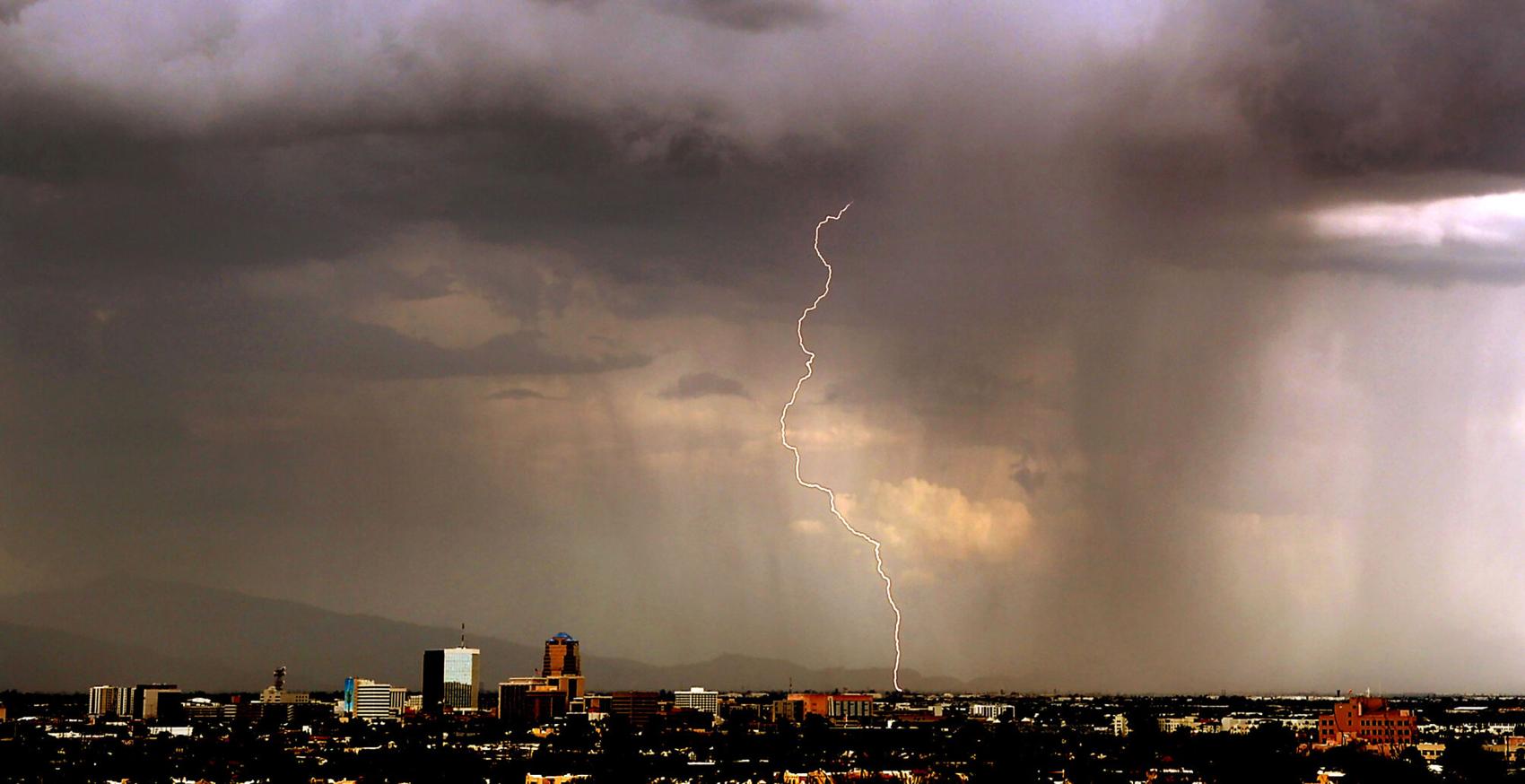
A lightning bolt hits just east of downtown one of a series of intense storms that skirted most of the city, September 25, 2025, Tucson, Ariz.
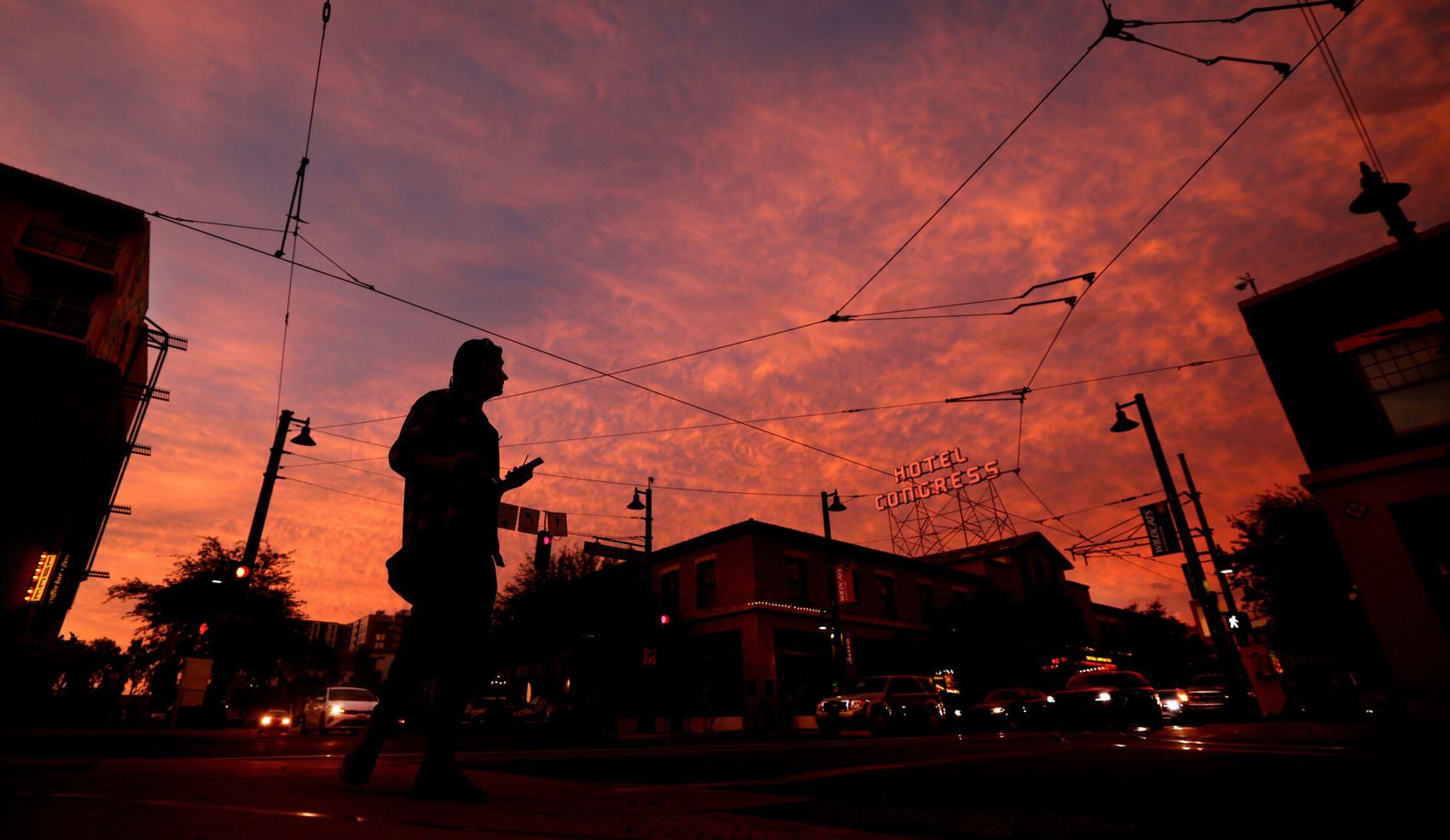
Foot traffic along Congress Street moves under a red monsoon sky as dusk settles over Hotel Congress and downtown Tucson, Ariz., July 18, 2025.

A pedestrian walks by along Church Avenue at Alameda Street with the sun going down after a monsoon storm skirted along the far eastern edge of Tucson, Ariz., before quickly dying out, July 8, 2025.

Kids take a ride on playground equipment at Joaquin Murrieta Park in Tucson, Ariz. under clouds that moved in early in the evening on June 30, 2025.

The last time rain was recorded at Tucson’s airport — the official location for weather data here — was .1-inches on July 22. This year’s monsoon has officially dropped less than two inches of rain since June 1, the start of the city’s monsoon period.

Garrett Asher uses an umbrella to shield himself from the rain during a visit at Reid Park Zoo, 3400 East Zoo Court, Tucson, Ariz., July 16, 2025.

A truck drives through flooded streets as heavy rain showers hit the city of Tucson, West Fort Lowell Road, Tucson, Ariz., July 3, 2025.

Petra Thompson uses a garbage bag to protect her hair from a monsoon storm that rolled over the westside in Tucson, Ariz. on July 2, 2025. Thompson said she her just done her hair and wanted to keep it dry as she crossed Grande Ave at St. Mary’s Road.

Guests explore Reid Park Zoo as rainfall continues through Southern Arizona, 3400 East Zoo Court, Tucson, Ariz., July 16, 2025.

A pedestrian picks his way over the pool gathered in the gutters of Stone Avenue and Pennington Street as rain from the first monsoon storm of the season drops on Tucson, Ariz., July 2, 2025.

A City of Tucson bus rider tries to keep dry as heavy rain and hail hit the city, Oracle and Fort Lowell stop, July 3, 2025.

A cyclists maneuvers through the puddles flooding the bike lane along Stone Avenue as the year’s first monsoon storm drops rain on Tucson, Ariz., July 2, 2025.

People exit Reid Park Zoo as rainfall continues through Southern Arizona, 3400 East Zoo Court, Tucson, Ariz., July 16, 2025.

The "Balancing Act” sculpture poses underneath the dark cloudy skies as rain showers pass through Southern Arizona, 4502 North First Avenue, Tucson, Ariz., July 2, 2025.

Traffic moves along St. Mary’s Road as the first monsoon hits the westside of Tucson, Ariz. on July 2, 2025.

A pedestrian braves the rain, walking along Church Avenue at Pennington Street in the first monsoon storm of the season over Tucson, Ariz., July 2, 2025.

A man crosses Scott Avenue at Pennington Street with the rain falling on Tucson, Ariz., July 2, 2025, in the year’s first monsoon storm.

A pedestrian, equipped for the rain, makes his way along Congress Street in the first monsoon storm of the season over Tucson, Ariz., July 2, 2025.

A man waits for the bus as heavy showers begin to pour in Tucson, North Oracle Road, Tucson, Ariz., July 3, 2025.

Afternoon traffic continues down North Oracle Road, as heavy rain showers hit the city, July 3, 2025.

Dark storm clouds roll through Southern Arizona, North Oracle Road, Tucson, Ariz., July 2, 2025.
The top five driest seasons are as follows: 1924, 1.59 inches; 2020, 1.62 inches; 1973, 2.33 inches; 1989, 2.40 inches; and 2024 with 2.42 inches.
The rainfall totals pale in comparison to Tucson’s wettest monsoon months, which date back to 1921.

August rainfall (of which there were four measurable days) totaled .11 inches of precipitation. And September crept in with 10 days of rain totaling .83 inches, the weather service said.
The top five wettest seasons are as follows: 1964, 13.84 inches; 1955, 13.08 inches; 2021, 12.79 inches; 1921, 11.04 inches; and 1983 with 10.50 inches.
Now that the rain seems to have moved on — clearing the sky and welcoming back the Tucson sun — temperatures are expected to hover between the mid-high 90s (about five degrees above normal) and cool back down to normal temperatures as the weekend approaches.
Nighttime temps will fall to the mid-high 60s.
The thought of falling temperatures should be come as a delight, considering the summer of 2025 has been the fourth hottest summer on record, according to the weather service.

A mere .03 inches kept this year’s monsoon from ranking as Tucson’s tenth driest season, beat narrowly by 1918’s 2.79 inches of total rainfall.
This will lead us into an expected warmer and drier-than-normal winter for this year.
The weather service said that after a dry, summer monsoon season, the prospect of a dry winter under La Niña conditions is expected to continue — or worsen — drought conditions in the region.
There’s an increased chance for below-normal precipitation in the Southwest, including Tucson, the Climate Prediction Center’s outlook shows.
Consistent with the warmer temperature trend, Tucson is likely to experience fewer nights with freezing temperatures compared to the historical average.
This means fewer days protecting plants from frost and scraping icy windshields.

