



Saguaro National Park isn’t in the business of digging up its namesake cactuses. But if it has to be done, why not learn something in the process?
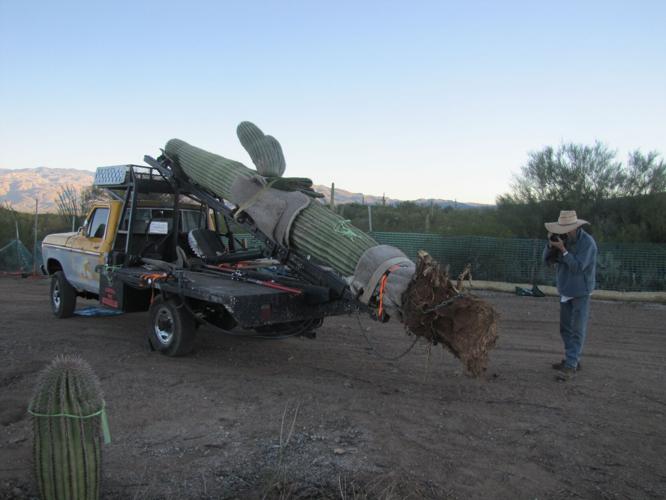
Contractors for the Park Service are in the midst of moving almost 90 saguaros as part of a major overhaul to the east entrance of the park, and researchers are using the construction to get a glimpse of life underground for the green giants of the Sonoran Desert.
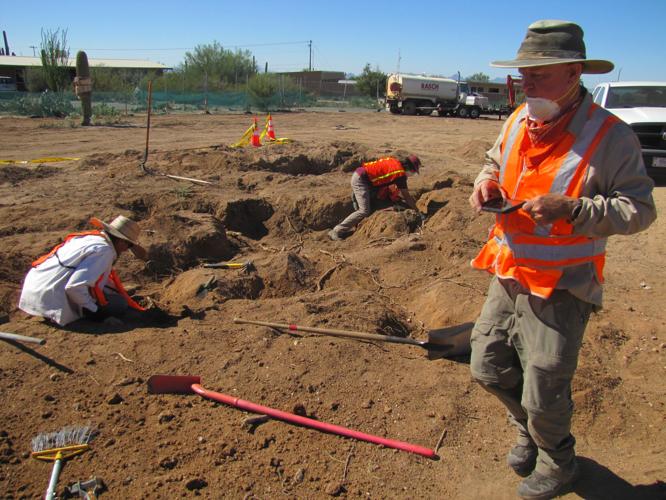
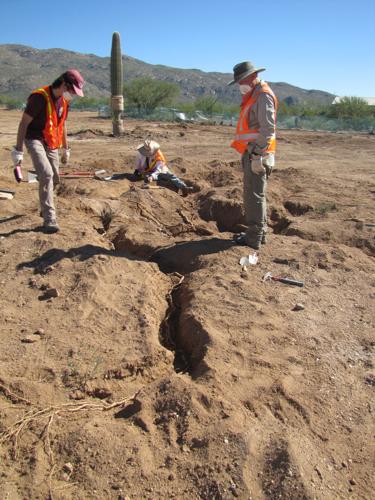
Over the course of several weeks, a study team painstakingly excavated shallow, meandering trenches around some of the saguaros scheduled for relocation, exposing the roots radiating out from the base of the cactuses.
“I thought, well, this is kind of a great opportunity there,” said biologist and team leader Don Swann. “They're going to be moving all these saguaros, and to move them, you have to cut off the roots. It wouldn't do any harm for us to excavate the roots and take a closer look at them, so that's what we decided to do.”

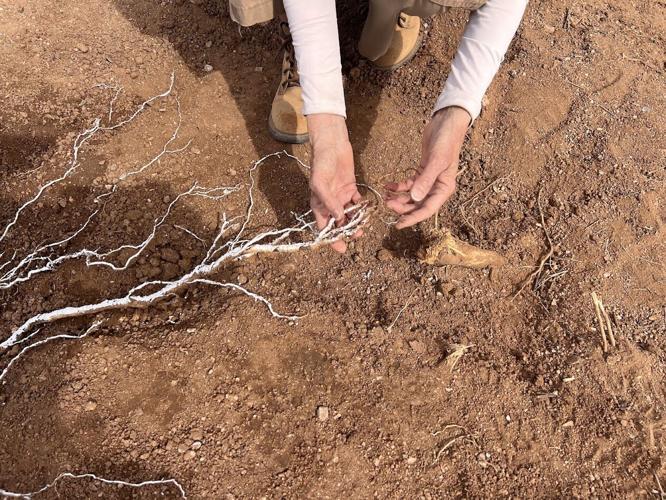
Saguaro National Park volunteer Kathleen Vestecka examines the roots of a saguaro being relocated as part of construction work at the park's Rincon Mountain Visitor Center.
Swann spent more than 33 years on staff at Saguaro, but outside of a few cactuses that tipped over, this was his first time getting to see their root systems up close and while they were still in the ground. It’s simply not something that comes up very often, especially in a national park established to protect the species.

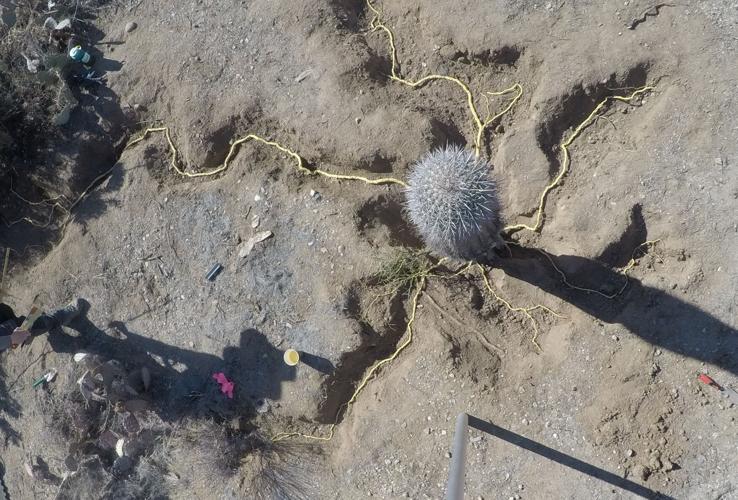
Roots branch out from the base of a saguaro at the Rincon Mountain Visitor Center at Saguaro National Park in a photo shot from above using a camera mounted to a long pole.
“We never would have gone out into the wild and dug up the roots of a wild saguaro,” he said. “This just seemed like a great opportunity to learn about these amazing plants.”
The team completely excavated and measured the root systems of six saguaros, and partially exposed the roots on several more.
The cactuses they examined ranged in height from just under 4 feet to just over 18 feet. “There weren’t opportunities to do any that were taller than that,” Swann said.
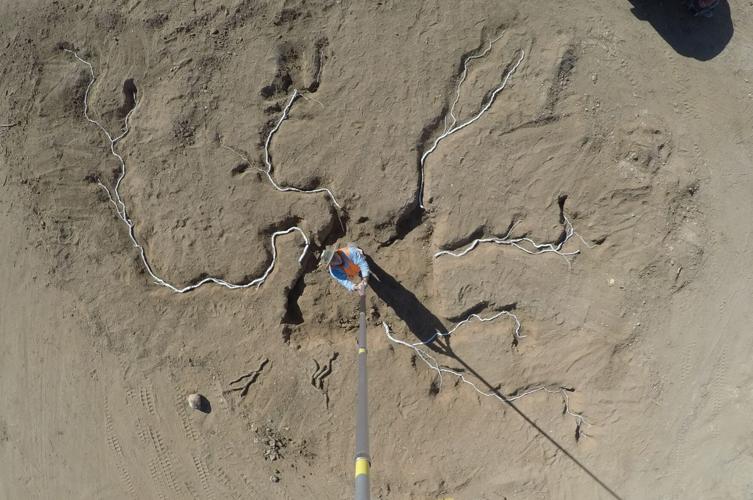
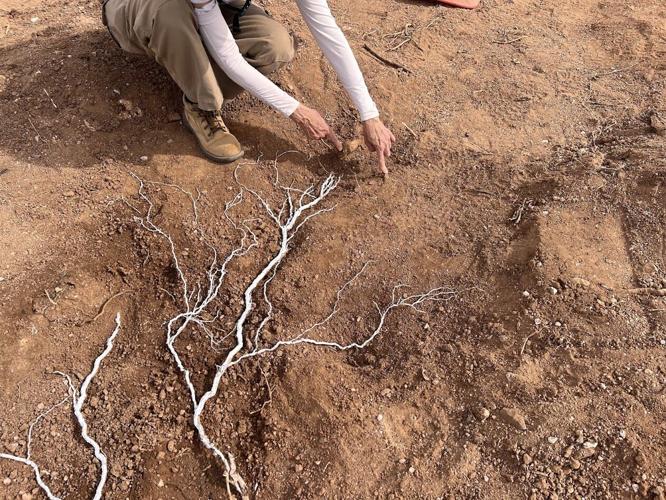
They coated the larger roots with white latex paint to make them stand out better in pictures, particularly the ones taken from above with a camera mounted on a special 30-foot pole the park uses to photograph the flowers and fruit at the tops of stems.
A net for water
Saguaros are known for having shallow roots that extend out to a distance roughly equal to the height of the stem, Swann said, “and that's pretty much what we found.”
Even on larger cactuses, most of what they excavated was no more than about 4 to 6 inches below the surface.
“Obviously we expected the ones that were taller to have longer roots, and they did,” said Swann, who retired earlier this year and now volunteers at the park. “Some of the roots were really long, like more than twice as long as the saguaro was tall, but they didn't go straight out. They meandered around.”
He likened them to the braided strands of a river delta. “The roots can be fairly wide at the base of the saguaro, but as they go out, they get more narrow, and they branch to form this incredible network,” he said.

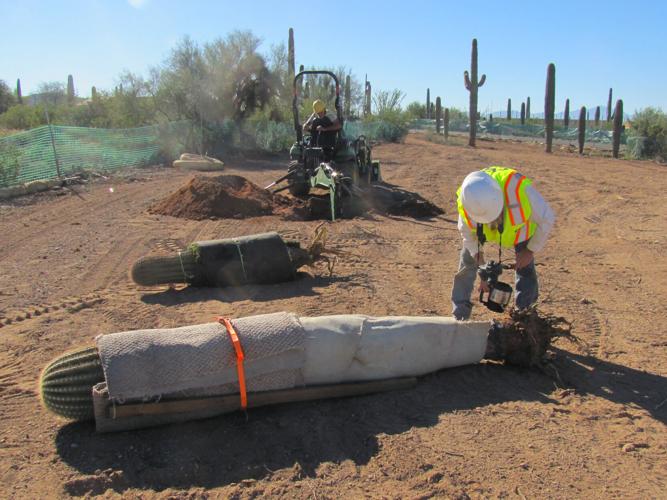
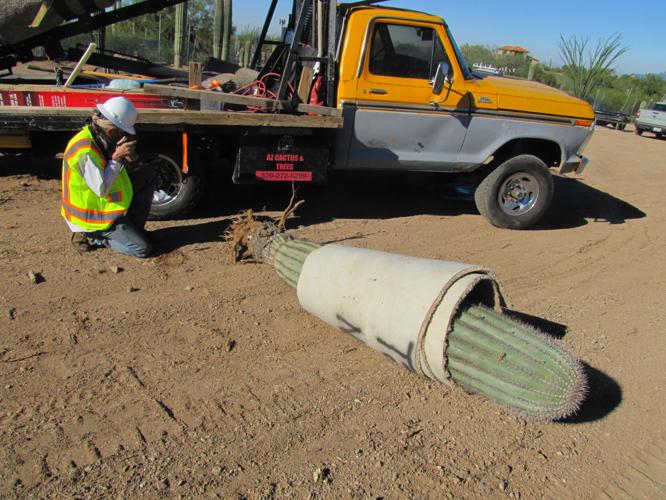
Cactus expert George Carlisle inspects the roots of a saguaro in the process of being moved at the east entrance of Saguaro National Park on Nov. 8.
Swann was also struck by how delicate they could be. They weren’t woody like the roots of a creosote, palo verde or other desert plant. These things were soft and fragile and “almost hairlike,” he said.
“A lot of them broke when we were digging them out, but in a few cases we were able to expose the network of really fine roots,” he said. “You can kind of think about it as this big net going out underground away from the saguaro.”
It’s a net designed with one main purpose: to quickly absorb as much water as possible over a wide area.
“If you live in a place where the groundwater is very deep, which it is in the Sonoran Desert, a good strategy for surviving these intense and long droughts we have is to collect water when it's available and then store it,” Swann explained. “That’s exactly what saguaros do.”

Retired Saguaro National Park biologist Don Swann walks around a site where a saguaro has been moved as part of a construction project, leaving behind roots for researchers to dig up and study on Nov. 9.
The contractor on the parking lot project got a firsthand lesson in that in September and October, when rainfall caused the saguaros in the construction area to swell. Plastic tape that had been wrapped loosely around the plants in late summer to mark them “all of a sudden got really tight,” Swann said.
Road work ahead
The park’s east entrance road off Old Spanish Trail is being realigned and the parking lot expanded for the first time since the Rincon Mountain Visitor Center first opened in 1953.
Construction got underway in mid-October and continued through the month-long government shutdown. Park spokeswoman Beth Hudick said the project remains on track for completion in the fall of 2026.
A total of 89 saguaros have been flagged for relocation and 60 have been successfully moved so far, either to new locations in the park or to a temporary nursery, Hudick said. The remainder of them will be transplanted in later phases of the project.
Many of the cactuses were previously relocated when the visitor center was originally built decades ago, she said.

Biologist Don Swann stands in the hole where a saguaro once stood and takes an overhead photo showing its exposed root system at Saguaro National Park's Rincon Mountain Visitor Center.
Swann and his team dug up the roots on their first batch of test subjects in January and finished the rest early last month.
With a crew of eight to 10 people, it took about a day to complete each cactus, he said. “I can't tell you how much work this was. The ground is hard, and the roots are soft. It's not surprising that people haven't done this very much before.”
When Swann and company weren’t attacking the ground with shovels and picks, they were crouched over clumps of roots, carefully scraping away the dirt with kitchen knives and forks.

Saguaro National Park volunteer Kathleen Vestecka points out the roots of a saguaro being moved to make way for the expansion of the parking lot at the Rincon Mountain Visitor Center.
In all, about 15 people helped out over the course of the field work, he said. “This was all done by volunteers, and we had a bunch of intrepid folks out there.”
Other researchers collaborating on the project include Kevin Hultine and Alexandra Schuessler from the Desert Botanical Garden in Phoenix and David Williams from the Department of Botany at the University of Wyoming.
More to learn
Saguaro researcher Bill Peachey doesn’t work for the Park Service, but he’s been following the root research closely. He even helped with some of the digging.
Peachey said he was especially interested to see the roots on those cactuses that had been moved once before during construction of the visitor center more than 60 years ago. “We saw some cut ends on some of the large lateral roots, but our sample size was pretty small,” he said.

During work on Nov. 9, researchers study the exposed roots of a saguaro that was moved to make way for the expansion of the parking lot at the east entrance to Saguaro National Park.
Something else the scientists noticed is that saguaro roots don’t appear to favor a particular compass direction as they branch out, but they do seem to seek out surrounding plants. In one case, the team traced a root to a nearby buckthorn, where it spread out underneath the bush.
“It makes me think that the nurse plant (connection) with saguaros is really complex, and there may be this whole other aspect of it, which is that the saguaros also have a relationship with these plants under the soil,” Swann said.
The cactuses could be collecting water leaking from the deeper roots of the other plants or tapping into the pockets of elevated soil moisture found beneath the shade of trees and shrubs. Or maybe there is some sort of nutrient exchange going on.

Cactus expert George Carlisle photographs the roots of a saguaro in the process of being moved at the east entrance of Saguaro National Park on Nov. 8.
“This is definitely stuff that brings up a lot more questions than it does answers,” he said.
Swann hasn’t been able to find much about saguaro roots in the scientific literature, either. “There was one study that was published in 1911, and it was on one small saguaro,” he said.
Swann and his team plan to publish their findings sometime in the next year. He hopes the data will help inform and inspire more root research in the future.
“We're always trying to learn more, and the more we can learn, the better opportunities we have to protect saguaros and other plants. That's what the park was created to do,” he said. “It's one of the most studied plants in the world, but there's always something new to learn. It's amazing.”

Cactus expert George Carlisle photographs the roots of a saguaro in the process of being moved at the east entrance of Saguaro National Park on Nov. 8.

