



There’s no way to sugarcoat this: Climate researcher Mike Crimmins is getting creamed in his own monsoon forecasting contest.
The University of Arizona environmental science professor predicted Tucson would get just 1.85 inches of July rainfall in the online Southwest Monsoon Fantasy Forecasts game he helped launch last month.
Instead, the official National Weather Service gauge at Tucson International Airport had collected just over 7 inches of rain through Tuesday night — more than enough to rank as the wettest July on record with four full days to spare.
Obviously, even the experts were caught off guard.
“My wife guessed 3 inches (for July), and I mocked her for it. I told her, ‘Do you have any idea how rare that is?’” Crimmins said with a laugh.
No other monsoon season on record has started with this much rain.
“It’s been fantastic,” Crimmins said. “It’s exceeded all of my wildest expectations.”
Less than half an inch of rain fell at the airport through all of July 2020. For the year, Tucson received just 4.17 inches of rain, its lowest total since record keeping began in 1895.

Crimmins said this season started normally enough, with daily rounds of isolated, afternoon thunderstorms that built over the mountains. But what we saw late last week was something else: a large, upper-level low pressure system that produced widespread, heavy rain over several days.
It was the kind of storm that only comes around once every five years or so, he said. It was the same kind of storm that walloped Tucson in 2006.
“It’s rare, but it’s not unprecedented,” Crimmins said.
All that rain has also helped cool things down. The average temperature for the month so far is 86.1, roughly two degrees below normal.
By comparison, July of 2020 ranked as Tucson’s hottest month on record, with an average temperature of 91.5.
‘Primal’ flows
As welcome as they are, the storms are causing the usual damage across the community, with strong winds that have uprooted trees and torn off carport roofs and awnings.

Fallen limbs lie next to a saguaro that was hit by lightning Friday at a home near Sabino Canyon and Cloud roads. Homeowner Tom Butler said the cactus's arms fell off moments after he and his wife were cleaning up debris at the base of the plant.
Emergency crews have been called in to pluck stranded motorists from flooded vehicles and escort hikers out of canyons cut off by rising creeks.
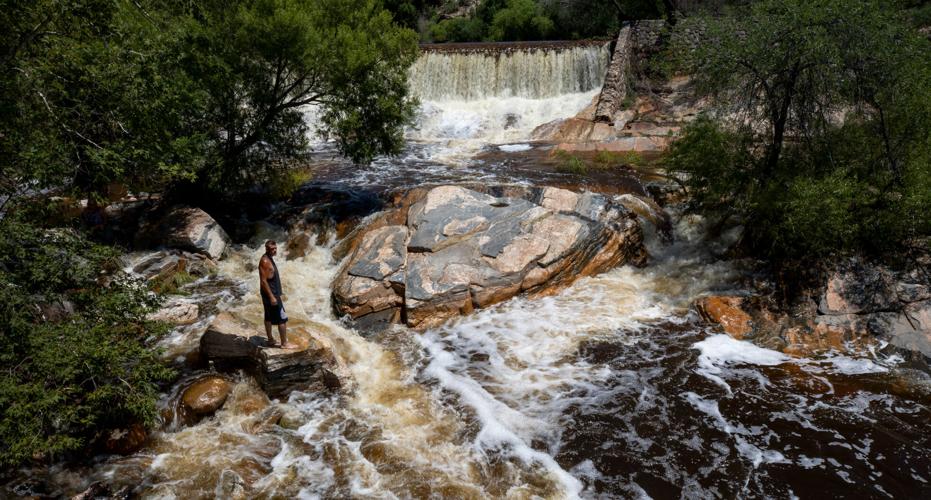
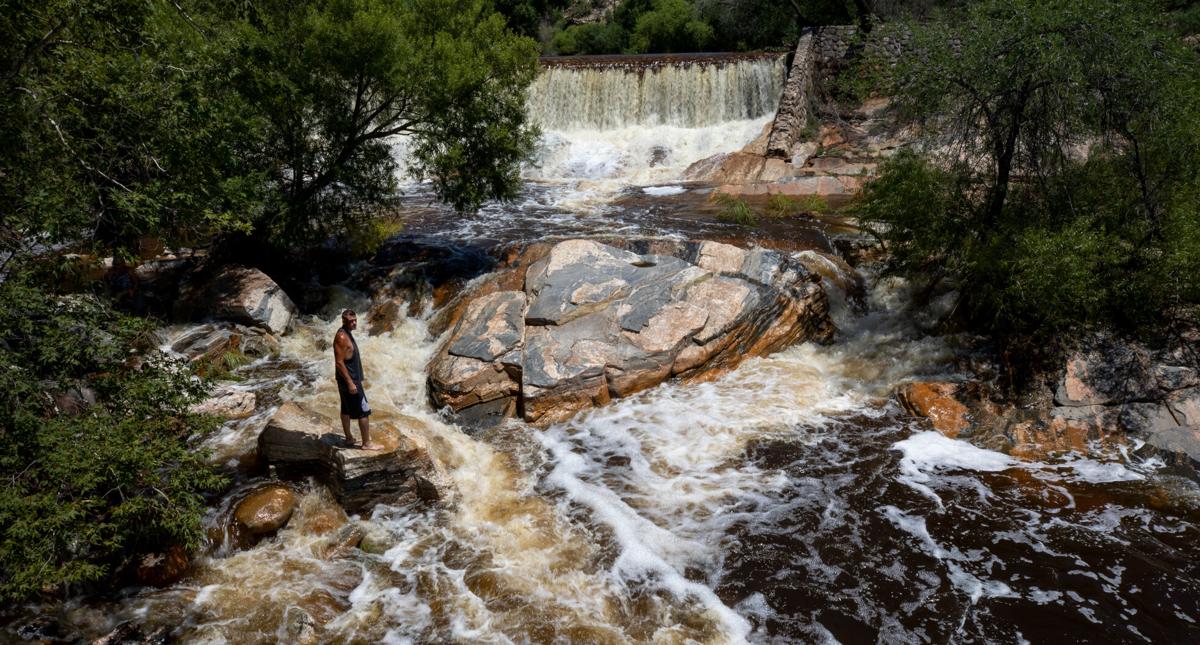
The heavy precipitation has filled Tucson’s dry washes and rivers to the brim and beyond, especially those downstream from the burn scar left behind by last year’s Bighorn Fire in the Catalinas.
Over the weekend, people with cameras and cellphones lined up on bridges and along the Chuck Huckelberry Loop to marvel at the raging runoff.
Crimmins said he and his wife went for a bike ride along the Rillito River on Friday, skirting caution tape and pedaling through mud left behind by the mocha-colored torrent.
“It was a blast,” he said. “It’s so primal, that flow of water.”
At one point, roughly 23,000 cubic feet of water a second was rushing down the Rillito past the La Cholla Boulevard bridge — enough to fill the swimming pool at the Tokyo Olympics in less than four seconds.

It was the second highest flow the river has seen since the channel was fortified following the devastating floods of 1983, said Joseph Cuffari, program manager for the Pima County Regional Flood Control District. Only the 2006 flood was bigger.
This time around, the water damaged some railings and closed portions of the Loop where the path dips down under bridges, Cuffari said.
Overall, though, the community’s flood conveyance network operated as designed, with no major problems reported, he said.
Killer bolts
The recent storms hit especially close to home for one Tucson family.
Tom Butler said he was lying in bed sometime after midnight Friday morning, struggling to sleep through a violent downpour, when an explosion shook the front of his house near Sabino Canyon Road and Cloud Road.
He went out into the driving rain in his flip-flops to find his front walk strewn with chunks of masonry and a dead, “barbecued bird” with its feathers burned off.
A bolt of lightning had struck the corner of the house and lanced through a 25-foot-tall saguaro a few feet away.
The sudden surge destroyed some of the Butlers’ electronics and scrambled others, seemingly at random. The air conditioner and internet modem were both fried. So was the Playstation 4, though a TV plugged into the same surge protector was undamaged.
The camera and internet link also still work on their Ring doorbell, but Butler said he had to disable the bell part of it because it wouldn’t stop buzzing.
“And our alarm panel started talking, which I didn’t know it did. It was like an ‘Exorcist’ thing,” Butler said.
He and his wife spent the next morning cleaning up debris in the front yard, including the gruesome remains of a dove family that had built a nest in the saguaro.
No more than a minute after they went back inside, they heard another loud noise out front. Two of the saguaro’s 5-foot-long arms had crashed to the ground, right where the couple had just been working.
The next day, a saguaro arborist told Butler the cactus was “an immediate danger to the house,” so within 30 minutes there was an emergency landscaping crew in his yard to cut down the massive plant.
There were no obvious burn marks on the outside of the saguaro, but Butler said the inside looked like a baked potato in places.
Removing it cost him about $2,400, though he hopes to recover some of that through his homeowner’s policy — just as soon as he convinces the insurance adjuster he spoke to in Oklahoma that cactuses really do grow that big.
“It was my favorite plant in my yard, and now I’ve got this stump here,” Butler said. “It’s just so sad.”
Wild swings
Monsoon season officially runs from June 15 through Sept. 30, but Crimmins said our summer rainfall typically peaks around Aug. 1, then starts to taper off.
“Anything we get in September is a bonus,” he said.
What’s happened this month fits with some climate-change models that predict higher levels of atmospheric moisture and more extreme weather events. But Crimmins isn’t ready to chalk this up to global warming just yet.
“There’s a tendency now to see meaning in everything,” he said. “Maybe 20 years from now, this might make sense.”
To be clear, Crimmins said, human-caused climate change is happening, it is serious and it needs to be addressed. It’s just difficult to pin a single “weather-scale event” on the phenomenon, he said, especially in a region where wild swings from drought to flood are a recurring theme over the past 10,000 years.
The rain so far this year has not pulled Tucson out of its ongoing dry spell, though it has lifted us from “exceptional drought” to mere “extreme drought,” according to the weather service.

That might not sound like much of an improvement, but it comes as a huge relief to desert plants and animals left struggling to survive after 2020’s driest monsoon on record.
“Things really impacted by the lack of rainfall last year are really helped by it showing up this year,” Crimmins said.
And more could be on the way. The weather service forecast calls for increasing storm chances starting Thursday, July 29, and lasting through the weekend.
“At least in the near term,” Crimmins said, “it looks like the party keeps going for a little while.”
Washes and canyons have been flowing strongly around Tucson after seeing the wettest monsoon season on record through July 25, according to the National Weather Service.
This video shows rushing water nearing its peak in Sabino Canyon the morning of Sunday, July 25.
Video courtesy Coronado National Forest.

